

“I’m a German Romantic at heart – there’s no better music.” I found myself saying this recently after performing Robert Schumann’s song cycle Dichterliebe. It was in response to a deceptively simple question from an audience member: why Schumann? Other composers are, of course, available (oh Schubert, where would we be without you…), but for the moment, at least. I am Schumann-obsessed.
Written in his annus mirabilis of song, Dichterliebe (A Poet’s Love) comes from a sudden flurry of creativity in 1840. 16 poems by Heinrich Heine chart a cycle of obsession: elation tipping into despair, the memory of falling in love so vivid that its fate is to be relived again and again. My first encounter with the piece was as a teenager, hearing the seventh song, “Ich grolle nicht”, at a school concert. I can’t remember what I sang that evening, but I remember the two minutes before it perfectly. “Ich grolle nicht” is Dichterliebe’s greatest hit. A classic; full of swagger and bubbling venom that explodes with utter majesty in the second verse. It’s a seemingly simple song: pulsating block chords in the right hand of the piano are paired with a stentorian leaping octave bass line in the left.
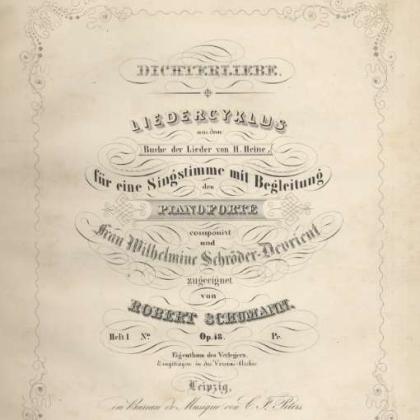
Adolescent Helen found it completely thrilling. It’s gutsy and brash. There’s an incredibly satisfying ascent to a huge top A in the voice (exhilarating when sung by the tenors and sopranos, over-exciting and sometimes dangerous when sung by mezzos and baritones!) before it winds up in a whirl of crescendo. Crucially, it was just within reach of my capabilities as a pianist: I could go home and more or less play it and before long I was hooked. I now realise I had no idea what the song was about – I didn’t understand German then like I do now – and it never occurred to me to look up the poetry. But I knew it made me feel and I couldn’t stop thinking about it.
In 2023 Dichterliebe was again on my mind, and for the first time, in my performing schedule. With the help of BBC Radio 3, I commissioned Héloïse Werner to write a companion piece, or musical reflection, to mark my first foray into these songs. Like Schumann, Werner also turns to Heine in Knight’s Dream. Her knight hides from the world, dreaming of his beloved. In sleep, everything becomes a tumble of colour, sound, and ecstasy. But just as he reaches her, he wakes to utter darkness. Werner journeys through cloud-like musical dreams with flashes of exuberance, knocks on the piano, spoken dialogue and lines suddenly unexpectedly sung in English. Her final wordless song is the perfect prelude to the Schumann that I never knew I was missing.
These thoughts relate to the release of my new album A Poet’s Love, with long-time collaborator Sholto Kynoch, placing these two cycles side by side. Knight’s Dream receives its first ever recording; Dichterliebe joins a vast recorded history. Following in the steps of the greats of singing who, like me, have lived and grown with Schumann’s songs is an extraordinarily exciting place to be, but it is not lost on me that some reading this might be surprised to see this new recording coming from (*shock horror*) a woman. One comment that comes up without fail after any performance I give of Dichterliebe is “I didn’t know women sang this cycle too”. Certainly, the numbers don’t lie. Search for it on any streaming platform and the performers on offer will almost all be male.
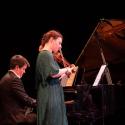
I’m hesitant to even give this particular thought too much space here, except to say that these really are songs for everyone. From Schumann’s iconic opening piano gesture that hangs suspended in time, we (singer, pianist, composer, listener, poet, anyone) are transported into a world of fantasy. It celebrates wild imagination, and I cannot begin to believe that such vibrancy and possibility was designed to be limited to those who happen to sing in the lower octave. (Charlston pictured below by Matthew Johnson)

So why record it now? There isn’t a grand answer. The opportunity came, with the ideal duo partner in Sholto and a wonderful team at BIS Records. Even so, committing a version (my version?) of a work like this to an album is daunting. I wasn’t aiming to leave a definitive mark, only to capture a fleeting moment in time. Any recording is and should be just that. It has been so uplifting to give a hint of permanence to this pairing and let the music speak for itself.
The more I live with Dichterliebe the more I am reminded of the privilege of my role in the world as a storyteller. For a while, I traverse the highs and lows of longing, feel the flash of love and the unimaginable wounds of loss. For its protagonist, the wild declaration “I loved and was loved” matters so much more than any tidy resolution. I have loved this music for a long time. I can only hope, in some small way, it returns the favour.



Add comment