

On a dank January evening in St Albans, there seemed little sign of life or excitement on the streets. To reach my destination – St Peter’s Church – I first had to walk through an ancient graveyard where the yew trees loomed like sentinels. It was quite a contrast to enter the church itself, where the sudden blaze of light and warmth and packed aisles made it clear that this, for tonight at least, was the heartbeat of St Alban’s. In an otherwise straightforward programme, the Amadeus Chamber Orchestra was about to tackle that Everest of concertos – Brahms Piano Concerto 2 – performed by a young man from Russia at the start of his career, the 23-year-old pianist Misha Kaploukhii.
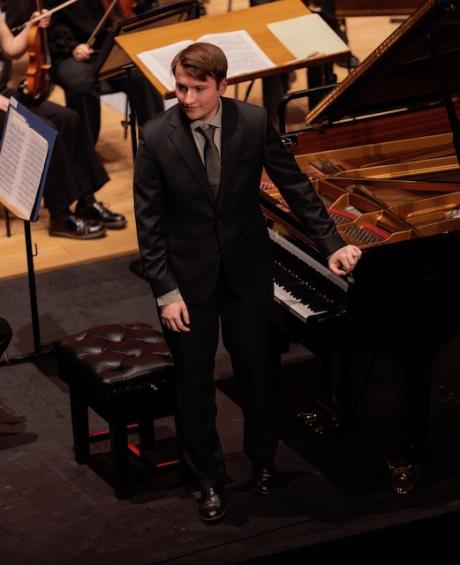
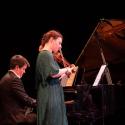
Kaploukhii (main picture, and below right © Beastly Studios), a graduate of the Moscow Gnessin College of Music, who’s now studying a Masters of Performance at the Royal College of Music, has already acquired himself a decent-sized mantelpiece of awards. He won the RCM Concerto Competition both in 2022 and last year, the first and audience prizes in the UK Sheepdrove Piano Competition, and the Grand Prix at the Sicily International Piano Competition.
Yet in the cutthroat world of being an international pianist – in which excellence is the minimum achievement – does he have what it takes to assert himself as a distinctive voice on the world stage? We had some time to contemplate this in the first half before Kaploukhii came on as – under the assured baton of American-British conductor, Johann Stuckenbruck – the orchestra gave a nimble and vibrant account of Mozart’s Symphony 35 in D. This was followed by a rendition of Richard Strauss’s Serenade for 13 Wind Instruments in E flat. There were some creaky moments, but overall the ensemble won through with a rich, butterscotch warmth.
Even so, the creakiness raised a couple of question marks about how the orchestra was going to tackle what was – when Brahms completed it in 1881 – the longest and most difficult piano concerto of its time. Happily, those question marks were swiftly dispelled in the opening bars of the first Allegro non troppo movement, as the resonant introduction from the French horn was met by the swell of rising chords from Kaploukhii on the piano. As the orchestra blazed into life, Kaploukhii responded with a virtuoso account that was both thrillingly authoritative and stirringly poetic. Thunderous chords in rising triplet sequences alternated with shimmering arpeggios and hauntingly poetic passages in which individual notes rang out like bells.
Already it seemed clear that here was a serious talent who will undoubtedly be playing this – and other concertos – in larger concert halls in the near future. In the Allegro appassionato, he followed the volatile grandeur of the opening with an exquisitely introspective rendition of the more elegiac second theme – going from fireworks to starlight and back again.
In the silence before the third movement, a lady behind me whispered furiously “Fancy asking him to play a piano like that.” Though the Bösendorfer grand (not the piano pictured above) was perfectly respectable, and is regularly used in recitals at the church, her exasperation certainly captured the sense that Kaploukhii was a musician whose range of expression befitted an eight-foot eleven Steinway. Never less than professional, he himself gave no sense that he wanted to be playing any other instrument. Diligently he continued to excavate every atom of emotion from the Brahms, not least in the opening of the Andante as he went from the sonorous gravity of the bass notes to the cobweb delicacy of the upper reaches.
As the movement progressed, whirlwinds of passion were interposed with passages of limpid beauty – in which the notes seemed to fall like raindrops on a lake at dusk. Throughout Kaploukhii demonstrated a spellbinding mastery of the piece’s dramatically shifting emotions. Then we were on to the levity of the Allegro grazioso, in which he had the chance to show his more playful side, along with his capacity for executing immaculate runs. As the whirling B flat major arpeggio brought the concerto to its conclusion, the audience was ecstatic in its applause. This impressive account of one of the most difficult concertos in the repertoire shows that this 23-year-old is well worth watching for the future.







Comments
I agree, Kaploukhii is a…
Add comment