

JB Priestley’s glorious pot shot at marital complacency in pre-First World War Bradford proves to be a tonic at a time of year where, for better or for worse, many people are forced to play happy families. Written in 1938 – seven years before his markedly different An Inspector Calls – it was so successful that it went on to be the first play ever broadcast live on television.
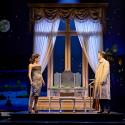
Though you couldn’t imagine it appealing to broadcasting bosses today, that doesn’t detract from Tim Sheader’s assured, mischievous production, which transports us to a confidently hideous drawing room with mustard yellow William Morris-style wallpaper offset by a purple rug and a mutant aspidistra. On the one hand the aspidistra seems like a cheeky symbol of the bombastic overconfidence of its owners. On the other it provides a cue for Janice Connolly’s hilariously devil-may-care servant Mrs Northrop to warm proceedings up with a rendition of Gracie Fields’ The Biggest Aspidistra In The World.
The song injects a lovely, gently surreal element before the consciously contrived plot is unleashed. We’re at the 25th wedding anniversary of three couples, the Helliwells (who own the house where the action takes place), the Parkers, and the Soppitts. Yet their bombastic marital bliss hasn’t prevented them from summoning the new organist (a southerner), who’s upset them with his innovative ideas about Handel’s Messiah and his lah-di-dah dressing-style. Worse still, he’s been spotted out and about with a young woman with whom he’s clearly in love – an outrage in respectable, Bradford society.
Sheader has assembled a dream cast to channel the affluent prudery of Edwardian Bradford’s finest. John Hodgkinson (below, centre), fresh from playing the title role in Titus Andronicus, is Joseph Helliwell, a rather more benign tyrant, while Siobhan Finneran as his wife, Maria, does a fine turn in icy snobbery. Sophie Thompson is superb as Annie Parker, the much put upon wife of Albert (Marc Wootton), who’s as stingy with his affections as he is with his money. Her comrade in marital oppression proves to be Herbert Soppitt (a hilariously repressed Jim Howick) who cowers in the shadow of his wife, Clara (Samantha Spiro).
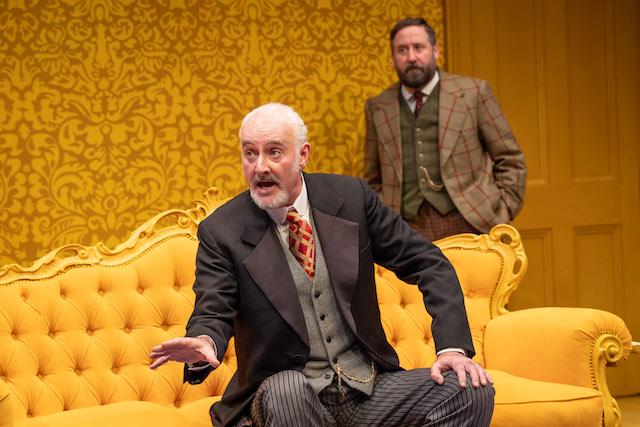
The bombast is quickly blown up by a bombshell delivered by Gerald Forbes’ urbane organist, who – in a fantastically unlikely coincidence – has met the man who apparently married all three couples, and has discovered he was not qualified to do so. This, unsurprisingly, goes down like a lead cream tea, as the couples realise they have been living in sin all this time. As Priestley’s script unfurls, it both poignantly and comedically explores the lives that might have been. Fidelity, it shows, is not necessarily the virtue that society proclaims it to be, especially when it involves some of the bullying and belittling that we see before us.
The visitation of a barmaid from Blackpool (Tori Allen-Martin) provokes further reflections on the way Edwardian gentlemen feel about their marriages when they’re “working” away from home. Yet far more devastating is the link we see developing between two of the characters, who we realise would have been much happier than they are now if they’d been brave enough to admit their feelings at the time. Marriage for them has proved to be a prison. Now they are apparently free, but what does that freedom mean?
Amid this swirl of questions, considerable entertainment is provided by Ron Cook, who plays an impressively inebriated newspaper photographer sent to create a portrait of the happy couples. Connolly’s Northrop threatens to steal entire scenes as the increasingly bolshy servant, while Rowan Robinson injects a breath of fresh air as Joseph Helliwell’s liberated niece.
Adding Beyoncé’s Single Ladies as a satirical comment at the end of the first half is an enjoyably disruptive humorous touch. Even though the plot ends up redirecting us to the status quo, you get the feeling that nothing will be the same after this. The overall impression is that the company had a ball putting this production together. Happily their enthusiasm proves gleefully infectious.







Add comment