Unexpectedly, there’s a sly reference to James Joyce’s Ulysses interpolated into Act One (in case we hadn’t caught the not so sly one, naming a leading character Leopold Bloom). While that’s a nice callback from brash commercial Hollywood to the high art salons of Paris, it also links the works. If Ulysses is the book whose legend persists despite so few people having read it, is The Producers its cinematic equivalent?
No matter. Like the chorus of “Yellow Submarine” it’s so embedded in popular culture that it feels like we’re born knowing it. There’s Bloom and Bialystock, the titular Broadway shysters, there are the walkouts and the walkbacks as the audience makes a hit out of a bad taste flop and, Jawohl!, there’s “Springtime for Hitler”. At 99 years of age, Mel Brooks, who wrote the book and the songs, has seen his creation morph from movie to stage to movie again and stage again and on to YouTube clips – and his bite may have never been needed more than right now, 58 years on from its original mixed reception.
The tightrope that a director, even one as lauded as Patrick Marber, walks with such material stretches from the redundant and clichéd at one end to a new vision that swamps the source at the other. Go too far one way, and the dread descriptor, hackneyed, knocks you down; go too far the other way and egos supervene and the fragile magic disappears in a puff of directorial smoke. There’s risk as well as reward in name recognition on a playbill.
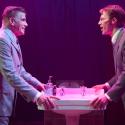
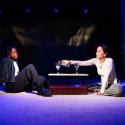
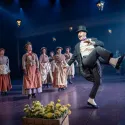
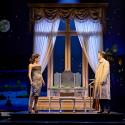
The best way to stay upright on the highwire is to trust the performances – and Marber does exactly that, bringing his principals from the award-winning Menier Chocolate Factory production to the West End for this transfer.  Andy Nyman starts at 11 and stays there as Max Bialystok, the Broadway veteran down on his luck, his musical adaptation of Hamlet, Funny Boy, having, unsurprisingly, failed. He’s raising money again via his usual method of screwing over, literally and metaphorically, lonely spinsters for cash, when his meek accountant, Bloom, a charmingly beta male Marc Antolin (pictured above with Joanna Woodward), remarks that the IRS never bother looking at the books for a bomb.
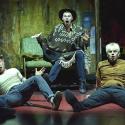
The dollar signs flash in Max’s eyes and the unlikely pair seek a surefire flop, a play so bad, so utterly misconceived, so doomed that it’s bound to fail and, thus, ensure that its skimmed accounts are kept hidden from prying eyes. They find it in the Third Reich revering, jackbooted, helmeted Franz Liebkind’s script, Springtime For Hitler, the crazy ex-Führer flunky’s theatrical rehabilitation of his hero. Roll in a set of cast and creatives that make Frank’n’Furter and Rocky Horror look understated, and what could go right?
Everyone has enormous fun and so, in consequence, we do too. Even in this grim era of online and offline policing of taste, it’s all so warm, so winning that the satirical jibes (and no sacred cow ventures into the cross-hairs without a shot being fired) which would raise an eyebrow thudding on to the page, skip from stage to stalls with a lightness that’s impossible to resist.
As the wildly flamboyant director hired to sink the show, Trevor Ashley holds nothing back, his “Keep It Gay” putting the camp into the camps (see – even I’m doing it now). We instantly recognise Joanna Woodward as Ulla, the blonde, bosomy, sexy shiksa who always turns up in Brooks’ stuff, but she’s got agency to burn, dresses to die for and some great numbers of her own.
Stealing the show as the Nazi we love to hate – no, actually, that we love to love – Harry Morrison is sensational as Liebkind, lonely without his leader, hankering in song for the days “In Old Bavaria”. He’s bonkers or course, but there’s a poignancy that Morrison finds in the role that leavens the laughs and reminds us that evil men find it far too easy to fool the vulnerable.
It’s a crucial element in the show because it underlines Brooks’ assertion that the best way to deal with demagogues is to laugh at them – after all, reason does not penetrate their thick skulls. It also makes clear that ‘punching up’ is the right way to go, Hitler and his perverted ideology the butt of relentless ridicule, not his misguided followers.
I’ll confess to some surprise at how much of the satire is directed towards musicals and Broadway, but I guess that’s a little naive on my part. Theatre never misses a chance to talk about theatre, after all.
It’s shamelessly entertaining stuff, even if the air goes out of the balloon a little in the last 20 minutes or so after the soaring highpoint of “Springtime”. Instead of going meta with a gigantic custard pie fight as he did with Blazing Saddles, Brooks labours a little to tie up the loose ends and contrive a happy ending. Honestly, Mel, we’d have been happy with the Nazis nailed and Max and Leo panicking as the flop flies.
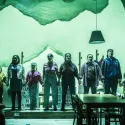
Some punters may expect more of a big West End show. This production's fringe roots show in the absence of video projection and the serviceable rather than spectacular sets from Scott Pask – there's a slight feeling that it's a tad underpowered. But Paul Farnsworth’s costumes are distractingly eye-catching, and the inherited intimacy only brings us closer to the marvellous menagerie of kooks so brilliantly given life by the cast.
Populism’s false promises brought thousands to London’s West End just a couple of days before The Producers’ opening night. It’s not enough merely to laugh at the failed but dangerous ideology in a cosy theatre (there’s the Weimar cabarets to prove that point), but it certainly helps. Just as importantly, it’s a rattling good night out in these troubled times.