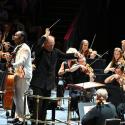
Fresh from their triumph at the Proms, the Budapest Festival Orchestra arrived at the Edinburgh International Festival with a programme that centred on dance, and culminated in as fine a performance of Bartók’s Miraculous Mandarin (the complete score, not the suite) as you’d hope to hear. This is music that the Budapest players have in their blood, and you could tell that in the way they conjured up sound that managed to be grimy and nasty but lush at the same time.
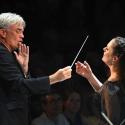
Iván Fischer paced the manic opening more slowly than you’d expect, but he shaped the unfolding drama with masterful edge, reminding us that this is no mere orchestral showpiece but a story with a desperately dark underbelly, and there was a gripping finality to the shuddering ending. The players understood that, too, the strings consistently playing with a tingle of suggestion as well as excitement. The brass sounded sleazy and violent, and the winds played throughout with just the right hint of a screech. And the singers for the eerie chorus were none other than the BFO musicians themselves, of course.
Trust them to bring something extra special, too. They played Bach’s Fourth Orchestral Suite on period instruments, and always with a massive adrenaline-kick of energy. The period trumpets and drums brought terrific ebullience to the opening, and there was a real whiff of the dance to the other movements, with an engaging swing to the Bourrées and Gavotte, and persuasive elegance to the Menuets. Fischer conducted as though caught up in the ecstasy of the moment, but he never let the tempo rush ahead and maintained a sense of weight that you only occasionally get from Historically Informed Performance.
Weight was one thing noticeably lacking in Fischer’s own composition, however. His Dance Suite for Violin and Orchestra in memoriam JS Bach started from a good idea: just as Bach’s suites referenced dances that, to his audiences, were slightly archaic and out-of-fashion, Fischer put together a suite of dances that sound the same to us. After his prelude we got a bossa nova, ragtime, tango and boogie-woogie, each of which was quite fun. Not much more than that, though. Fischer’s Prelude was an inoffensive wash of harmonies, and each of the main dance movements felt like a cheesy pastiche rather than anything more. Soloist Guy Braunstein, who also led the orchestra in the Mandarin, gave the strong impression of finding it all so easy that he was phoning it in. The main consolation? Not even Fischer gave the impression that he was taking it particularly seriously.