It is Passion season, and Bach’s St John and St Matthew – as well as his less well-known Easter Oratorio – have been well covered on theartsdesk in the last few weeks. Whether with large choir, small choir, or one to a part with no separate chorus, there have been plenty of great performances to be heard this year. The Academy of Ancient Music’s St Matthew Passion at the Barbican yesterday was an example of the latter and was up there with the best, if not perhaps benefiting from the acoustic of Edinburgh’s Queen’s Hall, as reported on by Simon Thompson.
The Barbican, both in its size and sound, is not entirely friendly to this kind of performance, and the decision to place the eight singers behind the band, and thus further from the audience, occasionally caused some balance issues. But for the quality of the singing and playing I have nothing but praise, and found it as moving an experience as I ever have.
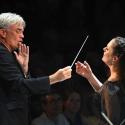
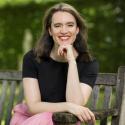
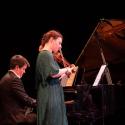
Whether you are convinced or not that this is how Bach’s passions would have been performed (on balance, I probably am), it is a separate point whether your taste is for single-voice interpretations like this. I am very much on board with the small-scale, and mostly don’t lament the absence of massed voices. Only in moments like “Sind Blitze, sind Donner” in part 1, or the outburst “Barrabam” in part 2 does an octet feel underpowered. Elsewhere, the smooth transitions between the arias, choruses and chorales feels really natural, without the gear change of a bigger choir. It also means we get to hear the Evangelist singing more than recitative, which with Nicholas Mulroy in the role is excellent news. Mulroy, the Hardest Working Man in Easterbiz, is a wonderful narrator, by turns conversational, peremptory, confiding and rapturous, and so much more. The intimacy with which he sang of “und verschied” – “and died” – belied the size the hall he was playing, and was completely heartbreaking. He also gave a lovely account of “Ich will bei meinem Jesus wachen”, alongside the sweetest oboe playing by Robert de Bree, and joined the chorales, often singing from memory. He completely inhabited the piece. The other singers were also great. George Humphreys was a noble and straightforward Jesus, but his “Mache dich, mein Herze, rein”, for me usually the high point of the whole piece, suffered from him being at the back of the orchestra. Anna Dennis (pictured above) has an imperious stage presence and perhaps the best hair in British singing; her “Ich will dir mein Herze schenken” was direct and humble, and “Aus Liebe, will mein Heiland sterben”, with two oboe da caccias and no continuo, strikingly restrained. Countertenor Tim Mead had lots to do, and nothing more impactful than the long, growing “Ach” that starts the second half. Also busy was Rodney Earl Clarke, who vigorously characterised the various roles of Peter, Judas and Pilate.
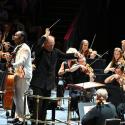
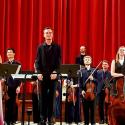
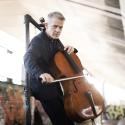
The orchestra of period instruments, led by Laurence Cummings from the organ and harpsichord, provided elegant support, from the heartbeat pulse of the opening to the extraordinary, defiant final chorus, some three hours later. There were notable solos from leader Bojan Čičić and Julia Kuhn, leading orchestra 2, and cellist Joseph Crouch and bassist Timothy Amherst were in perfect accord with Cummings as continuo. The whole thing could perhaps be summed up by the chorale “Wenn ich einmal soll scheiden”, sung with utterly bereft shock and grief immediately after Jesus’s death, enough to deeply move even this convinced atheist with the power of the moment.