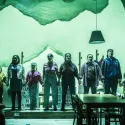
In a too brightly tiled Gentlemen’s public convenience (Nitin Parmar’s beautifully realised set is as much a character as any of the men we meet), a lad is shaving his head. He’s halfway to the skinhead look of the early Seventies, but he hasn’t quite nailed it – he's too young to know the detail.
Another walks in, older, confident to the point of arrogance, looking not just for another man, but for this particular man-child. Handing over a pair of oxblood DMs with the garish red laces, he doesn’t just complete the boy’s outfit, he inducts him into the two worlds that he will straddle, uncomfortably, secretly, for the next two decades – far right street politics and anonymous gay sex.
Quite early on, we clock the older man as Oswald Mosley, the once-celebrated politician who went on to found the British Union of Fascists, Matthew Baldwin capturing not just the aristocratic entitlement that the old Blackshirt still radiated, but also the desperation that clung to him, as he seeks to recruit the skinhead into the tiny, but growing, neo-Nazi British Movement. The vestiges of Mosley’s once seductive charisma are visible, but long since curdled into cliches and promises of ping-pong with other lost boys. That proves enough – which says something for the emptiness of the kid's life.
The lad is sharper than he looks and sees through the weakness of his benefactor and how he can use his physical presence and fearsome amorality to get what he wants – and what he wants is to advance the fascist cause on the streets and in the clubs and avail himself of as much cottaging as possible. He is successful on both counts.
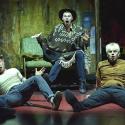
It takes a while to clock skinhead as Nicky Crane, the vicious thug who featured on the iconic cover of the notorious compilation album, Strength Thru Oi! It is this deservedly forgotten man whom we follow through his brief music career, his jobs in security (then wholly unregulated) for the infamous band Skrewdriver and ultimately to his dying days on an AIDS ward. It was not pleasant to be reminded of such a character – it is, however, timely.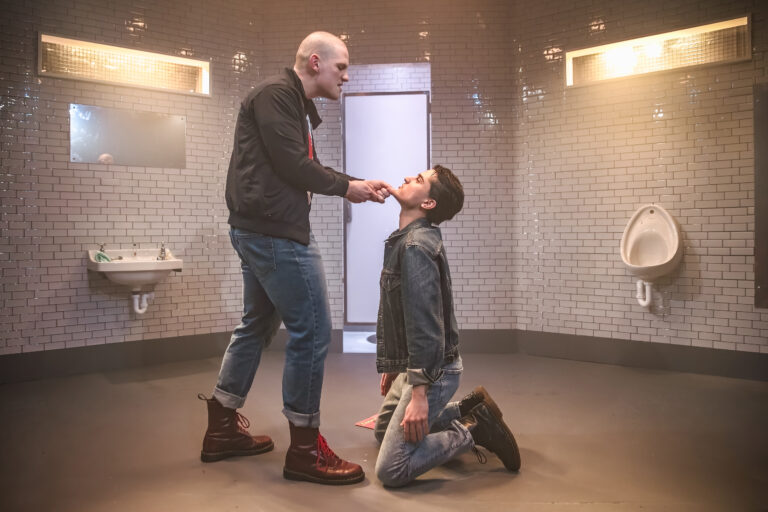 Jake Richards (pictured above with Kishore Walker) is tremendous as Nicky, early bravado sliding into fanaticism before crumbling into a body as broken as his ideology. But we’re never quite invited to dehumanise him as he would have us dehumanise others. Harry McDonald, writing only his second play, avoids the easy option of making Nicky a caricature monster and director, Matthew Iliffe, eases just enough fragility out of Richards’ hulking presence to allow us to glimpse the man he could have been. Whether that does enough to acknowledge the genuine victims of Nicky’s appalling violence is perhaps moot, but it makes for fine drama.
There are other encounters portrayed that fill in Nicky’s life. Kishore Walker plays a teenage photographer (reminiscent of the protagonist of Colin MacInnes’s novel Absolute Beginners) transfixed by the thug's transgressive glamour. Keanu Adolphus Johnson is a gay, black youth who fought the British Movement on its own turf with fists and weapons and has all the polish Nicky lacks and the cojones to back it up. Those scenes work less well as we already know all we need to know about the antihero.
McDonald’s play comprises more promise than fully realised potential across its 90 minutes running time, but, at its best, the dialogue sparkles and the acting is utterly compelling. That he conjures such theatrical magic from so unsympathetic a lead character augurs well for his future.
Crane, dead at 35, never had much of a future, but this no matter for regret, the streets that little bit safer for the absence of a relentlessly violent man who had no compunction in assaulting children with broken bottles. Good riddance to him and to those who parrot Mosley's rancid rhetoric today.