There’s a chance – a slim one – that you haven’t seen Noises Off, Michael Frayn’s farce about a farce that, as legend has it with The Rocky Horror Show, must surely be going up somewhere in the world every day.
If you’re in that minority, its origin story tells of Frayn observing the chaos backstage at one of his shows in 1970 and realising that things were a lot funnier there as actors desperately worked to get every entrance just right, than it was sitting in the stalls watching the shiny professionalism that emerged for the audience's amusement.
The challenge for director, Lindsay Posner, 12 years on from his production at the Old Vic and at the end of an autumn tour, is to say something different, something that appeals to the post-Play That Goes Wrong generation, something relevant in 2023 and not frozen in 1983. Poking through the cracks of some very well-worn narrative paths and characters blurring into stereotypes, he does.
We open on Felicity Kendal going full Mrs Doyle as fussing housekeeper, Mrs Clackett, dealing with the phone, the newspaper and (of course) the fan-pleasing sardines. Soon, there’s a shout from the stalls and it’s clear that we’re witnessing a rehearsal and that the company is somewhat up against it, with the clock past midnight and the curtain for Nothing On, the aptly-named show-within-the-show, less than 20 hours away. There’s much work to be done… if only that were their only problem.
 Farce, like pantomime, requires three essential elements to succeed. The audience needs to buy in to the conventions of the form and not wince as another door slams, another pair of trousers ends up round the ankles, another prop goes into the wrong hands. The company needs to hits its marks and cues with perfect timing, trusting each other 100% - the clanging of a joke dropped means the next one goes too, as there’s never long left for the audience to draw breath. Thirdly, the story has to be compelling in and of itself – we need to care about these people floundering about like sheets in a tumble dryer. It is in this third aspect that the production scores in a way that gives it its contemporary relevance.
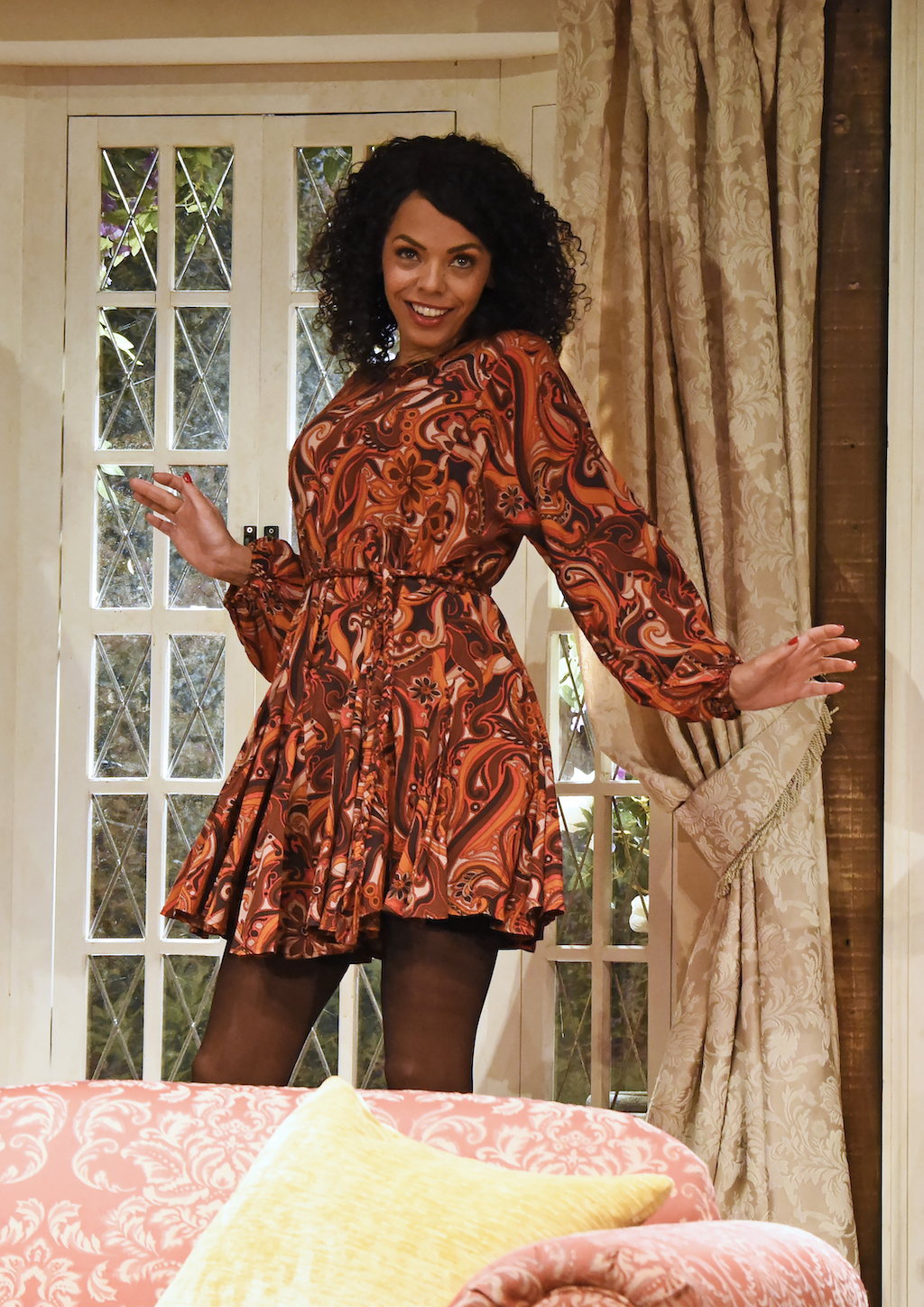
Meanwhile, Garry (the excellent Joseph Millson, channeling Chaplin in his spectacular physical comedy) is determined to inflict damage on Freddie (Jonathan Coy) for, supposedly, making eyes at Kendal's Dotty, while director Lloyd (Alexander Hanson) is having pre-#MeToo affairs with airhead actress Brooke (Sasha Frost, pictured above right) and assistant stage manager, Poppy (Pepter Lunkuse). Got all that? Don’t worry, if not, Frayn is a master of the form and, with a bit of help from Simon Higlett’s super set, every domino is lined up perfectly before being, to our delight, pushed over (and over and over again).
Frayn's structure gives us a country house farce unravelling in rehearsal due to a lack of preparation, only to be seen in further disarray in the middle of its provincial tour due to the rising tensions within the company. The third act lets us in on a final performance where everyone is utterly pissed off with everything, and sheer chaos has taken hold.
It’s still very satisfying to see the middle section from a backstage perspective, emotions boiling over in near silence (the noises off must be contained after all) as who doesn’t enjoy a bit of meta these days? But comedy’s mask often has a touch of tragedy lurking close to its surface, which is where this production scores. Jonathan Coy and Tracey-Ann Oberman (in a dress that nods to Alison Steadman’s Beverley in Abigail’s Party) represent two strands in the journey theatre must take in the next five years or so – and its a perilous one.
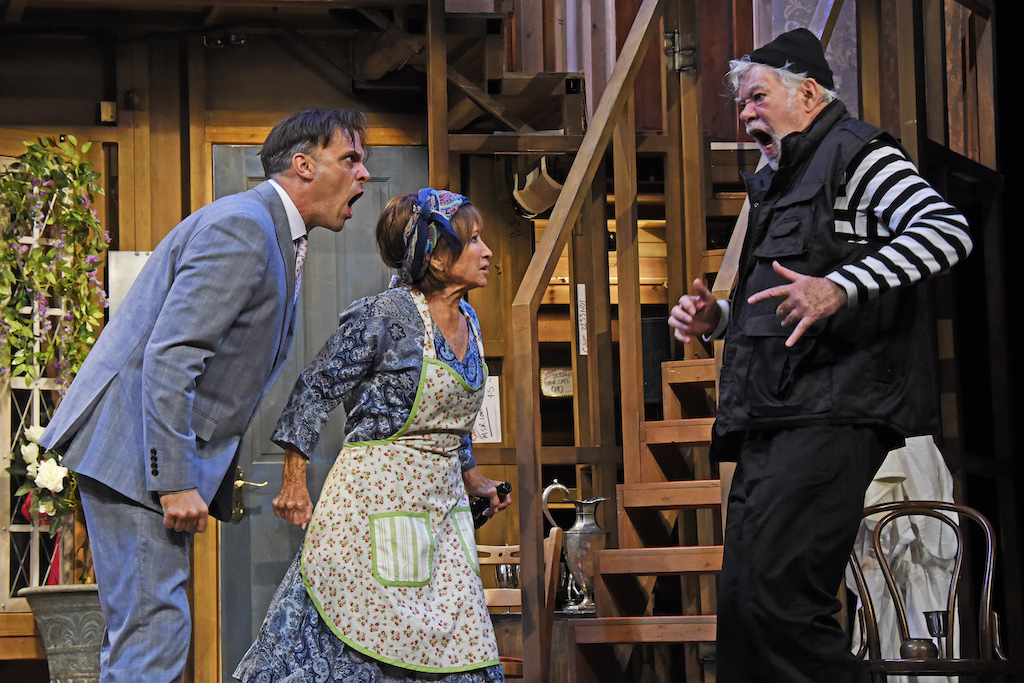 Coy’s Freddie wants to do things the old way: find his character’s motivation and worry about the craft of getting things on and off stage plausibly. At the same time, Oberman’s Belinda wants everyone to muddle through, to make the best of things, to stay true to the maxim that the show must go on. Both are right of course, but one could not help wondering (with a sharp reference to a matinee house comprising mainly OAPs to remind us) whether there will be any theatres left in the provinces within which the future Freddies can fret and the future Belindas can cope. And, on the day I learned of an existential threat to Theatre Alibi, having had its Arts Council England funding withdrawn after 40 years of bringing shows to kids in the South West, I wonder where the audiences will come from even if the buildings can be lit and heated.
So there’s a 21st century poignancy leavening the wisecracks and pratfalls of one of the great 20th century plays about plays that, notwithstanding such subtext, still delivers on its primary objective even for those of us who find farce easier to admire for its slickness than to love for its entertainment – it makes people laugh.