

It probably tells you all you need to know about Igor Levit that when a mobile phone pinged just before his encore, he neither ignored it, nor seemed annoyed, but turned it into a seamless musical gag. After sending a ripple of laughter through the audience as his eyes widened in comedic shock, he played a responding ping on the piano at exactly the same pitch. But then, as the New Yorker article famously put it, Igor Levit is “like no other pianist”. Musically, politically and technologically he is so consistently on the pulse that frankly you would have expected nothing less.
This moment of levity – no pun intended – came as a deft coda to a Herculean evening of performance, in which he wrestled with three well-known big beasts of the piano repertoire and introduced a newly created one. He opened with Busoni’s transcription of six of Brahms’ 11 Chorale Preludes, powerful meditative works which he had performed to great acclaim in his livestreamed concerts during lockdown and then recorded for his well-received album Encounter.
Right from the start Levit demonstrated a mastery of tone and technique that made it seem almost as if he was calling different voices out of the piano with each finger. The challenge of this work is to evoke the warmth and range of the organ on its much more percussive sibling, the piano. From the almost devotional stillness of the opening Herzlich tut mich erfreuen – in which he conducted the theme as it was established by the left hand – to the sentinel-like menace of Herzlich tut mich verlangen (I) he did just that. Moments of bell-like clarity interchanged with whispering lament, while passages of spidery delicacy were superseded by rich, portentous melancholy.
In the third movement especially, Es ist ein Ros entsprungen, there was a real sense of a conversation between the hands, transforming the deceptive simplicity of its theme into an elegant, philosophical meditation. In the second setting of the Herzlich tut mich verlangen, the left hand sounded the notes out as if played by a cello while the right hand gently escalated the tension till the movement resolved in its prayer-like conclusion. 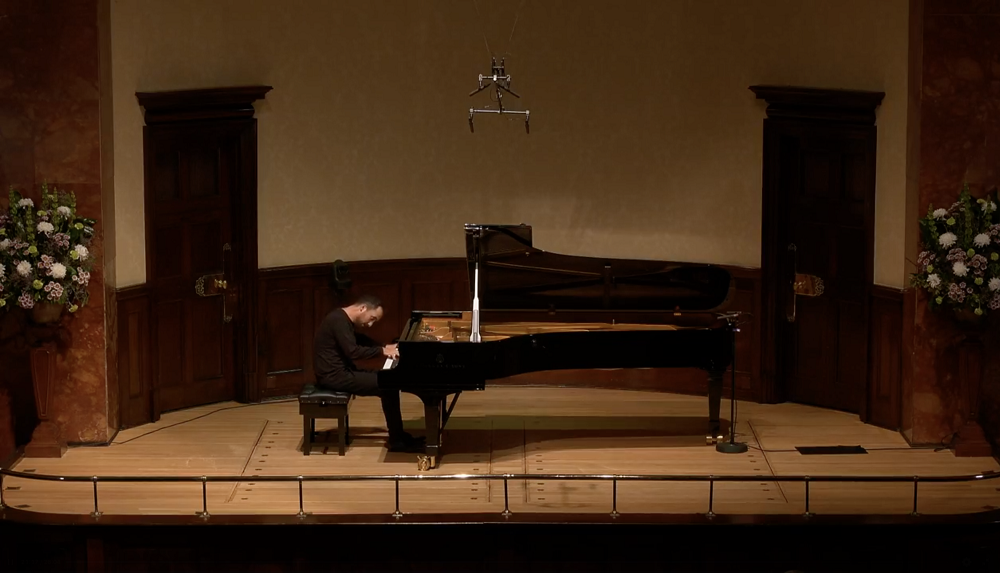 The second big beast of the evening was created specially for Levit by jazz pianist Fred Hersch, who Levit has described as “an absolute idol”. It constituted 20 fiendishly difficult variations on a folk song that was originally sung by fur trappers in the upper Missouri in the early 19th century.
This looked like it was going to mark a tonal shift from the other more romantic works of the evening, but the variations were often as lyrical as they were technically difficult, echoing composers such as Chopin or even early Scriabin. In the resonant statement of the theme it was as if Levit made the piano weep. While movements like the second were crisply acrobatic and the seventh a flurry of helter skelter animation, the ninth – in which for the most part, he played both bass and treble clef with his left hand alone – could have come straight from the 19th century. As throughout the evening Levit shifted seamlessly between the different emotional and technical challenges; in these variations you sensed a whole world.
As if that weren’t meat enough, after the interval he turned to the Prelude from Tristan und Isolde as transcribed by the late Hungarian pianist Zoltán Kocsis. He let his fingers play silently for a moment above the keyboard before resonantly delivering the famous Tristan leitmotif. Once more he let us experience the scale of an immense work without giving any sense of the strenuous acrobatics needed to pull it off. Each voice in the music was given free rein as he went from thunderous gravity to runs so fluently delicate they could have been made from spun glass.
There was no pause between this and Liszt’s B minor sonata, famously one of the most demanding in the pianist’s repertoire. The Gs at the closing of the Tristan and Isolde melded perfectly with the Gs at the sonata’s sinister opening. At the point of the Lento assai we were in the presence of a performer contemplating the darker aspects of his soul. Then the Allegro energico released fireworks as he threw himself into the demonic agitation of the sonata’s first section.
The challenge of this powerful diabolical sonata is not to deliver the whole piece at full blast. If you were to see it as a series of weather systems, there is no shortage of tempests and tornadoes, but equally there are moments of elegy and incredible stillness. Levit particularly demonstrated his emotional and intellectual mastery of the piece in moments like the Grandioso section which famously builds from repeated D major chords to a cathartic sforzando. It would be easy to bash this out, but as ever there was as much thoughtfulness as release. In the reprisal of the theme he carefully separated the chords, allowing us to feel Liszt’s muscular intent at the same time as distilling the intensity of the emotion.
This then was an astonishing evening, once more asserting Levit as a pianist whose technical brilliance is underscored by serious intellectual and emotional heft. As for that mobile phone ping. After such a titanic display of so many demanding pieces of music I think it was what we all needed.







Add comment