When Bliss, a new play adapted from an Andrei Platonov short story by Fraser Grace, made its debut in Russia in early 2020, Cambridge-based company Menagerie were told that their production was “very Russian”.
I’m no expert on Russian culture, but I would agree – in a good way. Paul Bourne’s production for the Finborough Theatre takes a while to warm up, but still packs a poignant punch.
Nikita Firsov (Jesse Rutherford) has returned home from the Civil War to a post-apocalyptic landscape: rural Russia in 1921. There’s no food and almost no people. The price of stealing grain is execution, and the flesh of the dead is sold in the market. Nothing blissful here.
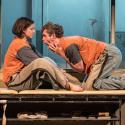
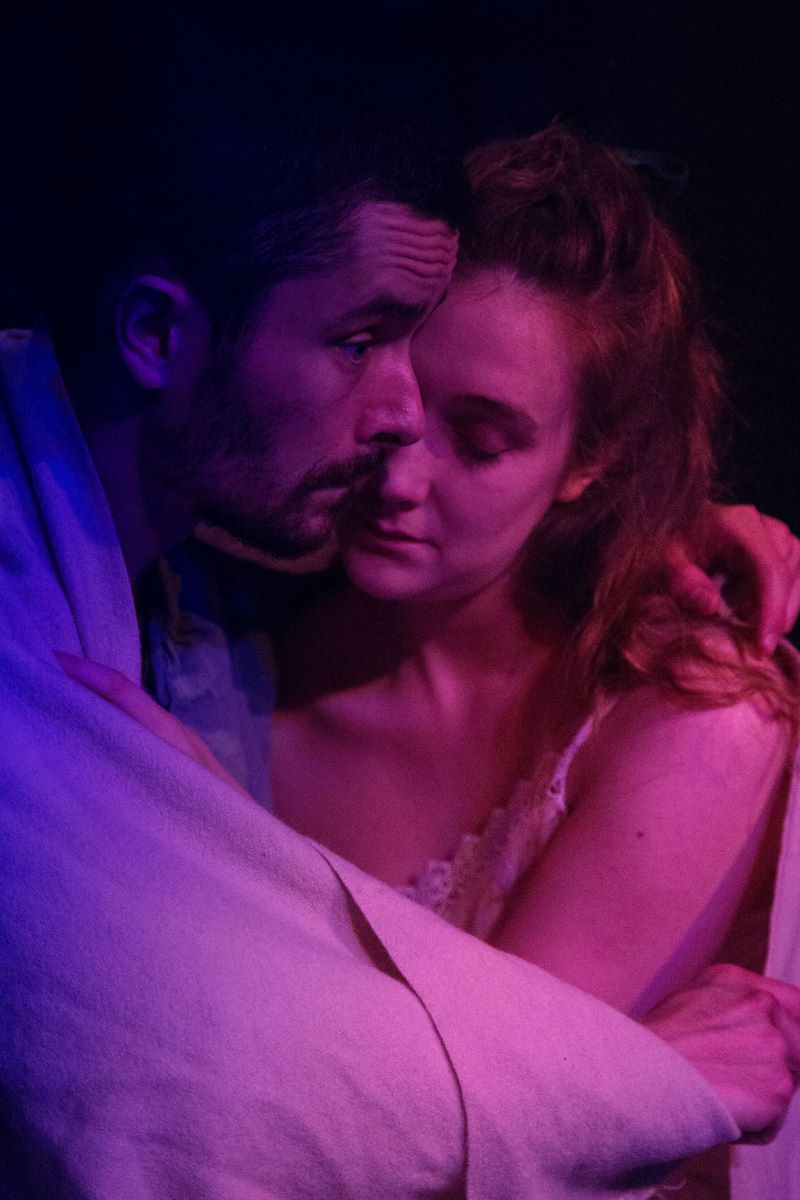
Somehow, Nikita’s childhood friend Lyuba (Bess Roche) is still around, as is his embarrassing dad, the town carpenter (Patrick Morris). Lyuba is studying to be a doctor but is perilously low on food. Her friend and fellow-student Zhenya (Caroline Rippin) provides her with enough potatoes to keep her going; Lyuba, in return, memorises whole chapters of textbooks and recites them so they can both, hopefully, pass their exams. That is, until Zhenya starts coughing up blood.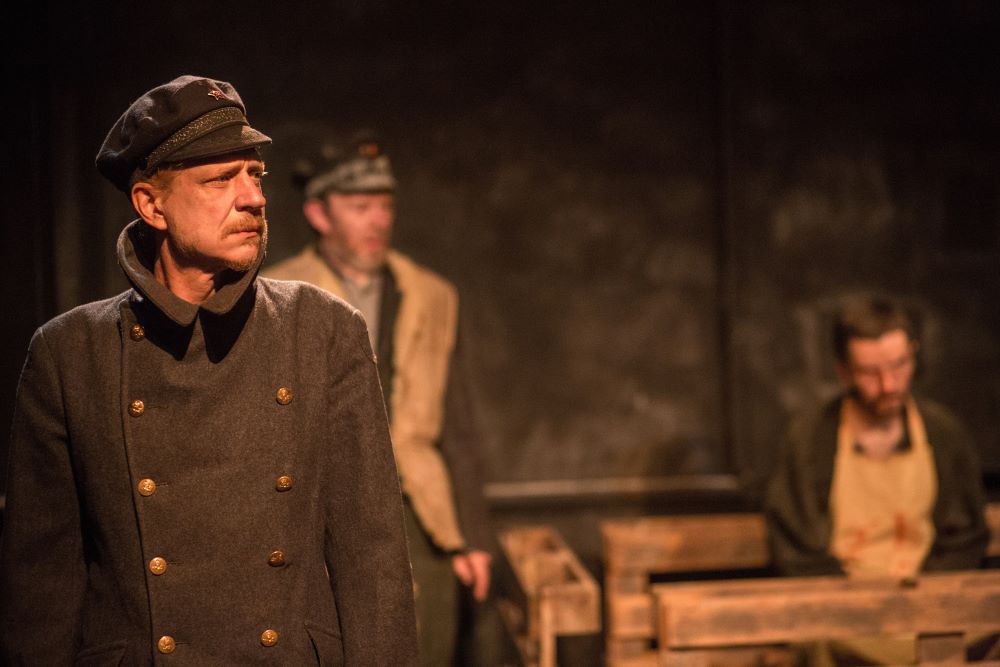 Lyuba wants to do things the “right” way, ie. marry Nikita and have children. The war has rendered everything meaningless except survival – maybe even that. Roche shows Lyuba’s desperate attempts to salvage a quiet married life from the rubble with a light touch. Nikita, meanwhile, both haunts and is haunted. A tramp (Jeremy Killick) follows him, gaunt and wordless. It’s implied that the tramp isn’t visible to anybody else, but Nikita is obsessed by him. He only seems fully present when he joins Lyuba in singing a traditional folk song. They dance and stamp and sing and look more alive than we’ve ever seen them. Their love story is briefly but tenderly sketched: they have a sweet "no, you hang up first" moment on a walk by the river. Nikita’s dad commemorates their wedding by making the happy couple the 1921 equivalent of a flat-pack wardrobe, assembled onstage by Morris.
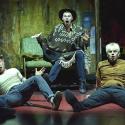
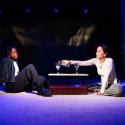
Bliss is, in a word, bleak. Nikita has only come home in the literal sense – his mind was left behind somewhere on the front. Rutherford’s wide eyes and open face make him seem at once like an old man and a small child. He grows more closed off in Act 2, when his attempted suicide takes him to a town about 20 kilometres away. There, he’s taken in by Paulina (Rippin) and Vlass (Morris), who run the marketplace, and is renamed "Croak", because he will not tell them his name. Without Lyuba, Nikita, it seems, is a different man altogether.
 It's hard to know what to make of Bliss. Certain moments verge on Brechtian; Vlass and Paulina feel one-dimensional. Paulina’s cockney accent is perhaps a little over the top, but Rippin’s transformation from gently teasing Zhenya to rough-and-ready Paulina is impressive. Grace’s language is difficult to grasp, perhaps belying its Russian origins. “We have to be strong for each other now, that’s our real work,” says Lyuba, sounding like a child trying to wear a parent’s clothes.
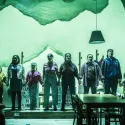
Bourne’s set is sparse, too, wooden pallets and crates moved around a bare black floor during Michaela Polakova’s unsettlingly jaunty piano interludes. The walls show outlines of pictures and a cross, like ghosts from a time before the revolution. There’s also a vague figure of a person near the door, where Nikita first enters. Puffs of dust come off everyone’s clothes, as if they’re all slowly disintegrating. Astonishingly, Grace wrote Bliss before the pandemic, let alone the Russian invasion of Ukraine.
The play ends with a tentative kind of hope: Lyuba and Nikita are reunited, Nikita’s dad a nuisance, as usual. Zhenya is still dead, and who knows what has happened to those market-folk. But the three of them are together, and Lyuba’s broken clock has started to tick again. Bliss, indeed.