

Helen McCrory is an actor who can inject a world of feeling into one syllable that many actors would struggle to muster in an entire script. Towards the end of The Deep Blue Sea, she is telling her estranged husband what it was that attracted her to the feckless pilot for whom she has thrown away her marriage. She describes a conversation at a golf club, in which after talking about “how life seems to have no direction, no purpose”, he puts his hand on her arm and says, “I really think that you’re the most attractive girl I’ve ever met”. She explains, “In that ti-ny moment,” – her voice cracking on the “i” so you can hear the swirl of emotion beneath the understatement – “when we were so close, I had no hope”.
Director Carrie Cracknell first collaborated with McCrory on a much feted modern-dress production of Medea, another woman who risked the scorn of society to pursue her love for a man who would eventually desert her. Yet the haunting elegiac tone of this production, as well as the centuries’ difference, makes it an entirely different proposition. Tom Schutt’s looming blue set simultaneously evokes the dinginess of the post-war Ladbroke Grove flats where Hester Collyer lives, and a vast sea in which everyone is floating like a lost soul. Part of the extraordinary emotional power of this production is down to the all-pervading sense of how thin the line is between life and death in this broken world.
It opens with the discovery of Hester stretched out motionless in front of a gas fire after a botched suicide attempt. Rattigan frames this with wry social comedy, as neighbours Philip Welch and Ann Welch (Hubert Burton and Yolanda Kettle) cluck and speculate over what might have happened, and landlady Mrs Elton (Marion Bailey) frets that “25 years Mr Elton and I have had these flats. Not a speck of trouble.”
Just as Noel Coward’s 1936 play Brief Encounter used an extra-marital affair to evoke the clash between emotion and respectability he experienced as a gay man, so too Rattigan uses this 1952 work to reflect his own experiences after his male lover committed suicide. That sense of an ecstatic, self-destructive joy that transcends the two dimensions of social convention inhabits every aspect of McRory’s performance. What’s particularly fascinating about this play is how much affection there clearly is between her and her estranged husband, a young judge played with warmth and stiff-upper-lip empathy by Peter Sullivan. But there is also a sense that while, unlike her lover Freddie, he is dependable in this crisis, once it’s over she’ll go back to being another acquisition in his life, like his Rolls Royce and golf club membership.
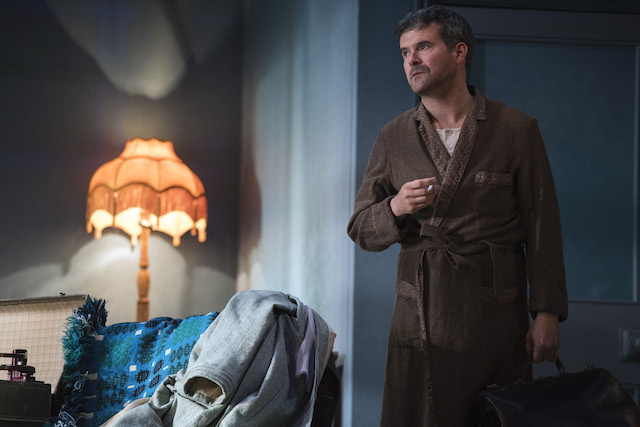 Tom Burke’s charming unreliable Freddie is complex too – he’s not letting Hester down because he’s a bastard, but because something in him has never recovered from being a pilot in the war. True, he may always have been narcissistic and self-absorbed, but as Hester perspicaciously observes, “his life stopped in 1940”. The fact that she analyses his plight in this way, and forgives him, suggests that for different reasons she felt her own life had stopped long before she was found in front of the fireplace. What’s worse, a death or a living death, the devil or the deep blue sea?
McCrory is the broken, irreparable heart of this production – distilling emotion not just into the brittle wit of the words, but also into the silences in which, while never losing her poise, she seems to collapse inside. Both Burke and Sullivan come across strongly in Matthew Amos’s screen production, conveying the attractions of both the devil and the deep blue sea. Yet the other performance of real note comes from Nick Fletcher (above). As Mr Miller – the doctor who it is hinted was struck off because he went to prison for homosexuality – he exudes the humanity of a man who has seen respectability for what it is, and is now devoting his life to picking up its casualties. It is he alone who understands Hester, and therefore comprehends that her tragedy isn't over, but merely waiting for a proper conclusion.
- The Deep Blue Sea National Theatre at Home till Thursday 16 July
- Read more theatre reviews on theartsdesk









Add comment