The Florence Foster Jenkins industry reaches newly giddy heights with Stephen Frears's film of the same name, which cleverly casts a great talent - who else but Meryl Streep? - as the cheerfully self-deluded American soprano. The subject already of separate Broadway and West End plays (both in 2005) and a French film (Marguerite) that has only just been released, Jenkins's extraordinary story here stands apart by virtue of that rare leading lady who can make a character's misguided belief in her gifts seem a form of bliss.
Was it a blessing of sorts that Jenkins's head was somewhere in the clouds? Perhaps, or so the film suggests from its first glimpse of Streep dressed as an angel and kept airborne during a 1944 entertainment at New York's Verdi Club that happens to have been founded by this self-same philanthropist.
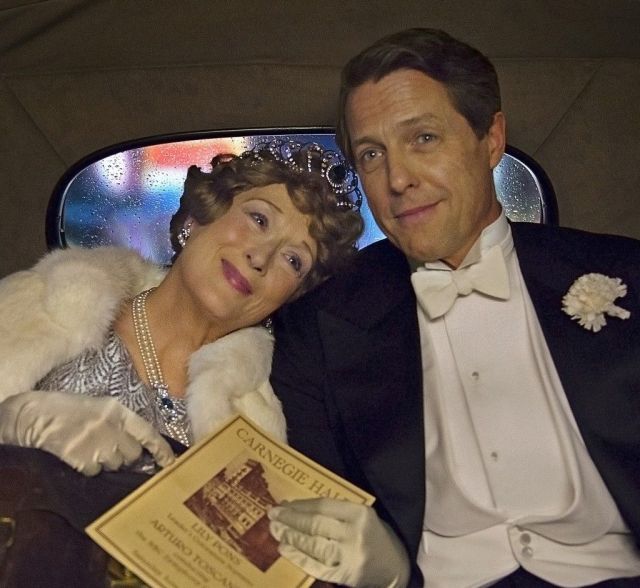 A culture doyenne with a particular avidity for potato salad - bathtubs of the stuff, in fact - Jenkins dreams of bringing her coloratura soprano to the tony confines of Carnegie Hall. That goal finds a ready enabler in her ever-droll common-law husband St Clair Bayfield (Hugh Grant, pictured with Streep above), who makes up in support and kindness toward his beloved "bunny" what he may fail to provide sexually. On that front, Bayfield has a mistress (Rebecca Ferguson), about whom Jenkins remains seemingly as oblivious as she is when it comes to recognising her limited talent.
Determined yet dithery, her sweetness amended by a gently perceptible sorrow at her syphilitic past (Jenkins contracted the disease at 18), our heroine completes a triptych of sorts for Frears of singular women from entirely divergent backgrounds that includes Helen Mirren's Oscar-winning turn in The Queen and Judi Dench's Oscar-nominated Philomena.
If Streep gets a nomination for this, as surely she will, that will mark her 20th Oscar nod, and there's something lovely about seeing so consummate a talent play this blithely self-absorbed squawker - the enjoyment amplified for those who caught Streep's two most recent films, Into the Woods and Ricki and the Flash, in both of which she demonstrated her well-known singing skills.
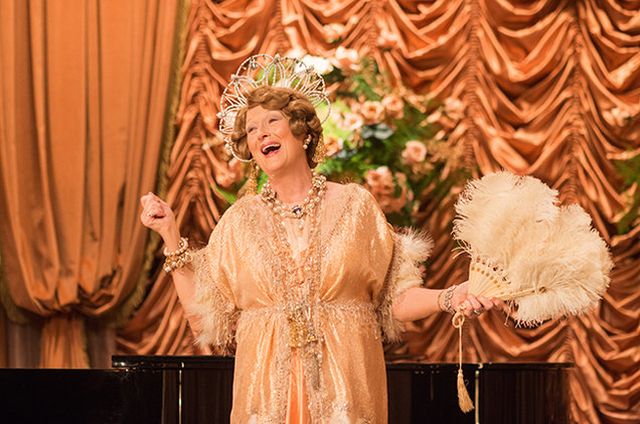 And while a more churlish view of the material might glory in Jenkins's comeuppance, Frears and screenwriter Nicholas Martin remind us that here was a performer who sold out faster than Sinatra and who could make fans out of even the frostiest observer. The Tony-winning Broadway actress Nina Arianda illustrates as much with her scene-stealing bit as a ditzy Brooklynite who shifts from jeers to cheers, while a quorum of drunken soldiers in attendance at Jenkins's eventual Carnegie Hall appearance might as well be us in their about-face from sceptical disinterest to fervent ovation. (Frears isn't above employing some familiar showbiz clichés.)
Amid inevitable and deserved praise for Streep, one must pay very real tribute to Grant, who seems to have found a humanity not evidenced from him in years. While an endearing Simon Helberg gets ready laughs as the pianist Cosme McMoon, who regards his newfound employer with a mixture of admiration and alarm, Grant tempers his sometimes curdled urbanity with a depth of feeling that meets Streep head on.
Can it be that, faced with a first-rate scene partner, Grant decided to up his game? "No one can say I didn't sing," Jenkins tells a teary Bayfield near the end. Nor can anyone say in Florence Foster Jenkins that Hugh Grant didn't act.
Overleaf: watch the trailer to Florence Foster Jenkins