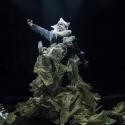
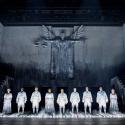
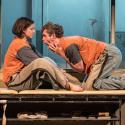
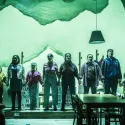
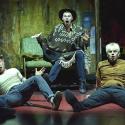
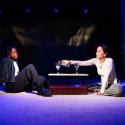
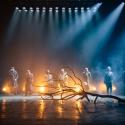
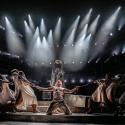
Those expecting an evening at the circus tonight, such as L’Oublié(e)’s advertising hinted at, were in for a shock. I saw a few children in the foyer and would be intrigued to know what they made of it. There were moments of pure nightmare amidst its parade of striking imagery. The debut show of French dancer and contortionist Raphaëlle Boitel is an imagistic, allegorical hour, heavily dipped in circus techniques, yet mostly deserting that medium’s levity and comedy in favour of an abject hallucinatory quality. I was gobsmacked by its audacious visuals but occasionally turned off by its defiant, take-no-prisoners artiness.
Things started with a voiceover: “One day a man was waiting for something somewhere and he died but he kept on breathing.” This Beckett-ian opener hinted at what was to come, but first was the only sequence to rouse untrammelled laughter. Behind a large, rectangular glass screen, three women tried to resuscitate a man using CPR, all in silhouette and in clownish fashion. From here, however, things immediately moved sideways. Boitel, topless, is lowered up and down on a trapeze, wrapping a sheet about herself, then, as the six strong cast scuttled about like flitting phantasms in the darkness, things took a turn into the sinister, with very occasional glimpses of light.
What little light there was hit the stage with precision and wild creativityA chronological or narrative description would be senseless but some of the most striking moments include the following: three women in black wearing long skirts gliding about the stage, as if on wheels, in a queasy, uncanny manner, as one of them sings a funereal dirge; a woman aggressively assaulted and contorted by a doctor, with hints of sexual violence; a series of tableaux viewed by an old woman in a two-way mirror, troubling subconscious flickerings involving knives, murder and masks; two scantily clad women dancing disorientatingly between stroboscopic squares of spotlight; the persistent use of Louis Armstrong and Ella Fitzgerald’s version of “Dream a Little Dream of Me” as a spooky sonic chimera; a troubling, projected visual effect that had the aspect of a demonic cloud; the use of extreme bass frequencies; and, less horror filmic, an acrobatic episode involving a table.
L’Oublié(e) wasn’t so much about individual performances as the overall production and styling, with particular praise due to the lighting. Darkness and shadow were pervasive but what little light there was hit the stage with precision and wild creativity. Indeed, the finale, which I shall not spoil for those who might see this as it tours Europe, involved spotlighting of extreme skill.
I have read, since watching it, that L’Oublié(e) is a homage to three female 19th century free-thinkers; the writer, socialist, beauty and sexual libertine George Sand, the pioneer of early photography and mistress of Napoleon III, Virginia Oldoini, and the sculptor and lover of Rodin, Camille Claudel. While the spectacle was easily watchable without any knowledge of these historical figures, the fact that they all shocked contemporaries with their sexual conduct and that two of them suffered from mental illness in their latter years, certainly provides some sort of key. In the end, though, L’Oublié(e) is, in essence, a thought-provoking performance art piece that happens to use theatrical and circus techniques.
Overleaf: Watch a trailer for L'Oublié(e)