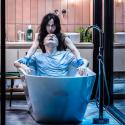
Instead of that small well-worn stone balcony in that courtyard in Verona, picture an extended well-worn cast-iron balcony in the Victoria Baths in Manchester. The young lovers have ample room to move in the labyrinthine interior of the old building, with its three disused tiled swimming pools and ecclesiastical stained glass windows. Romeo is the length of a cricket pitch away as he addresses Juliet on the balcony and, for some reason, is moved to do a take on “Love Me Do”.
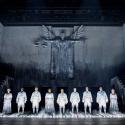
The old changing cubicles are still there, crumbling away, but providing hidey-holes for the warring gangs of Montagues and the Capulets to confront each other across the empty bath below. Their opening exchange is in chorus form rather than the written dialogue.
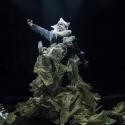
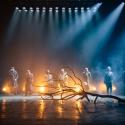
Director Walter Meierjohann, in his first production as artistic director of HOME, Manchester’s £25 million art house due to open next spring, has taken on the challenge of putting Romeo and Juliet into this vast space. He has come up with a spectacular promenade production. The largest pool has even been filled with 86,000 gallons of water for the occasion. He has also brought in some university students and a chorus to populate the place. So there is much exuberance, echoing noise and cavorting around. And Shakespeare’s text had been judiciously edited by dramaturg Petra J Tauscher to make it all fit into a site-specific show in just over two-and-a half hours. In short, it is a bold venture. Romeo and Juliet has never been seen like this before. (Pictured below, Ncuti Gatwa as Mercutio being carried aloft by the cast, chorus and ensemble.) The tale is retold as a contemporary fantasy loosely set in the criminal underworld of post-communist Eastern Europe, because when Meierjohann first saw the Victoria Baths he was reminded of visiting buildings in Eastern Europe in the 1990s. That’s the idea anyway, though you wouldn’t really notice. True, Macedonian composer Nikola Kodjabashia has created a percussion-driven soundscape which emphasises the ongoing action.
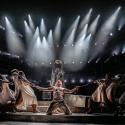
To begin with, the action is focused on an innocuous-looking raised platform slung across the centre of the pool area. But when we come to the Capulets’ masked ball the platform opens up like a cantilever bridge, revealing great mirrors and lights. This is the first of many stunning effects. The dancers jig around under glitter balls and chandeliers. And the mirrored walls and floor of the “bridge” work like a Hall of Mirrors, making odd reflections.
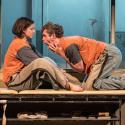
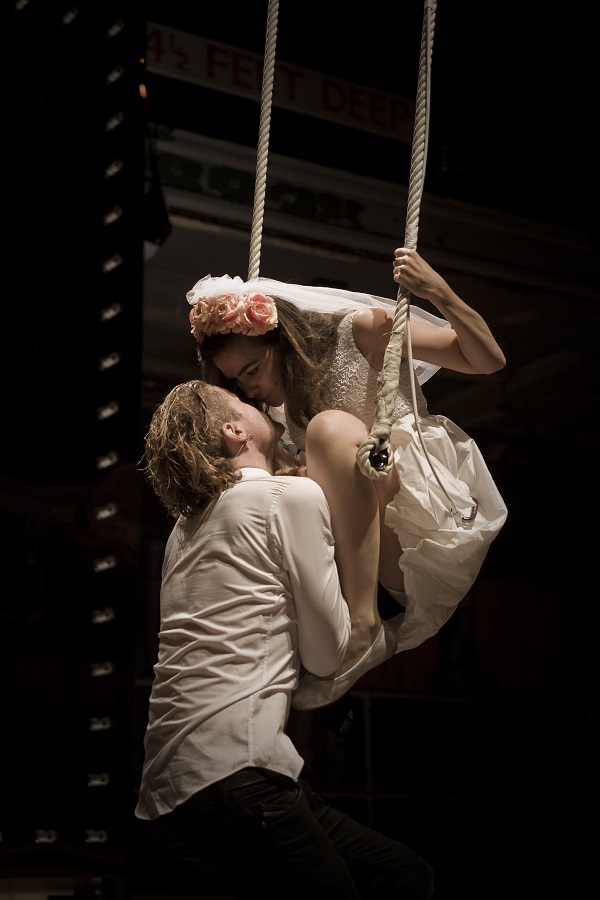 This is an all-action production, making constant physical demands of the actors as they cover the pool area, running up and down staircases and ladders. When Romeo and Juliet marry, a trapeze drops (pictured right) from the ceiling and he pushes her joyously back and forth. Not quite a circus, but as busy and noisy. The problem is that the actors tend to be dwarfed by the space and there are real problems with the acoustics, even with personal mics. Much of the dialogue is impossible to make out as it echoes round the place and there are also sightline issues, depending on where one is sitting or promenading.
Sara Vickers, virginal all in white, is an affecting Juliet, athletically partnered by Alex Felton as Romeo, although I was never drawn into a sense of a great love between them. Felton’s physicality shows up dramatically in his fight to the death with Tybalt, played by newcomer Will Coban. Mark Jax makes a commanding, bling-adorned, cigar-smoking Capulet and I enjoyed Rachel Atkins’ Nurse, a real Italian (or Jewish) momma.
The show builds to a breathtaking and spectacular climax in the vast, cathedral-like interior of main pool, where we find Juliet lying “dead” on a gigantic ceremonial cross laid flat on the water, surrounded by floating candles and flowers. And through the vaulted ceiling we see a star-lit night sky. It is a memorable setting for the lovers’ final act.
In a way, this sums up the show, which is an absolute triumph for designer Ti Green, lighting man Mike Gunning and the technical team. The building is both the star of the show and the villain of the piece. What stays in the mind is not the performance, but the sheer spectacle of it all.