“You’re great listeners. You have surrendered your ears.” The reverent hush that descended for two hours on the Festival Hall is a new sort of sound at a Christy Moore concert. There was a time when such a gathering would bristle with fervour. Twenty years ago, if not of Irish descent, you could feel distinctly like the odd one out. Things have changed, for any number of factors: the peace dividend in Ulster, the ever-diluting Celtic DNA of the Irish diaspora, while the senior sections of Moore’s audience – and pensioners abounded last night – have grown older and less raucous with him.
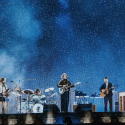
But most importantly there’s the man himself, who used to stand and confront his audience alone with a guitar. In recent years the oul fella has taken to sitting on a swivel stool alongside Declan Sinnott, who winnows out infills on a variety of guitars. And now they have been joined by the much younger Jimmy Higgins, the most deferential of drummers who migrates between a discreet snare, a shuddering bodhrán and a resonant Moroccan darbuka.
The result is a quieter night in a shebeen rather than a rabble-rousing summons. The other difference – and this is just one person’s impression - is that the footprint of Moore’s set list nowadays feels genuinely global. He began by sending hands across the water to South Africa with “Biko Drum”, and proceeded on a world tour in the Holocaust-referencing “Yellow Triangle”, the Spanish Civil War in “Viva la Quinta Brigada”, and summoned sorrowing Chinese mothers in Kevin Littlewood’s “On Morecambe Bay”.
He is a magician of atmosphere, grimacing and gurning and storytelling in a voice undiminished by long usage
Peppered throughout were songs of the displaced Irish – the mournful “Missing You” and the comedic “Don’t Forget Your Shovel”. But however widely he roams Moore will always embody a quintessence of steadfast stay-at-home Irishness. It’s in the undiluted poetry of his speaking voice, in the cheeky anti-authoritarian narrator in “My Little Honda 50”, in the wonderful patter songs (“Lisdoonvarna”, as first encore, sparked the usual delirium).
Through it all, he alternated between soulful longing and scabrous celebration, between his own home bankers (“Delirium Tremens”, “Ordinary Man”, “North and South of the River”) – and communicating the words and melodies of others - John McDermott’s “The Voyage”, Natalie Merchant’s “Motherland”, Barney Rush’s heart-breaking “Nancy Spain”. Throughout, Moore is resolutely Moore: a minstrel of loss, a magician of atmosphere, grimacing and gurning and, above all, storytelling in a voice undiminished by long usage. Perhaps the higher notes required perhaps a little more digging out these days, but the baritone instrument flits without effort from lyrical to knockabout, Moore’s percussive way with a consonant turning him into an extra member of the rhythm section.
The requests were fired out from the cavernous dark. “I can’t be doing all my hits halfway through the gig,” Moore pleasantly replied. From his vast back catalogue stretching back through Moving Hearts and Planxty (the jaunty “The Pursuit of Farmer Michael Hayes” had a rare outing), there were 28 songs in all – 30 if you include Sinnott’s country blues outing from a forthcoming solo album, and the traditional snatch of Van the Man’s “I’ll Tell Me Ma” in “Lisdoonvarna”. The biggest roar was reserved for Ray Houghton’s goal against England in “Joxer Goes to Stuttgart”, alluding to an Irish victory that stays fresh in the memory even for those who weren’t around in 1988.
He closed quietly, spellbindingly, with two other songs about memory – an account of Ewan MacColl’s “The First Time Ever I Saw Your Face” and then, bringing it all back home, “The City of Chicago”, which summoned the ghosts of the potato famine. It was written by Moore’s brother Barry (aka Luka Bloom), but on lovely nights like this, everyone’s family to this all-embracing performer.