Pete Seeger has had a vast number of tributes since he died aged 94 on Monday. That might seem surprising for an artist whose real heyday was over 50 years ago. Part of the reason no doubt was the dignified and steadfast aura of a man of the people and heartfelt activist. Along with his friend Woody Guthrie, he ushered in a period in American music when after the initial flush of rock'n'roll had subsided it became interesting to sing pop songs that were not mere romantic slush, but often had a political message. His mission was also to re-imagine the folk music of the steppes of America.
Having been hauled over the coals by the Committee for Un-American Activities as a Communist in the senate in the 1950s he was politically active to the end, appearing at the Occupy Wall Street protest in his nineties, and was a pioneering environmental campaigner. In our era, where despite more openness sexually, there are parallels to the conservatism of the late Fifties (and nearly everything in music is cross-platform brands, demographics and shifting units), Seeger still seems a refreshingly radical figure.
Seeger was a big noise, if only playing acoustic music, in the Greenwich Village scene in the early 1960s as portrayed in the latest Coen Brothers film Inside Llewyn Davis (a very loose and, friends say, woefully inaccurate portrait of Seeger's friend the singer Dave Van Ronk). The film doesn’t capture the atmosphere of artistic energy and the excitement of fermenting the progressive ideals of the 1960s. Where else in the world at the time could you be openly gay, for example.?
Folk went in and out of fashion, but Seeger was revered by the likes of Neil Young, Dylan and Springsteen
The story that has most stuck with Seeger was that he tried to cut the cables to keep the music's purity when Bob Dylan went electric at the Newport Folk Festival in 1964. Seeger claimed later he only wanted to cut the wires because the sound was technically bad quality not because of Dylan's heretical conversion to electricity. Even if not exactly accurate, there was some mythic truth behind the tale, which is why everyone believed it.
Seeger went out of favour as the 1960s went more psychedelic and he was seen as a more straight-laced avuncular figure rather than where-it-was-at. The new pop was seemingly a lot more fun. Seeger represented a link to a more puritan American tradition which was out of vogue. But he also had a habit of not fading away, and after “Turn! Turn! Turn!” became a huge hit for The Byrds, his “We Shall Overcome” became the rallying cry for the anti-Vietnam protest movement.
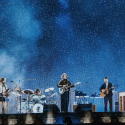
Folk went in and out of fashion over the next decades, but Seeger was always revered by the likes of Neil Young, Dylan and Bruce Springsteen (who relaunched his career in 2006 with We Shall Overcome:The Seeger Tapes, versions of songs written by or made famous by Seeger). Later artists such as Billy Bragg have acknowledged a major debt to him, and so should the current wave of folk-pop stars like Mumford & Sons. He was also a pioneer in rediscovering global songs from the past such as those from the Spanish Civil War and popularising tunes like the Cuban “Guantanamero". He also wrote the standard banjo instruction manual. If there was at times something absurd about all those well-scrubbed white boys he inspired singing about picking cotton or being in a chain gang, and while only a very few will have heard much of his 100-album output, a handful of his songs are for the ages. Onthe next page, enjoy some other artists' interpretations of a few of his best-known songs.
Overleaf: Marlene, Trini Lopez, Springsteen and The Byrds sing Pete Seeger
Marlene Dietrich: "Where Have all the Flowers Gone?"
Trini Lopez: "If I Had a Hammer"
Bruce Springsteen: "We Shall Overcome"
The Byrds: "Turn! Turn! Turn!"