

The reappearance of Gloria Mundi’s I, Individual is a surprise. Most of what related to UK punk – however tangentially – over 1977 and 1978 has been reissued, and has often been around the houses multiple times. But, until now, Gloria Mundi have escaped the attention of those recycling this aspect of the past.
I, Individual was Gloria Mundi's first album, originally issued on 7 July 1978. The band were live circuit regulars from late 1976 and split in 1980 after a second, very different, album which came out in October 1979.
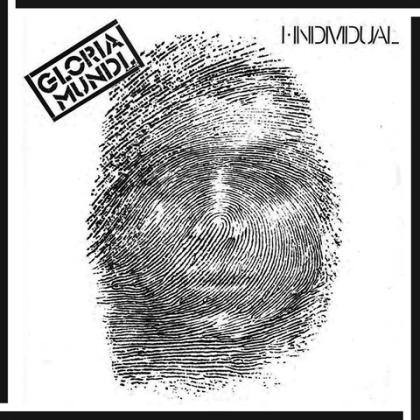
What’s on their first LP is a challenging punk-infused form of angular art rock, with leanings towards David Bowie and the Roxy Music of For Your Pleasure. The band was aggressive, forceful, very much in keeping with the times during which they emerged. But despite headlining prime London punk venue The Vortex in January 1978, a day before a show there by Sham 69, they were not punk as such. Musically, during ’77 and ’78, their closest bedfellows were the Ha! Ha! Ha! configuration of the John Foxx model of Ultravox!
Pushing in the opposite direction of much of the period’s music, Gloria Mundi's debut album is the opposite of reductive. Irrespective of when the band was ploughing its particular furrow, the album is one of the UK's art-rock highlights. Indeed, notwithstanding the Ultravox! parallel, it stands apart from anything else generated over 1977 and 1978 – though their one-time Vortex support band Rikki and the Last Days Of Earth were on a similar wavelength, thematically and musically.
In spite of Gloria Mundi being declared a precursor to Goth by Panache fanzine editor and future Melody Maker mainstay Mick Mercer, I, Individual hasn’t received much love over the years. Music historian Mario Panciera declared the album “over pretentious and ultimately dull.” I, Individual was lost, overlooked. Its return – in a very smartly presented package – is appreciated.
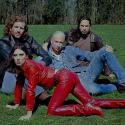
The band which recorded I, Individual was front person Eddie Maelov (Colin Francis), co-singer and keyboard player Sunshine (Valerie Patteson), guitarist Beethoven (Pete Vas), sax player c.c. (Chris Cullen), bassist Ice (Roland Oxland) and drummer Mike Nicholls.

There was history. Mike Nicholls previously played with Hawkwind’s Robert Calvert. Beethoven auditioned for Sex Pistols in 1975. Maelov and Sunshine were Gloria Mundi's drivers. They too had a past. In 1974 and 1975, they were part of Tiger Lily – the band which renamed itself Ultravox! in Autumn 1976. The duo were not were on the sole Tiger Lily single as their role was, as Maelov puts in in his essay for the new reissue, to add “stage performance visuals.” At this time, the duo’s goal was to create a science-fiction rock opera and form a band to perform it. Not very punk. When Ultravox! signed with Island Records, Maelov and Sunshine brought together their own band. In late 1976, Gloria Mundi were billed as “Theatre Rock.” The science fiction concept was abandoned. (pictured left, Eddie Maelov and Sunshine on stage with Gloria Mundi. Photo by Len Hooper)
However the “Theatre Rock” tag came across, there was an innate aggression and forcefulness. Gloria Mundi picked up Rod Smallwood as their manager. He had previously handled Steve Harley and Cockney Rebel (later, he managed Iron Maiden). Early Gloria Mundi shows included ill-fitting support slots at Soho’s Marquee – to rockers The Scorpions and Clemen Pull on separate dates in November 1976, to pub rockers Plummet Airlines in January 1977. More sympathetic bookings came with Marquee support slots to Generation X (31 March 1977) and, inevitably, Ultravox! (15 April 1977). The live Gloria Mundi evolved – Eddie and Sunshine acted-out songs, the band wore all-grey clothing, bright white lights shone from the back of the stage into the audience, a deafening siren shrieked.
For the weekly music press, benchmarking Gloria Mundi was tough. Reviews namechecked Devo, Doctors Of Madness. Steve Harley, Hawkwind, The Tubes, Ultravox!, Van der Graaf Generator, The Velvet Underground. Slotting Gloria Mundi into the punk-era UK was difficult.
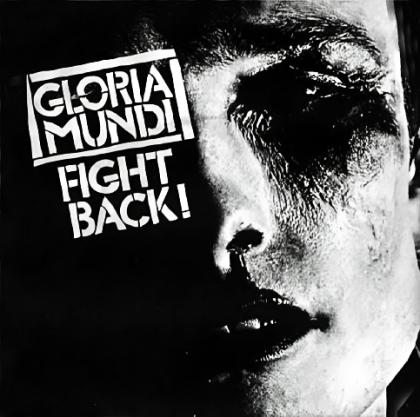
Given the inability to pigeonhole them, it unsurprisingly took a while to attract record label interest. c.c played sax on “Hiroshima Mon Amour" on Ultravox's October 1977 Ha! Ha! Ha! album, but this did not open a door. The “Fight Back” single arrived on RCA on 17 February 1978 (it is added to the end of Side Two of the new reissue). RCA ran with it and I, Individual was issued in July 1978. Working hard, Gloria Mundi picked up an audience and there was a national tour to coincide with the release of “Fight Back." A headline show at mid-scale London venue The Music Machine was reviewed by Paul Morley. He fatuously declared “they have no presence and fail to evoke an atmosphere. They are dull.” Their music was, he said “flat. feeble, unimaginative.” Well. (pictured right, the "Fight Back" single)
I, Individual was the opposite of feeble and unimaginative as – indeed – was the case with the live experience. Album opener is the waltz-time “The Pack,” a full-on, power-chord-infused art rocker with a Diamond Dogs undertone. It is heavy. Next up, the exceptionally moody, driving attack of “Condemned to be Free.” This is followed by the manic “Daughters of Rich Men.” Lyrics are Burroughsian, sometimes allusive or cut-up-esque, yet generally direct: of the corrupt and corrupted. Everything is claustrophobic, imbued with paranoia and decadence. Beyond the Bowie and Roxy Music touchstones, the lyrically shocking “Park Lane” has a “Walk on the Wild Side” vibe and “Daughters of Rich Men” evokes Queen had they gone punk. The creepy, dark, Sunshine-sung and composed "I Like Some Men” is a strong feminist kiss-off to predatory males. Heady stuff.
The album’s co-producers were Ian Bennett and Ian Taylor. What ended up on vinyl indicates they were not a great choice. The former’s most recent credit – his second overall as a producer – was an album by rock guitarist Paul Brett, also issued by RCA. The latter had a few more credits, but not many: a 1976 album by rocker Pat Travers, a spin-off album from TV series The Brothers, an album by singer-songwriter Peter Skellern, an album by folk rockers Magna Carta. None of which was a great fit with Gloria Mundi. And so it proved for I, Individual, a very dry, closeted, undynamic-sounding album. Bennett and Taylor were miscast. During the period it was recorded, Martin Rushent – although he was tied to United Artists – would have been a better, logical choice. Production-wise, Gloria Mundi’s debut album was a misfire. Still, it did hit hard. The band, their performance and songs cut through.
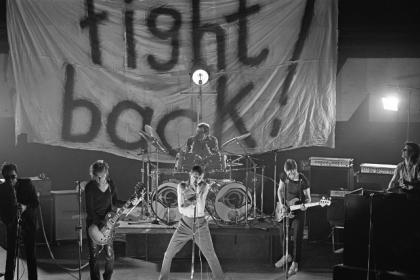
Now, for the reissue, the sound has been tweaked and there is some balance, warmth and mid-range punch, all of which were previously lacking. The additional track, the hyper-kinetic, vigorous "Fight Back" – solely prodcued by Bennett – sounded flat and overly trebly back then in its released iteration and, heard here, after the album, still comes across thus. Great song though. (pictured left, Gloria Mundi on stage in 1978. Photo by Len Hooper)
Following the album, guitarist Beethoven left and there was a normalisation, a refinement, of the Gloria Mundi approach and sound. This was first evidenced on the October 1978 “Glory of the World" single. More line-up changes followed, as did two further, synth-focussed singles and 1979's second album The Word Is Out. As Maelov says in his essay “that’s another story.”
After Gloria Mundi split, Eddie and Sunshine continued as a duo. They also appeared with John Foxx for his September 1981 "Europe After the Rain" Top Of The Pops appearance. Eddie and Sunshine were subsequently billed with Foxx on his debut solo live dates in 1983. They supported the post-Foxx Ultravox on 1981’s Rage In Eden tour.
A few years earlier, Gloria Mundi's wilfulness made them integral to the changes UK music underwent from 1976 to 1978. Even with the production shortcomings, their idiosyncratic early records remain a gale-force blast. The dazzling I, Individual and the “Fight Back” single have to be heard. Seek this reissue out.
- Next week: Motorway City - The Golden Age Of Car Travel 1966-82. Bob Stanley helmed concept compilation evoking the halcyon days of high-speed road travel
- More reissue reviews on theartsdesk
- Kieron Tyler’s website








Add comment