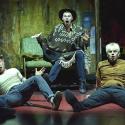
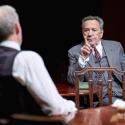
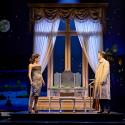
The voice has landed, and what an astonishing sound it makes. I'm referring, of course, to the mighty roar unleashed by James Earl Jones's majestic Big Daddy in the new West End revival of Cat on a Hot Tin Roof over which this legendary actor rules, much as the Southern landowner he is playing speaks vaingloriously of his "kingdom". When Jones isn't on stage, Debbie Allen's production serves Tennessee Williams's dissection of Mississippi-style "mendacity" sensibly if not definitively. But come the second of the play's three acts, and Jones's roof-raising redefinition of a great role takes hold. Trust me, during that extended passage there's not another West End theatre where you would rather be.
Allen's New York account of this same play did knockout business but got sniffy reviews a season or two ago, where discussion at the time centered around the supposed distaste of film star Terrence Howard, making his stage debut as Brick, for the rigours of a Broadway run. In London, Howard and his Broadway leading lady, Anika Noni Rose, have given way to Adrian Lester and Sanaa Lathan, both of whom acquit themselves more than creditably as the alcoholic, "click"-happy Brick and his curvaceous, child-hungry wife, the febrile Maggie: Williams's eponymous "cat".
But deftly though she powers through the opening act - in essence, an extended monologue punctuated by interruptions - Lathan is in essence priming us for the main course that arrives after the interval. That comes with first the unmistakable sound, and then sight, of the physically capacious James as the cancer-ridden patriarch who won't go gently into the good night. Exulting in a reported reprieve from "death's country" that Big Daddy will later discover is a lie, the actor sends the production hurtling into life and toward a third act from which he then, alas, is mostly absent, at which point Phylicia Rashad's tremulous Big Mama brings the evening home.
I've always thought Williams's most outsized male character was one of those supporting roles whereby you can't go wrong, rather like Mercutio, say, or Ibsen's Judge Brack (a part I once saw Jones do). But even by comparison to such previous, and formidable, Big Daddys of my experience as Eric Porter, Charles Durning, and the role's last London and Broadway occupant, Ned Beatty, Jones is a breed apart. Here are pride and contempt, anxiety and tenderness, robust comedy and roiling anger folded into an overwhelming whole, a onetime fieldhand who has ascended the social scale and then some while remaining impotent against the imminent mortality that lies in wait.
The much-vaunted fact of an all-black cast - or perhaps not: one of the pre-pubescent gaggle of calamitous "no-neck monsters" is very light-skinned - turns out to be of less significance than a renewed awareness of the universality of a playwright who with Cat hit any number of home truths hard. The updating of the action to the 1980s makes one wonder whether the inexplicable "little fever" that felled the former athlete Brick's beloved Skipper might be an early form of AIDS; at the same time, such specifics open on to a view of thwarted communication that may be the only thing, ironically, that binds this family together. Jones at the start is magnificently funny, his face locked into an epic scowl as he attempts to clear an overcrowded room so that Big Daddy and Brick can at last have their talk. (The porous quality of Morgan Large's cage-like set makes plain the lack of privacy that helps drive the plot.) Not long after, though, Jones has passed through scorn and disgust to something infinitely moving, Big Daddy cradling Brick like a father and son fearful of two very different reckonings.
Rashad, a Broadway Tony winner for the same Raisin in the Sun in which Lathan co-starred, got some cool New York notices for Cat, in which case the actress has clearly upped the stakes in the move across the Atlantic. As if to remind us how democratically structured is this play, her Big Mama turns the third act into the awakening of a woman who must confront both the hatred of her husband of 40 years and the extent to which her "precious baby", Brick, has surrendered himself to booze. Dabbing at her eyes, Rashad gives us a mother in near-meltdown, her cheery prattle a heartbeat away from tears.
The British contingent begins with Lester's unusually sinewy, crutch-wielding Brick - flawlessly accented, for those who are wondering - and extends to a pair of remarkably vivid turns from Nina Sosanya and Peter de Jersey as the couple whose ceaseless breeding exists in painful contrast to the barren Maggie. And so Williams's play ends where it began, with Maggie in heat, oblivious (or not) to the chill settling in around her. Her "cat", to be sure, commands attention, but when this Big Daddy lets rip, the entire animal kingdom - not to mention the lucky audience at the Novello - had best watch out.