Lindsay Seers is one of the most exciting artists to have emerged in Britain over the last 10 years. Preoccupied with big philosophical questions, her work explores notions of truth, memory, imagination and history. Nowhere Less Now, commissioned by Artangel, is her first new work in London since Extramission was shown at Tate Britain in 2009. It is no ordinary work.
Skilfully combining photography, video, performance and animation, Seers takes us on a journey - one that begins inside a rusty corrugated iron chapel off the Kilburn High Road in north-west London. The Tin Tabernacle, built in the 1860s, has been home to the Willesden & Marylebone Sea Cadets for the last 50 years. It looks like a shoddy makeshift church in need of a fresh coat of paint but behind a pair of battered old gates is an undiscovered world, a mysterious realm that feels instantly eerie.
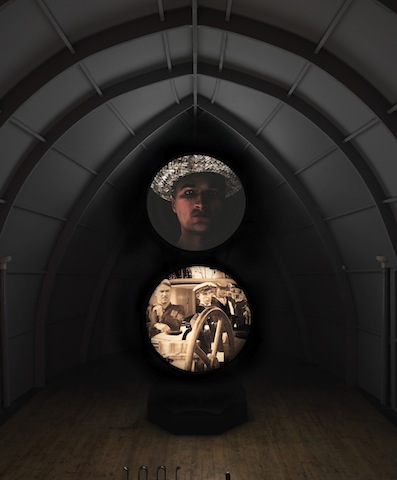 On arrival, each visitor is given a headset and a dubious look. The waiting room is tight and only 25 guests are allowed in at once. Viewings are on the hour, each hour and last about 40 minutes. Bookings must be made in advance. During the 1950s, the sea cadets transformed the tabernacle to mimic the inside of a Royal Navy ship, so it’s packed with ropes and guns, portholes and old black and white naval photographs. For Seers, whose great great uncle George Edwards, born in 1866, joined the navy and sailed to Zanzibar, this was an uncanny discovery.
The product of that discovery is Nowhere Less Now, a challenging film that is part reality, part experimental storytelling. In a blackened room, images are projected onto two floating spheres that resemble giant ping-pong balls. A pair of eyes - one blue, one brown - blink, before a soothing voice starts to narrate a story that moves backwards and forwards like the ebb and flow of the ocean. We enter a world of witchcraft and fortune-tellers; photographs have become redundant and history no longer exists. But the narrative is puzzling. We are whisked through a hasty multilayered montage about not one George Edwards but two that is almost impossible to follow – and that is just the point.
The story is far too complex to understand fully. The viewer's task has less to do with trying to decode the code and more about the big philosophical questions. How do we search for meaning? Can we rely on our memories?
The film is neither beautiful nor poignant. It sparks no great emotion but, masterfully woven together and deeply original, there is something strangely compelling about it. Nowhere Less Now takes us on a journey that has no clear direction but, like memory itself, is both ambiguous and convincing.
- Lindsay Seers: Nowhere Less Now is an Artangel commission at The Tin Tabernacle, 12 to 16 Cambridge Avenue, NW6, from 8 September until 21 October