Britain’s favourite ballet choreographer Chris Wheeldon rode into his homeland last night, bringing with his Anglo-American company Morphoses work by himself and by Britain’s second favourite ballet choreographer Alexei Ratmansky. Two favourites should be enough to guarantee the opening programme, but there are two drawbacks: the pieces filling the middle of the programme, and the limp video in which it’s all wrapped. And the whole represents a split in taste between US and British ballet expectations from which I am beginning to fear Morphoses - that shining optimistic light of new ballet a couple of years ago - is destined forever to suffer.
In the US it’s common for the choreographer to come on and charmingly introduce himself, thank the venue winningly for having them, and wishing everybody a wonderful evening - it’s also, I dare say, more common for film accompanying the dancing to be a bland PR package. In Britain we actually don’t care if the choreographer doesn’t say a word as long as his choreography does, and we expect dance film packages of the poky quality that the Ballet Boyz have accustomed us to. Less of the gladhanding and reverence, let’s just get on with the meat.
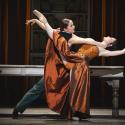
Wheeldon himself has two choreographic faces, more interesting and more ruthlessly self-editing on the dark, chillier side of his talent that the charm hides. Commedia, which he premiered here at Sadler’s Wells last year as a contemporary take on the Italian commedia dell’arte theme of Stravinsky’s Pulcinella (a highly inventive rewrite in Stravinskian terms of 18th-century music), is an uneasy ballet of two halves, not hitting stride until the second.
Its music was commissioned by Diaghilev for the Ballets Russes, whose centenary is this year, and the playing of the score by a small tight band conducted by Paul Murphy was the most consistently commendable part. A group of harlequins in white and black leotards, sporting carnival masks and coloured capes, throw out male-female couples who dance a series of winsome duets, well short of the ambiguous sexuality and satire that you beg for from commedia dell’arte and far from Wheeldon’s best invention.
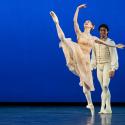
Spirits rise with the appearance halfway through of the ever-witty little Leanne Benjamin in a tutu and with a much spikier, more characterful solo, whose detailed gestures pick up the rough Russianness of that part of the music (shades of Petrushka), and there is later a blithely flirtatious pas de deux with Edward Watson, in which they nuzzle or kiss while performing tricky pirouettes - he cups the back of her head, she cups his bottom in return. This smart pair, loaned by the Royal Ballet, make the event of the night.
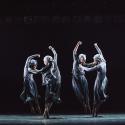
Two exceedingly drippy pieces follow, the first by Australian step-maker Tim Harbour, Leaving Songs, in which the boys wear blue and the girls wear pink, the manifesto (enunciated by Harbour on the film) is about how life ends in death and something new starts, and sundry such inanities that burble on until the sound engineer, divertingly, fades his burbling out mid-flow. The boys cradle the girls, the group swing clear balloons about like huge tears, and the whole, including the music, has that synthetic gloopiness that makes you want to feed so-called choreographers to crocodiles.
Paul Lightfoot and Sol Leon, a choreographic duo from Holland (via the Royal Ballet School, Lightfoot’s alma mater), produce the more sophisticated but still emotionally vacuous Softly As I leave You. Two extremely beautiful dancers, male and female, thrash out how being beautiful means being hopelessly in love and suffering in a beautiful way to an Arvo Pärt CD, and it’s about as touching and credible as an item about Jordan 'n’ Pete’s sobs in Heat. Why is it so hard for modern choreographers to interest themselves in real character, vagaries in emotion, individuality, rather than clichés?
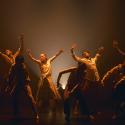
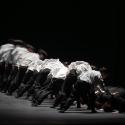
With the very first steps of Alexei Ratmansky’s Boléro, it’s evident at last that we do have an individual in the house. In nocturnal lighting three boys and three girls dressed like college athletes with numbers on their vests make immediately intriguing movements that combine sure jazzy phrasing, cool classical line and a true lighthearted youthfulness.
Though he made it in Denmark eight years ago, it feels somehow American, as if Ratmansky, until recently the Bolshoi Ballet’s director, now settled in New York, has a real interest in his new neighbourhood of Robbins, Tharp and Broadway. Girls pal up with guys, then clip off triumphantly on pointe in a female faction, while the famous Ravel music’s perpetual crescendo (well managed by Murphy) invites you to believe that there’s a dramatic climax being stored up here. In the end, there isn’t, the couples pair up conventionally, which leaves the entire evening feeling like a promise that wasn’t fully delivered.
The same programme tonight; tomorrow and Saturday, Continuum and world premiere of Rhapsody Fantaisie (both Wheeldon) and Lightfoot/Leon’s Softly As I Leave You. Book online here
Check out what's on at Sadler's Wells this season