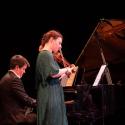
We all make mistakes. I was absent for the start of Ingrid Fliter's Tempest sonata at her Queen Elizabeth Hall debut. Fliter was absent (mentally speaking) for much of the final movement of the Appassionata. The parts of Fliter's recital that we were both wholly present for, however, suggested she may well be as good a Beethovenian as she is a Chopinist.
Chopinists don't always make great Beethovenians (or vice versa). Fliter showed she had all the essential tools to be both: an engineer's feel of logistics, a circus entertainer's eye for variety, a bombardier's sense of timing. In the final movements of the Tempest sonata she also showed she could sing a line as well as she could plan and deconstruct it. Her cantabile line seemed to have a happy time being blown around unthinkingly but beautifully in the Adagio of this otherwise moody sonata. In the Mendelssohnian Scherzo of the Sonata in E flat, Op 3 No 3, there was more purpose to the jolly whistling melody in the right hand (very much a thinking melody) that is propelled by a thousand skittish legs in the left.
Yet Fliter's touch can pack a punch too. Her percussive interruptions in the first movement of the Sonata in E flat showed there was plenty of Semtex stuffed in those fingers. This power was quite a shock when I first heard her play at the Wigmore Hall last year. In the Beethoven, it made perfect sense. Her weighty account of the first movement of the Appassionata sonata was full of these explosive, ardent outbursts, allowing the work to spring forth and snatch at our throats. Then came an odd final half-hour.
It had been a pretty flawless recital up to this point. But then from nowhere flaws appeared: first, a poorly pedalled, oddly flat Andante (very much sine moto), and then a final movement which should have upped the con moto of the Andante but instead ground to a moto-less halt just as the first theme began to bubble up to the surface. She never really recovered. The rest of the movement was a bit of a smudgy fudge, though she collected herself enough in the coda to deliver a final night ride of impressive lightness and anxiety.
She came on for three encores: less attempts to show off, more chances to cast off the demons of that 11th-hour collapse. Schubert's Impromptu in E flat major was delivered in a perfectly attractive gusty way. But Fliter seemed unsatisfied and came out to the piano once more, this time for the Chopin Nocturne in D flat major. Despite spidering the fioritura with a breathtaking nonchalance reminiscent of Martha Argerich (who we might have been listening to next door at the Royal Festival Hall had she not cancelled), the piece saw her foul up several times, her rendition serially flopping onto its bottom like a toddler. So, to finally excise these gremlins she came on one last time for the Minute waltz. Faultless it wasn't. But as a display of pianistic rubato, it was exceptional. That'll do, her shoulders seemed to say. It did very nicely.
 Find Ingrid Fliter's