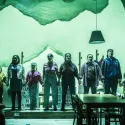
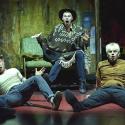
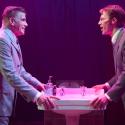
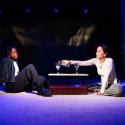
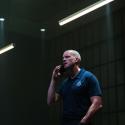
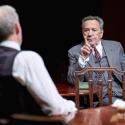
When cultural talk drifts toward Mr Big, thoughts tend to turn to Sex and the City's Chris Noth, whose New York is world enough and time away from the doomed metropolis populated by the "big fellah" played by Finbar Lynch in Richard Bean's play of the same name. This big guy is, in fact, slight but menacing: the type of man not unacquainted with the very methods of violence which Harold Pinter, among others, dramatised so well. And when Lynch's Costello remarks, "Unlike you, I am not mentally ill," one sits up and takes notice. The issue here has less to do with what Costello is not and everything to do with what and who he is.
Lynch's softly spoken IRA hard man is one of a trio of superb male performances - an Irishman, Rory Keenan, known in Dublin if not London, contributes another as an IRA man wanting to go clean State-side - who animate the latest from the (presumably) ever-busy and unclassifiable Richard Bean, whose plays range from small-scale to epic, the domestically focused to the politically charged. (He adapts Mamet as well, as visitors to the Almeida can discover for themselves.)
Most notably, Bean locates comedy in material that always has a moral compass. Take, for instance, the final line of the first act: "I like being in the IRA, but if there's one thing I'd change, it's all the fucking killing." Martin McDonagh, whose The Lieutenant of Inishmore this play at times resembles, couldn't have put it better himself.
At the same time, it's difficult not to feel that The Big Fellah marks Bean some way short of the top of his game, even before we get to the ironically sunlit finale that takes place on 9/11: a date that is catnip to dramatists but is becoming much too convenient, even glib, a dramatic shorthand. Set in an IRA safe house in New York across 29 years that begin in 1972 and end, well, you know when, The Big Fellah follows the hurtling chronology of Bean's England People Very Nice without seeming sure whether to fully explore its satiric impulses or to settle for something more banal, and when one character remarks, "It's 1998, loser", it's clear that the exposition, too, could use a helping hand.
In some ways, this is yet another Faust rewrite, and why not, in a season alive to that tale at seemingly every turn? "I sold yer me soul and done alright by it," or so says the chatterbox that is Keenan's Ruairi, a wanted man back home who hopes to reinvent himself in New York as an architect with the Hugo Boss clothes to match. And yet, geography in itself is no barrier to anything, as 9/11 would in its own way prove, and before long a nondescript Bronx apartment finds itself hosting all manner of bedlam, not least given the arrival of a drill-wielding Irishman, Frank (Fred Ridgway), who on this evidence would seem to have a thing for Popeye. (Not, in this context, that spinach would prove much help.)
The play traces a continuum of terrorism from Ireland to Libya and then home to New York and across decades that take in, whether explicitly or obliquely, Bloody Sunday, Enniskillen and Omagh, and the suggestion that no one, nowhere, is safe. An Englishman writing about both New Yorkers on their own turf and Irishmen abroad, Bean has fun with the American locals, starting with a Protestant New York fireman/IRA sympathiser (musicals actor David Ricardo-Pearce, still grappling with the role), who will end up in the thick of 9/11, and a cop who goes by the McDonagh-esque name of Tom Billy (Youssef Kerkour) and whose blue-collar bluntness might give even the inhabitants of Clybourne Park pause.
Max Stafford-Clark, directing a co-production between the Lyric, Hammersmith, and his own Out of Joint company, is clearly attuned to the play's often brazen energy, and it's not his fault if the women, for instance, seem appendages to a decidedly male landscape. (Small wonder - spoiler ahead - one of them doesn't make it to the second act.) And for those wanting further opportunities to ponder man's ongoing propensity for violence, hang in there. Next up at the Lyric Hammersmith is a revival of Blasted.
- The Big Fellah continues at the Lyric Hammersmith until 16 October
- Further information, including touring dates, on the Out of Joint website
- Richard Bean interview on theartsdesk