One of the recurring themes in BBC4's recent documentary, Krautrock: The Rebirth Of Germany, was the importance placed by so many of its participants upon transcending Germany's then-recent past. Move on several decades, and you now have a country with a rich, varied and unique musical culture that not only has a global reach and influence, but which can also afford the luxury of being able to look back at itself and even have a little fun at its own expense.
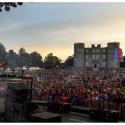
The Berlin Sounds evening at this year's Ether festival highlighted all this and more, bringing together both veteran and modern practitioners of krautrock and kosmiche styles whilst acknowledging the influence of the often-overlooked Neue Deutsche Welle (the post-punk new German Wave) in bridging the gap between the Tresor (the influential techno label) generation and the bands that grew out of the turbulence of the 1960s.
During their headlining set, To Rococo Rot's Robert Lippok spoke of Berlin's position as a cultural and artistic melting pot similar to London in the way that it draws people from all over the country and beyond, so it seemed fitting that the evening should begin with a short set from Sasu Ripatti performing as Vladislav Delay. Finnish by birth, Ripatti became a significant figure in the growth of German electronic music during almost a decade's residence in Berlin, and tonight he concentrated on the semi-improvised textures and shifting ambient dub that his Vladislav Delay pseudonym is known for. Each piece built slowly upwards from dreamy, heavily processed synth pads, Ripatti adding layers of random, often abrasive sound as the music built to a crescendo before falling away to a gentle conclusion. Although it occasionally entered the realm of the aimless noodle, this modern take on the approach of kosmiche pioneers like Ash Ra Tempel or Achim Reichel nonetheless skilfully set the tone for the rest of the evening.
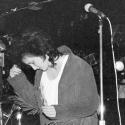
During the last few decades, a great deal of new German music has found itself struggling under an accompanying and predictable weight of clichés - drab, joyless, austere, und so weiter. As someone who played a central role in its development, particularly during the post-punk years, you'd expect Gudrun Gut to know most of them inside out. It was especially amusing, therefore, to see her and Antye Greie (aka AGF) put the steel-toed Arbeitsschuhe in with relish, playfully poking fun at a succession of well-worn “industrial” tropes with their new collaboration Baustelle (which translates as “construction site”). Gut's perma-grin throughout betrayed the mischievously funny aspect of the project, evident in everything from the set design – step-ladders, industrial tape and back-projected footage of iron foundries – to Gut and Greie's dungarees and boiler-suits. The music itself looed forward as well as back, taking in rhythmic elements from dubstep and techno, and blending them seamlessly with the more established metal-bashing styles so affectionately lampooned by the pair, the gag coming full circle when they theatrically donned hard-hats for a radical rework of Palais Schaumburg's “Wir bauen eine Neue Stadt”.
Ostensibly here to promote their first album in six years, Speculation, To Rococo Rot were augmented for the evening by Faust's Jochen Irmler, who added waves of kosmiche organ to the latter half of the set. Earlier, the Lippok brothers and Stefan Schneider worked through a number of energetic new pieces, with the muscular propulsiveness of Ronald Lippok's drumming and Schneider's high-register basslines often echoing Joy Division-vintage Stephen Morris and Peter Hook. The new material seemed looser than usual, but no less tightly focussed, and the precise rhythms – flitting between motorik, post-punk disco and even languidly-rolling afrobeat - never became mechanical. Things took a more meandering, perhaps even indulgent turn after Irmler, resembling a grizzled electronics lecturer, joined the trio centre-stage behind a Scrapheap Challenge arrangement of homemade keyboards, but the energy level didn't dip.
The three younger men clearly relished the opportunity to perform alongside someone who'd arguably been playing post-rock before the phrase was coined, and their enthusiasm transferred to the audience. As the crowd drifted into the foyer following an improvised encore, they were greeted by the sound of former Palais Schaumburg/Orb member Thomas Fehlmann wearing his DJ hat, who quickly found himself facing an energetic audience of dancers, thus bringing to a close an enjoyably circuitous evening of musical join-the-dots.
To Rococo Rot discuss their new album Speculation