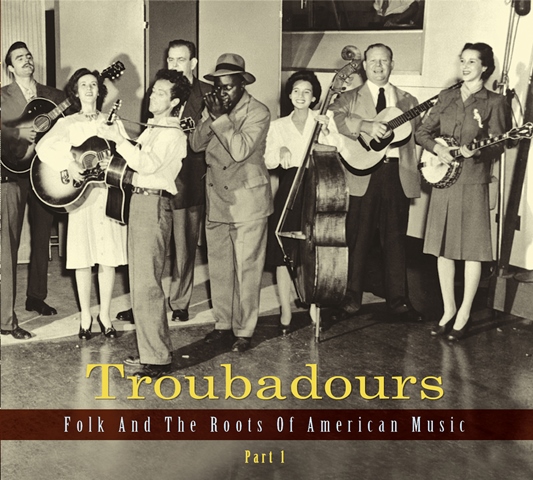
 Various Artists: Troubadours - Folk and the Roots of American Music Part 1; Part 2; Part 3; Part 4
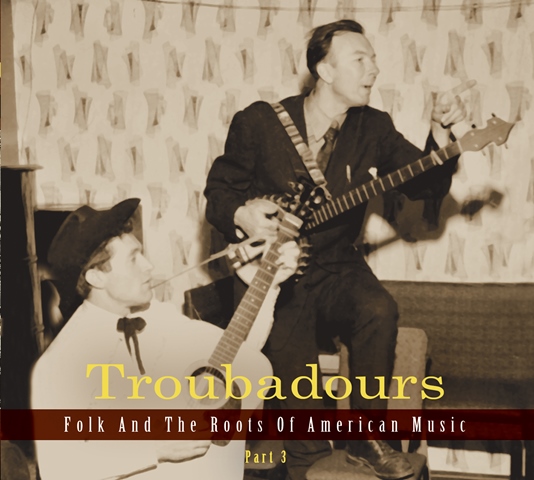
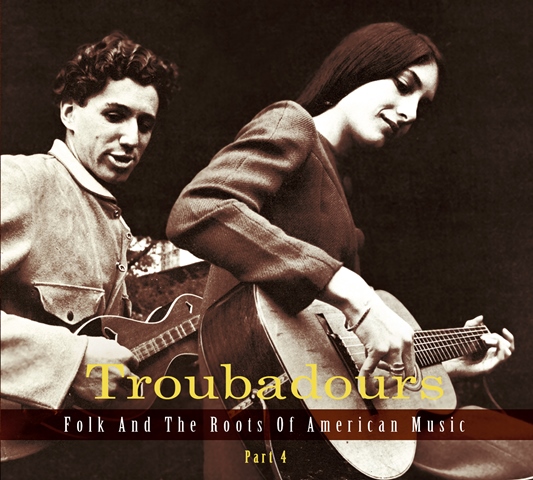
This is one of the most important reissues of the year. As the year ends, it may become the most important. Troubadours - Folk and the Roots of American Music is a set of four, individual three-CD sets charting the evolution of the American folk-based singer-songwriter style from its roots and influences to when it became a default mode of expression in the mid-Sixties and later.
All-encompassing are words underselling Troubadours. Everything which should be, and everyone who needs to be, is here. This aural encyclopaedia has a scope never attempted before. The packaging is fantastic. Each three-CD set is in a triple fold-out digipack and includes a 110- to 150-page book with definitive, literate essays on each artist and contextualising summaries for each group of selections. The music is also, always, fantastic with the contributor's most influential or definitive songs chosen.
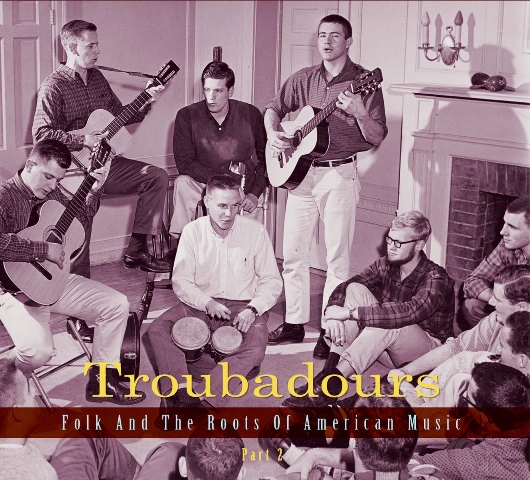 Overall, 288 tracks are heard. The total playing time is 15-and-a-quarter hours. The earliest performance is The Carter Family’s “Wildwood Flower”, recorded in 1928, and the – in general – cut-off point is 1974, the year of Harry Chapin’s “Cat’s in the Cradle” and John Denver’s “Back Home Again”.
In tracing the path from the Twenties to the Seventies, the content is broken down under a series of headings – musical chapters effectively. Part 1 begins with The Influences (Goebel Reeves, The Carter Family, Lead Belly) and moves on to The Pioneers (Carl Sandberg, The Dixon Brothers, Earl Robinson) and The Lomax Folksingers (those brought to attention by or influenced by archivist Alan Lomax: Josh White, Burl Ives). The final Part 1 disc ends with The Folk Singers from the Fifties (The Gateway Singers, The Easy Riders, Vince Martin's Tarriers). Ths is a continuum where Bob Dylan was amongst the influenced, rather than the signifier he became codified as.
 Breaking this mammoth set into discrete sections is both logical and brave. Logical as there were identifiable waves and geography specific scenes. Brave as it’s always possible to quibble. Tim Buckley, for example, is included along with Rod McKuen, Richard & Mimi Farina and Gene Clark in the West Coast grouping. Buckley first made a mark in New York, but the bulk of his recordings were made in Los Angeles.
Dylan appears on CD5 (the discs are numbered sequentially as if this were a single box set), the second disc of Part 2. Grouped with The Standard Bearers, his epochal sextet of songs (“Blowing in the Wind” and "Tambourine Man" included) precede six by Phil Ochs. The pair were sparring partners and fed off each other – the photo of a smiling, cat-got-the-cream Ochs sitting by a gravestone bearing the name Zimmerman in the booklet is both ironic and extremely funny.
 The names keep coming: Woody Guthrie, Pete Seeger, Merle Travis, Cisco Houston, Jean Ritchie, The Kingston Trio, The Limeliters, Dave Van Ronk, Judy Collins, Fred Neil, Joan Baez, Buffy St. Marie, Jack Elliot, The Lovin’ Spoonful, Melanie, The Byrds, Harry Nilsson, Kris Kristofferson, John Prine, Gordon Lightfoot. It seems, and almost is, endless. Curiously, Simon and Garfunkel are not included. Their “Homeward Bound”, despite being written by Simon in the UK, is arguably part of this canon. But their absence hardly makes this less definitive.
Endlessly dissecting and discussing Troubadours - Folk and the Roots of American Music is possible. But that would take almost the time required to listen to the set. It’s enough to know that as an overview of the development of a strain of music integral to American culture, this ground-breaking release is as important as Harry Smith’s 1952 Anthology of American Folk Music.
Overleaf: watch the trailer for Troubadours - Folk and the Roots of American Music
Watch the trailer for Troubadours - Folk and the Roots of American Music