The fact that what’s now known as The Paper Factory – a disused paper and cardboard manufacturing plant on the west of Edinburgh – is soon to be demolished (for flats, obviously) gave this year’s Hidden Door festival an even more spooky, ethereal feel than previously. Whilst last year’s event – the first in that venue – felt weird and exploratory, this year the death of the space was very much to the fore, with the Hidden Door team giving it a blazing requiem to see it out in style.
Again, the physicality as well as the history of the venue inspired much of the programming. One of the most eye grabbing visual art installations was a little garden built into the factory floor, with flooring stripped away to create small flower bed, and trailing plants hanging from above in disco-ball planters. Artist Emma MacLeod’s Rituals of Moss continued the nature theme, with a disconcerting diorama of figurines emerging from tiny moss-made sculptures. It’s a playful take on both figures from folklore but also an exploration of what happens to both human matter and the stories of our lives once we pass away and return to the land.
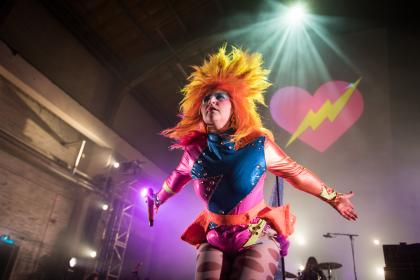
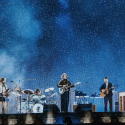
Music-wise, US Indie pop star Caroline Kingsbury played her first ever UK show on Hidden Door’s main stage, in the Long Room, on Thursday night, with her synth-heavy, 80s-inspired uplifting blend of heartfelt yet fun pop being one of the festival’s highlights. With a style that seems to land somewhere between David Bowie and Cyndi Lauper and melodies that feel at once nostalgic yet cutting edge this is an artist to seriously look out for. Closer to home, in collaboration with Creative Edinburgh and Edinburgh’s National Centre for Music, 12 UK based artists selected from an open call performed, including the eclectic, slightly whimsical Buffet Lunch, the dreamy, electronics driven Post Coal Prom Queen and Glasgow based multi-instrumental trio Taupe. DJ Fred Deakin – one of the two men behind Lemon Jelly – brought a proper club vibe to the Long Room on Saturday, while French singer-songwriter Lauren Auder gave a more mellow mood to the final night on Sunday.
The venue’s vastness is both a blessing and a curse. On the downside, even when busy it never feels truly full; and that goes for audience as well as art. However, the austerity of the main floor-space means the encountering of little treasures in nooks and crannies and stumbling across performance art when you’re not looking for it is all the more delightful. The spoken word “bit” – for I don’t think I could call it a stage – was one such delight. A semi-circle of mismatched old chairs and sofas, and well-worn coffee tables provided a quiet space for a seat and a chat, before an intimate poetry reading that felt more like a friend divulging a secret in a cosy kitchen at a house party than a performance in a disused factory.

Perhaps the most poignant piece though was “The Machine Stops”, and interdisciplinary collaboration which fuses recorded narrative of former factory workers, the words from safety signs found throughout the site, dance from the animal like "ghost" figures who’d previously been roaming the entire space and some seriously well synchronised percussion – all physically in and on one of the last machines used in this now former place of work.
As the speaker says at the end of this performance piece, "the machine has stopped". Indeed, it has. The machines are silent, the doors are closed, the work here is over. But what a way to mark the end.