Two years ago, Dylan played his best concert in years here at the Royal Albert Hall, the dim stage circled by vintage movie studio lights, and circling Dylan a band seasoned enough to bottle its own oil, delivering a new kind of quiet, late-night music. The broad unpredictability may have had gone, but so had those too-common troughs in quality and penchant for urban barns in Wembley. Could this new quality – forget the width – be sustained?
After the release this year of Shadows in the Night, recorded at the same Capitol studio Sinatra used, with the same band that joins him tonight, a couple of those songs made their way into set lists for a largely open-air 2015 Summer European tour of piazzas and festivals. Dylan must like European venues, because he’s back for the autumn, and evenings beset with songs from Shadows in the Night – a shifting hand of seven from a regular 20-song set; there's also five songs from his powerful 2012 album, Tempest. That there are just two songs from the Sixties – “She Belongs to Me” and “Blowin in the Wind” – shows you the distance present-day Dylan is from the decolletage of the Sixties legend (about to be celebrated in a concertina of CDs for the new Bootleg Series 12, The Cutting Edge).
You notice the odd way he walks, as if solid ground was something he was unused to
This opening night, the first of five at the Royal Albert Hall, has a different kind of edge, but it cuts deep. In many ways, his show is not geared towards the first-timer, though it accommodates them, by the renewed sense of order rather than breakdown in Dylan’s voice, and the seasoned assurance of his band, pretty well all of whom have served life terms (bassist Tony Garnier since the late Eighties), dressed like convicts, huddled like a gang and playing tight as two coats of paint on one piece of soundboard.
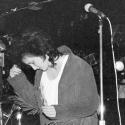
As for Dylan, it looks like he's wearing those pimpish brogues he sported on Love and Theft. Maybe they have powers, because he paces, struts, almost dances, looking focused and animated under that wide-brimmed hat, revelling in his own renewed powers of intonation, that subtle phrasing with ragged sides. You notice the odd way he walks, as if solid ground was something he was unused to.
From the great Nineties opener, “Things Have Changed”, through to the closing “Autumn Leaves”, the evening feels like a single cohesive body of work that won’t keep still or be tied down. The scattering of Sinatra-era torch songs and laments, undressed to their folk-blues core, are in a totally different spectrum to Dylan’s – even deliberately antique late-period pieces like “Spirit on the Water” – and they act like punctuating bands of colour and contrast, of hope and regret, scattered through Dylan's own songbook driven more by destiny and fate than sentiment.
Moments that stand out? A perfect “Tangled Up in Blue”, adhering to the familiar album version and with just one or two of those ongoing verse changes Dylan has made over the decades – I think the song’s palette is always wet paint for Dylan to play with. He brings a powerful new sense of light and shade to Tempest songs like "Pay In Blood", "Early Roman Kings" and "Scarlet Town".
Dylan himself performs superbly – compact and intense, no pretence, no drifting, no errata. You feel this is it, we have found the point where the tight connection between audience and artist finds its balance. As each of the Sinatra-era songs began, there was a blush of applause across the Hall, a kind of audience-artist recognition. His own songs entered the room silently, and exited like old champions; two songs from the end, “Long and Wasted Years” (with some new lines) got a standing ovation. What was good in 2013 seems to have just got better. He’s in his better voice than ever, the band is unsurpassed, and I love how those big Film Noir movie-set lights circling the musicians dim to near-darkness between songs.
Someday (maybe not tomorrow, but soon...) people are going to talk about these shows the way they talk about 1966, or Rolling Thunder. It’s like watching Picasso paint in Clouzot's film from the Sixties, under hot lights, on glass plates. Through the songs, many different figures and landscapes appear, and disappear. This is great work and it's more than worth your time to be its witness. Still rolling, Bob.