

To hear The English Concert playing Handel is to arrive in technicolour Oz after a lifetime of black and white baroque in Kansas. We’re not short on period bands in the UK, but few bring this music into anything like the kind of focus that Harry Bicket and his crack team of musicians achieve, nor demonstrate such love and joy in the process.
opera reviews
Graham Rickson

I’ve seen the future, and it’s semi-staged. The gains here are far more significant than the losses. And where Opera North’s minimalist Leeds Town Hall Ring let Peter Mumford’s video projections fill in the gaps, this new production of Turandot is costumed, lit and directed, lacking only a backdrop. The chorus are squeezed stage right, tightly crammed into the choir seats. The cast gamely do their thing in the narrow space betwixt strings and stage.
For such a macabre, dark work, there’s an awful lot of grinning going on – notably from Opera North’s on-form orchestra, gleefully let off the leash in this most startlingly modern of Puccini operas. Tintinnabulists will swoon at the sight of 13 tuned gongs, and how often do we get to actually see a real cimbasso perched next to the trombones? Conductor Sir Richard Armstrong revels in the opera’s brassier excesses. It’s excessively, joyously loud in places, but I didn’t see anyone complaining.
Listen blind, and it’s hard to believe that this score was written in 1924. Puccini’s stark, declamatory choral writing and outré harmonies sound as fresh as paint, and, until the problematic close, there’s not a wasted note. I’ve rarely heard anything as musically exciting as this production’s first few minutes: a series of savage chords depicting the falling of an executioner’s axe followed by the Mandarin’s angular declamation, sternly dispatched by a nattily-dressed Dean Robinson. All terrific, and then the chorus enter, their combined force powerful enough to dislodge a toupée in the rear stalls.
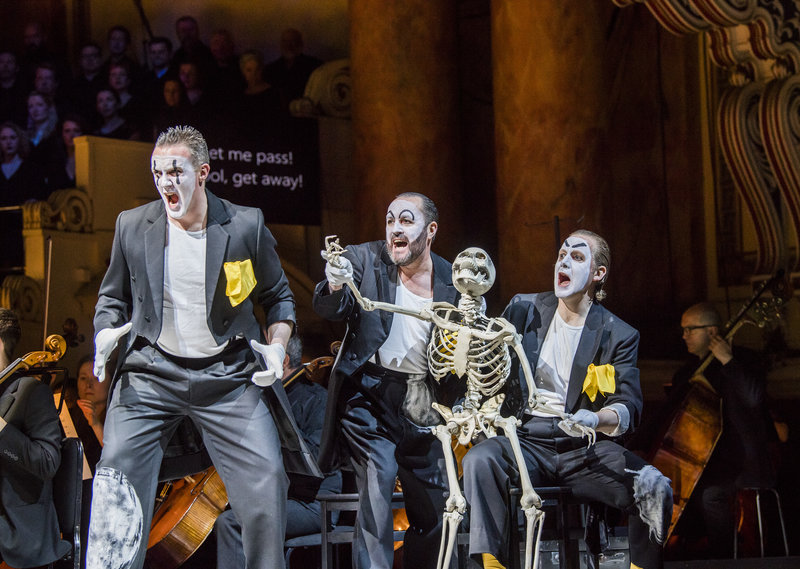
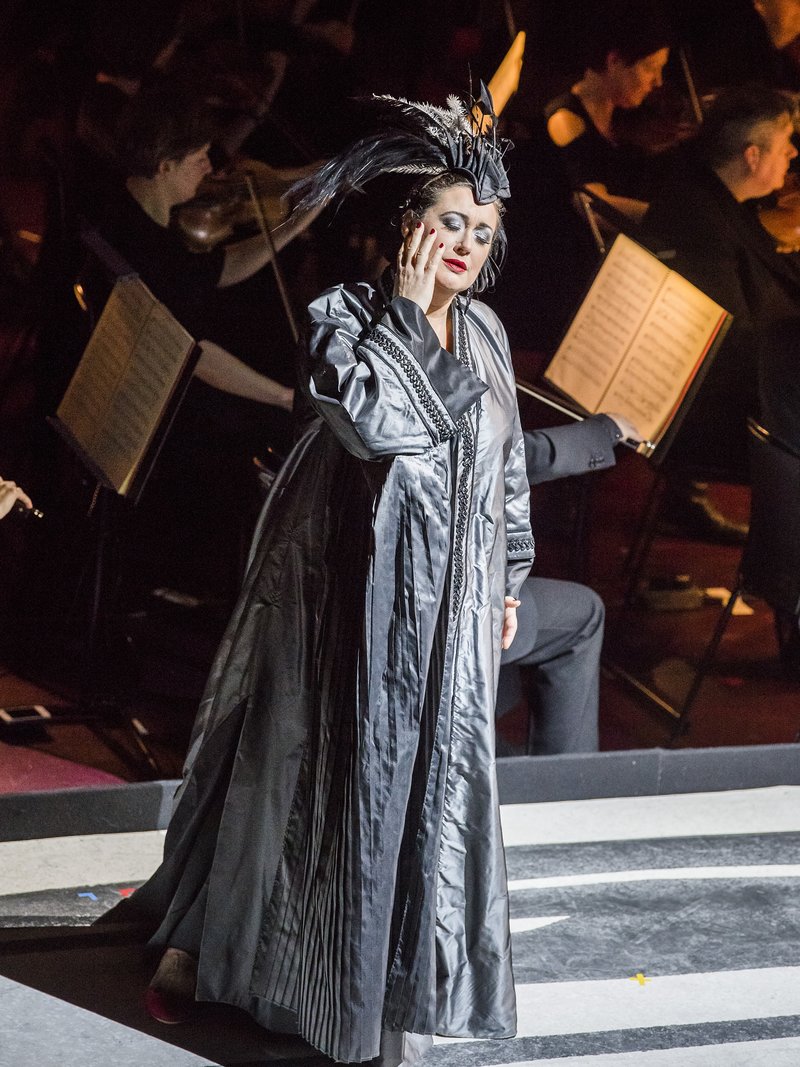 Annabel Arden’s staging revels in the physical constraints, the plotting and characterisation much clearer as a result. Alastair Miles’s Timur is a shabby, cowed wretch, his blindness implied with a mere smidgeon of face paint. Sunyoung Seo’s downcast, plainly dressed Liù stands out among the supporting cast, able to reduce her voice to a whisper while losing none of its colour. Rafael Rojas as Calaf is an impetuous, headstrong joy, his high register unchallenged by Puccini's louder tuttis. Set and costume designer Joanna Parker’s sole prop is a giant wobbly throne which begins to teeter precariously. Underneath which we catch a fleeting glimpse of Orla Boylan’s Turandot (pictured right) early on, a terrifying sight in metallic grey and black feathers. Her voice is suitably commanding and steely, only gradually revealing its warmth in the last act. And dressing Gavan Ring, Joseph Shovelton and Nicholas Watts’s Ping, Pang and Pong (below, left) as white faced circus clowns reminds us of their commedia dell'arte roots, the trio making brilliant use of suitcases, surgical instruments and a human skeleton.
 Bonaventura Bottone’s Altoun exudes scary authority. Armstrong and Arden ratchet up the tension as the evening progresses, and it’s difficult to suppress a cheer as Calaf solves Turandot’s three riddles. Rojas’s sweet-toned Nessun dorma is utter perfection, aided by immaculate chorus work, and what a surprise it is to hear this iconic aria in context: Puccini‘s refusal to linger a real slap in the face. It’s the final scene which doesn’t quite work. Turandot and Calaf’s love duet, completed after Puccini’s death by Franco Alfano, feels like too easy a resolution and can’t help sounding a bit, er, 19th century after what’s gone before. Adventurous listeners should seek out Berio’s much more radical 2001 attempt. Until that completion enters the repertoire, Opera North’s production will do, in spades. You can’t imagine Turandot being performed with greater gusto.
- On tour to Liverpool and Gateshead
- Read more Opera reviews on theartsdesk
- Overleaf - watch Opera North's flashmob Nessun Dorma
stephen.walsh

David Nice

Bomb-dropping is the new black again in Trump's dysfunctional America. Awareness of that contributed to the crackling cloud of dynamic dread hanging over last night's concert staging of John Adams's opera-oratorio - my description, not his - about the July 1945 desert testing of the plutonium bomb under the supervision of self-divided Robert Oppenheimer, an American Faust.
Peter Quantrill

"But is any of this normal?," asks poor Beatriz at the end of Act One. Of course not. She and 14 other grand creatures are crossing the space of an aristocratic drawing-room from which, they are coming to realise, there is no escape. At the same time, it’s completely normal. This is opera.
stephen.walsh

“Never give one concert if you can give a hundred” might stand as a motto for the conductor who once hauled his choir and orchestra round the world performing all 200 or so of Bach’s cantatas. And mathematically Sir John Eliot Gardiner’s latest project is a nearly exact honouring of that idea.
Richard Bratby

How well do you know your bad Victorian poetry? “When through the purple corridors the screaming scarlet Ibis flew/In terror, and a horrid dew dripped from the moaning Mandragores.” Go on, guess the author. Or how about this? “What time the poet hath hymned/The writhing maid, lithe-limbed,/Quivering on amaranthine asphodel". Got it yet? The first is Oscar Wilde’s The Sphinx, from 1881. The second, WS Gilbert’s libretto for Patience – written in the same year, and skewering Wilde with gleeful relish and lethal precision.
David Kettle

What to pair with Bluebeard’s Castle? It’s always a dilemma for opera companies. Something lightweight, even comic, provides contrast but also risks trivialising Bartók’s dark, symbolist drama. Something equally brooding risks submerging the audience into an evening of endless gloom.
David Nice

"È un'immensa pietà" - "it's heartbreaking," rather than "it's a huge pity" - sings consul Sharpless of "Butterfly" Cio-Cio San's fatal belief that her American husband will return to her.
David Nice

A wife dies to save her husband; a hero goes to hell and back to retrieve her from the underworld. Nothing of this dark myth, other than a rollicking row across the Styx from a bass singing Charon, ferryman of the dead, remains in Handel's incidental music to Alceste, a play on the subject by Tobias Smollett (of Roderick Random fame) which never reached a putatively extravagant Covent Garden staging and which has vanished from sight.