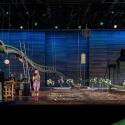
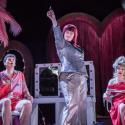
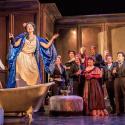
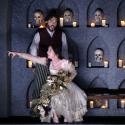
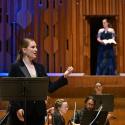
Most singers give recitals, and very nice they are too. But there are some – Bartoli, Florez, Netrebko, Terfel – who really put on a show. Mezzo Joyce DiDonato might just be the queen of this select band, and between the projections, smoke, sound effects, costume changes, lighting design and a solo dancer, her latest project throws down the gauntlet to any singer who thinks it’s enough just to learn the music and turn up in a clean frock.
In War and Peace is a classical concept-album. Faced with a world of ever-escalating conflict and chaos, DiDonato turns to music, both to explain man’s darkest and most violent urges and to offer them consolation and resolution. Can music create peace? That’s the question asked here in a programme of two contrasting halves.
You don’t come to a DiDonato recital for understatement, and at times the many elements become overwhelming
The answer remains uncertain, but if anyone can make it so by sheer force of will it would be DiDonato. You can’t fault her for effort. This is a singer who has crafted every aspect of this performance, from repertoire (largely Handel and Purcell, but also featuring rarities by Leo and Jommelli as well as a wonderfully anachronistic bit of Arvo Pärt) to the choreography and visual narrative of the performance. It’s a lot; you don’t come to a DiDonato recital for understatement, and at times the many elements competing for attention become overwhelming. But at best it’s an entirely new way of thinking about the concert format – a classical concert for the stadium generation.
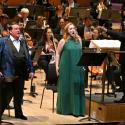
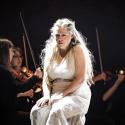
If DiDonato were a lesser performer none of this would work, but even among so much distraction it’s the mezzo who holds our attention. “Scenes of horror, scenes of woe” from Jephtha makes an arresting opening, scuttling strings matched by the nervy progress of the voice, lurching between extremes of range and texture. It’s music made for a singing-actress like DiDonato (pictured below), and she revels in it, drawing baroque ensemble Il Pomo d’Oro and conductor Maxim Emelyanychev with her into this gorgeous, grotesque sound-world.
 The coloratura numbers – Leo’s “Prendi quel ferro, o barbaro!”, Jommelli’s “Par che di giubilo”, Handel’s “Da tempeste” – surge and foam with minutely controlled passion. This isn’t spontaneous singing, but there’s a delight in hearing such careful vocal choreography, such meticulous shading and pacing. Just occasionally the voice betrays its master, blurting with too-vigorous vibrato or wavering when reduced to whitest purity – the product of too much crafting, too much control where others might release?
But it’s the slower arias that offer the greatest challenge here. The stillnesses, the absences in both Dido’s Lament and Handel’s “Lascia ch’io pianga” are far more demanding than any amount of semiquaver runs, and DiDonato’s solution is bold. She keeps ornamentation to an absolute minimum and lets the music do the talking, allowing her voice to be a vessel rather than the focal point. With sensitive collaborators like Il Pomo d’Oro, virtuosi in their own right, it works brilliantly, and offers the necessary counterbalance to so much extrovert showmanship and excess.
This is a curious concert, a concept not everyone could pull off. Oddities, like string arrangements of Gesualdo’s “Tristis est anima mea” and Pärt’s “Da pacem, Domine” work surprisingly well, creating a flow of musical narrative that’s miles away from stand-and-deliver recitals with their regular punctuating applause. DiDonato forces her audience to swap musical bonbons for something emotionally and musically meatier – arcs of musical storytelling that draw these works together into something larger. Is it enough to change the world? Very probably not. But if it changes how we think about concert programming, then that’s no small achievement either.
- Joyce DiDonato's In War and Peace tour continues internationally until July 2017
- Read more opera reviews on theartsdesk