

New writing takes many forms: this is one of the glories of contemporary British performance. One of these is the shared narrative, a style pioneered decades ago by Irish playwrights such as Brian Friel and Conor McPherson, which involves several straight-to-the-audience narrators telling a story directly. Unlike the naturalism of mainstream theatre, this method allows for a rapid delivery of events and feelings.
In Maggots, an exceptionally humane 65-minute piece by Farah Najib, who won the Tony Craze Award for her Dirty Dogs, the shared narrative also achieves a profound emotional depth. First seen a couple of years ago at the Lion and Unicorn Theatre, this recast version now settles into the Bush Theatre’s aptly claustrophobic studio space.
Provoked by true story of Sheila Seleoane, whose dead body remained undiscovered for more than two years, the play is about a group of housing association tenants living in Laurel House, “on a quiet street off a busy road in an unremarkable corner of London”. Their diversity reflects today’s capital city: 58-year-old widow Linda, who works as a cleaner and whose daughter Josie lives in Australia; 23-year-old Carly, a single mother with a new baby, Noah; 41-year-old Rebecca, a care home nurse with a 15-year-old son, Jaydn, and finally 49-year-old Adeel, a widowed Muslim pharmacy assistant with a bright teenage daughter Aleena, the object of Jaydn’s fantasies. Typically, these neighbours know nothing about each other – until a horrible smell pervades their housing block.
From the start, Linda’s suspicion that the tenant of flat number 61 has died is highly likely, especially when maggots start appearing all over the building. The tenants, whose WhatsApp group has been largely redundant, begin to make contact with each other, although the representative of the housing association, Darren, fails to respond to their concerns. Frustrated, the people who live in the block try to enter the flat, but no one wants to actually smash down the door. So the misery continues. Dozens of calls to the housing association go unanswered. Eventually, after about a year, the police finally arrive and break down the door of flat 61, revealing what we already know: the tenant there has died and been forgotten. Although an inquiry is set up, and the housing bureaucrats are embarrassed, nothing really changes. Except for the tenants.
This is a story about urban alienation, about people who live in proximity but who never talk to each other, merely making a quick nod when they meet in lifts or entrances. It’s recognizably London; it’s recognizably us. But the slowly intensifying emergency gradually forces them to meet and connect, however awkwardly, and they all discover inner resources, however small. The keynote is loneliness, with the two characters who have lost their loved ones a strong symbol of contemporary malaise, of a highly individualistic society which atomizes its denizens. At the same time, this block is working class and poverty accentuates loneliness, forcing the women to spend hours working. As a single mother, Carly likewise has her hands full.
Najib not only articulates the idea of loneliness, especially female loneliness, as a contemporary epidemic, an experience which results in individuals becoming increasingly inward and also ashamed of this condition, but is also careful to show how bad stuff can provoke personal resilience and a sense of community, however temporary. The image of proliferating maggots is visceral and gross, a metaphor for the bad housing conditions of the urban poor, neglected by the authorities. Yet Najib’s point is that loneliness is not just a disease of the under-privileged – her text directly addresses us an audience: this story, she says, “probably didn’t happen to you”, but “the important part is that it could.”
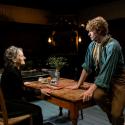
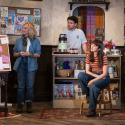
The shared narrative of Maggots is divided among three actors, storytellers rather than characters, who between them narrate this fiction that is, of course, based on the shocking fact that an estimated 8,000 to 9,000 people in the UK are found in an advanced state of decomposition each year (so-called “lonely deaths”), many of whom have been dead for weeks or months. In Jess Barton’s quietly intense production, designed by Caitlin Mawhinney on a bare stage with mismatched sofa and chairs underneath a canopy of dried flowers, Safiyya Ingar, Marcia Lecky and Sam Baker Jones bring their own individual characters to this fractured, but often choral, storytelling. With a nice twist at the end, which beautifully upends our easy love of optimism, this is a great piece of new writing.
Ingar, Lecky and Baker Jones perform beautifully, avoiding exaggeration or too much overt theatricality, taking time, supporting each other and interacting with the audience. The resulting meditation is not only on loneliness, but also on death and mortality, and it’s profoundly moving, with its calm seriousness finding room also for jokes about parenting and the small eccentric details of daily life: from Linda’s pig-shaped biscuit jar to Adeel’s love of EastEnders. Weed is smoked, chocolate digestives scoffed and awkward silences endured. The emphasis is on the need for community – it takes a village to bring up a child, and likewise to cope with end-of-life care. You leave the theatre elated by the power of the storytelling, and chastened by the grim fact that each of us is just as busy as these characters: if someone next door died on us, would we ever notice?










Add comment