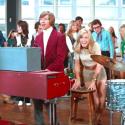
Richard Attenborough made himself known to the British public as a shark-eyed, snivelling psychopath. Pinkie, the teen gangster he portrayed in the Boulting Brothers’ 1947 film of Graham Greene’s Brighton Rock, chilled with his lack of empathy, even to the angelic girlfriend he means to betray in the most vicious way (watch a clip below). He is a predator of Brighton’s seedy, damp backstreets, a manipulator and coward. As the world came to know over the next 65 years, these qualities were the opposite of the man playing him.
Attenborough played a broad range of characters in the Fifties and Sixties. He touched on postwar Britain’s grubby moral compromises when captaining old naval comrades who, scraping for work, smuggle contraband and killers in The Ship That Died of Shame (1955), and as the sly factory boss in the Boulting Brothers’ cutting class satire I’m Alright, Jack (1959).
He was a memorable psychopath again at the other end of his film star life, as serial killer John Christie in 1970's 10 Rillington Place (watch a clip below). His unlikely pairing with John Wayne in Brannigan (1975), as a Scotland Yard detective who relishes a Western-style Soho pub brawl alongside the Duke’s tough Yank cop, is a fond, lighter late memory. A second Graham Greene adaptation, stirring espionage’s moral swamp in The Human Factor (1979), was his farewell to the acting life. When Spielberg lured him back for Jurassic Park (1993), it was as a version of the cuddly, sentimental Attenborough familiar from a hundred awards shows, as his second career as director replaced his sharp and unpredictable acting work in the public memory.
Attenborough the director was often dismissed as a junior, lightweight David Lean. However, the thread running through his greatest successes – Oh! What a Lovely War (1969), Gandhi (1983) and Cry Freedom (1987) above all – was a wish to popularise morally and socially exemplary heroes, and castigate lives’ brutal waste by the powerful and cruel. His unmade dream film, a biopic of 18th-century English revolutionary trouble-stirrer Tom Paine, showed the better world he wanted. His other historical epics, Young Winston (1972) and especially A Bridge Too Far (1977; watch a clip below), the all-star recreation of World War Two’s Arnhem disaster, lack Lean’s poetic vision, but are wholly gripping on Attenborough’s own terms, which were partly a patriot’s (he had insisted on flying as a cameraman filming bombing raids over Occupied Europe).
A possible attempt to answer critics with the more intimate chamber-musical A Chorus Line (1985) failed. But the real nastiness of Burgess Meredith’s murder in the ventriloquist horror pot-boiler Magic (1978) was part of a better, smaller film. Its star Anthony Hopkins returned for Attenborough’s last success, Shadowlands (1993). This historical biopic, of CS Lewis, is a study of cracking English repression which tears at personal emotional nerves (watch a clip below). Attenborough the director finally matches Attenborough the actor’s sympathetic subtlety here.
Those two careers only scrape the surface of a life of Dickens-like tirelessness, till a 2008 stroke felled him. The sense of social service in his directorial work also revealed itself in his simultaneous presence between 1986 and 1992 – when his steering of Hollywood epics was at its exhausting peak – as Chairman of Channel 4, RADA, the BFI and ill-fated production company Goldcrest, and Vice-President (later President) of BAFTA. Michael Grade noted this morning that his old Channel 4 boss’s intervention personally saved RADA and BAFTA from bankruptcy, and inspired Channel 4’s funding of films, fundamental to British cinema’s survival since the Eighties. Attenborough the weeping, award-clutching “luvvie”, so often sneered at, applied that sensitivity to a wealth of work.