It’s been a very good year for Beatlemania, with all the albums re-repackaged and the group going virtual in Rock Band. The BBC lobbed in their own Beatles season-ette, and one of the more striking images from their riot of documentary footage was of John Lennon escorting his Aunt Mimi up the steps onto the plane taking them to America, with her handbag and Sunday-best hat.
That surely settles any debate about his real feelings for Mimi. She is depicted in Sam Taylor-Wood's absorbing film about Lennon’s teenage years as a stern exemplar of moral discipline, but driven by honourable motives and very far from heartless.
Anybody expecting a movie about the Beatles may come out feeling slightly short-changed. Though the first sound you hear is a dischord reminiscent of the one that kicks off "A Hard Day’s Night", the group’s sacred name isn’t even mentioned, and the narrative ends just when they’re about to go to Hamburg and whip themselves into shape as a rough and raucous rock’n’roll band. But the sense of an explosive social upheaval thundering in from the west to blast the formaldehyde world of 1950s Britain to smithereens is excitingly evoked, and the story of Lennon’s disjointed upbringing offers meaningful clues about the driven, conflicted artist he became.
 The story is as much about Mimi (played with touch-sensitive precision by Kristin Scott Thomas) and John’s errant mother Julia (Anne-Marie Duff, both pictured right) as it is about Lennon himself, and the three central performances create an emotional force-field that thrums powerfully throughout the story. As John, Aaron Johnson maps his character’s progression from teenage confusion to the cocky, acerbic Lennon of popular renown with precocious skill, even seeming to look more like him as the story unfolds.
Lennon’s early years were like a test case at a psychologists’ convention. He was the only child of the marriage between Alfred Lennon and his unstable mother (“she liked company, if you know what I mean,” as her sister Mimi acidly puts it), and Mimi took John in when seafaring Alf relocated to New Zealand and Julia couldn’t cope.
John’s close relationship with Mimi’s husband George is warmly evoked in a few scant screen minutes by David Threlfall, but George’s death knocks him sideways. He feels excluded by Mimi’s stoical, buttoned-up response, so it’s a godsend when his cousin takes him to visit Julia, who, to his amazement, lives just a walk across the park away.
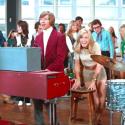
At first Julia seems like every boy’s dream mother. Funny, flirtatious and mad about Elvis Presley, she takes the disbelieving John to Blackpool and dances to rock’n’roll music on the jukebox. Back home, she teaches him the banjo. For a time, John can overlook his resentment at how she abandoned him.
But it becomes clear that Julia’s irrational exuberance – and her almost-sexual view of John - is a symptom of emotional problems, and her common-law husband Bobby (David Morrissey) insists John can’t stay and must return to Mimi. The fluctuating tensions between the sisters provoke John’s delinquent tendencies, but also motivate him to form a skiffle band, The Quarrymen.
When he meets Paul McCartney (a baby-faced Thomas Brodie Sangster), Paul’s manifestly superior skills and focused ambitions set John new hurdles, while the revelation that Paul’s mother died of cancer stimulates their tight emotional bond. It also triggers one of the best and nastiest lines in Matt Greenhalgh’s screenplay, when Julia mentions Paul’s mother. “She ‘ad cancer, what’s your excuse?” Lennon lashes back.
With Taylor-Wood at the helm, a few conceptual aerobatics might have been expected , but Nowhere Boy is almost an object lesson in conventional dramatic structure. The occasional hint of Freud-by-numbers aside, script and characters ring true, and the story is hardly in need of fictional embellishment. If you wondered if there could be any nuggets of Beatledom left unmined, here’s your answer.