The Peruvian Claudia Llosa's debut, Madeinusa, took place in a remote Andean village, whose religiously fervent inhabitants had an unusual spin on the festivities: during their tiempo santo, God was deemed dead, and all could sin with impunity before Easter Sunday. Unhappily, one girl's loathsome father intended to use this "free pass" to take her virginity. A village girl tormented by superstition is also at the heart of Llosa's sophomore film, The Milk of Sorrow, but this time she's struggling in the capital, Lima. Thus the writer-director broadens her gaze, while demonstrating that her impressive first film was no flash in the pan.
The result won the Golden Bear in Berlin in 2009, and an Oscar nomination. In a year when Katherine Bigelow was lauded as the first female Oscar-winner, Llosa's achievements are no less notable, not least considering the size of the industry she's come from.
The film stars Llosa's discovery from Madeinusa, the sphinx-like Magaly Solier, as Fausta, whose mother bore her after being raped during Peru's terrorist years and who – so the villagers believe – "transmitted her fear" through her breast milk to her child.
It opens with the old woman singing a plangent song about her terrible experiences, before promptly dying – leaving the shy, frightened Fausta in the care of her uncle's family in the Lima suburbs, isolated by her beliefs. Fausta's state of mind is a mess. "If you don't walk close to the wall," she advises a new acquaintance, "you will get caught by spirits." She's petrified of life, but men in particular, so much so that she has a potato embedded in her vagina, as a deterrent to rapists. Needless to say, the tuber is seriously affecting her health.
Fausta is determined to return her mother to their village to be buried. Unable to afford a coffin or transport, she puts her fears aside to take a job in the heart of the city as a maid in a large house. She may have family members to guide her through the streets, but once inside the iron gates the country girl is at the mercy of its owner – not a man, as it happens, but a woman.
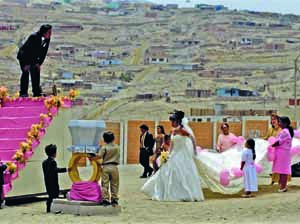 The film follows Fausta in her two worlds: with her uncle's impoverished, but defiantly optimistic family, living in a periphery that resembles a massive, abandoned building site, where they provide the catering and entertainment for cheesy, working-class weddings; and within the massive house and gardens, where her fearsome employer Aida (Susi Sanchez), a pianist in need of a new composition, pays the reluctant maid to sing her laments (and Solier really does sing beautifully). Straddling these two worlds is Aida's gardener, a watchful, sensitive man who starts to win Fausta's trust.
Despite its unusual conceit, it would be a mistake to imagine something of the old Latin penchant for magical realism in Llosa's tale. The director presents a palpable sense of such people as Fausta existing today. And so grounded is the story in the real, and indeed the mundane, that the result is a potent snapshot of a city, with its class distinctions governed by race (European and indigenous), prosperity and extreme poverty side by side, centuries-old rural superstitions meeting secular self-interest.
There is, in particular, a striking contrast between the financial struggles of the uncle, who has a wedding to pay for (and is justly concerned that the dead body in the house might dampen the matrimonial spirits) and Aida's bourgeois "troubles", which consist merely of a petulant temper and lost inspiration, and which manifest themselves in the callous exploitation of her servant.
Llosa's canny image-making serves the social, psychological and also comic aspirations of her story, sometimes all at once: the marvellous revelation of the mother's swathed body under her bed; Fausta's horror as she sees her uncle standing over a large hole in the ground, expecting it to be her mother's premature resting place, but discovering some children playing in an impromptu swimming pool; the absurd mountain of steps that she must traverse to and from work, suggesting not merely a trip into the city centre, but to another planet.
The film stars Llosa's discovery from Madeinusa, the sphinx-like Magaly Solier, as Fausta, whose mother bore her after being raped during Peru's terrorist years and who – so the villagers believe – "transmitted her fear" through her breast milk to her child.
It opens with the old woman singing a plangent song about her terrible experiences, before promptly dying – leaving the shy, frightened Fausta in the care of her uncle's family in the Lima suburbs, isolated by her beliefs. Fausta's state of mind is a mess. "If you don't walk close to the wall," she advises a new acquaintance, "you will get caught by spirits." She's petrified of life, but men in particular, so much so that she has a potato embedded in her vagina, as a deterrent to rapists. Needless to say, the tuber is seriously affecting her health.
Fausta is determined to return her mother to their village to be buried. Unable to afford a coffin or transport, she puts her fears aside to take a job in the heart of the city as a maid in a large house. She may have family members to guide her through the streets, but once inside the iron gates the country girl is at the mercy of its owner – not a man, as it happens, but a woman.
The film follows Fausta in her two worlds: with her uncle's impoverished, but defiantly optimistic family, living in a periphery that resembles a massive, abandoned building site, where they provide the catering and entertainment for cheesy, working-class weddings; and within the massive house and gardens, where her fearsome employer Aida (Susi Sanchez), a pianist in need of a new composition, pays the reluctant maid to sing her laments (and Solier really does sing beautifully). Straddling these two worlds is Aida's gardener, a watchful, sensitive man who starts to win Fausta's trust. Despite its unusual conceit, it would be a mistake to imagine something of the old Latin penchant for magical realism in Llosa's tale. The director presents a palpable sense of such people as Fausta existing today. And so grounded is the story in the real, and indeed the mundane, that the result is a potent snapshot of a city, with its class distinctions governed by race (European and indigenous), prosperity and extreme poverty side by side, centuries-old rural superstitions meeting secular self-interest.
There is, in particular, a striking contrast between the financial struggles of the uncle, who has a wedding to pay for (and is justly concerned that the dead body in the house might dampen the matrimonial spirits) and Aida's bourgeois "troubles", which consist merely of a petulant temper and lost inspiration, and which manifest themselves in the callous exploitation of her servant.
Llosa's canny image-making serves the social, psychological and also comic aspirations of her story, sometimes all at once: the marvellous revelation of the mother's swathed body under her bed; Fausta's horror as she sees her uncle standing over a large hole in the ground, expecting it to be her mother's premature resting place, but discovering some children playing in an impromptu swimming pool; the absurd mountain of steps that she must traverse to and from work, suggesting not merely a trip into the city centre, but to another planet.
- The Milk of Sorrow opens on Friday in the UK
- Find Madeinusa on Amazon
- Demetrios Matheou's The Faber Book of New South American Cinema is published later this year