

Perhaps if you are in a sufficiently patient state, this slowburn of a Swedish art house film will suit your mood, but if fast cutting and rapid crossfire dialogue is your thing, it may be best to steer clear of The Here After. The debut feature of writer-director Magnus van Horn has done well at overseas film festivals, but may be a harder sell as a night out in a UK cinema on a chilly March evening.
We first meet John (played by heart-throb pop star Ulrik Munther) as he’s packing up to leave the young offenders’ detention centre where he’s been for an undisclosed time, for an undisclosed reason. Munther has the face of an elf, all angled cheekbones, spiky nose and wide-set blue eyes that observe everything and give away nothing. His performance throughout the film is an exercise in low-key mannerisms, bare flickers of emotion, and much stoical enduring. His father hugs him warily, and drives John back home.
The setting is a rural Swedish community of kit-built houses and long roads buzzed by mopeds, tractors and the twice-daily school bus. This is a Nordic landscape familiar from Let the Right One In or The Hunt, rather than The Bridge’s hard-edged cityscape. It's a good 20 minutes before anything happens of a dramatic nature – up until then it’s minimal conversations and significant silences over family meals. For too long we don’t know what John’s done, and we never find out why home consists only of father, younger brother, and frail grandfather. Tension and resentment hum in these domestic scenes and a dour atmosphere is enhanced by naturalistic sound, but the narrative does take an inordinately long time to get going.
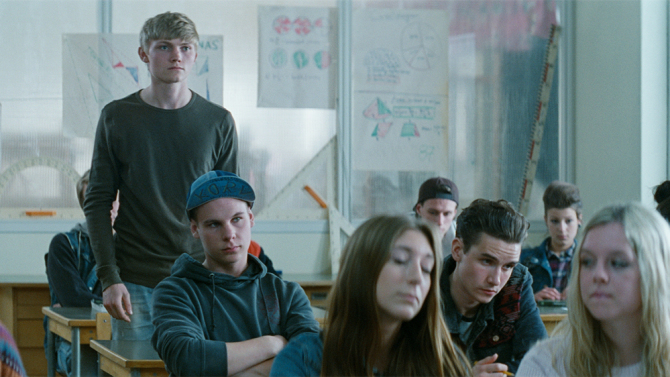 When John turns up at his old school the hostility to him is overt, with ineffectual teachers doing little to resolve his aggressive ostracism by his peers, an unattractive bunch of redneck teenagers. Over the course of the film, we slowly learn what led to John’s two years in jail, but never understand why he has returned to his home town, or why so little is done to reconcile his community to him. Apparently based on real case studies, the film’s longueurs unfortunately leave the viewer far too much time to puzzle at the naivety of all the adults involved. How could they ever believe that coming home so soon would work out for this tainted young man? Why was there no attempt to settle him in a new location?
Director Magnus van Horn is a graduate of the prestigious Polish film school in Łódź, and here he teams up with the brilliant cinematographer Łukasz Żal, who shot Pawel Pawlikowski’s Ida. Swapping that film’s monochrome 4:3 frame for pellucid, 35mm widescreen, Żal crafts atmospheric visions of flat agricultural landscapes. But unfortunately his director is so in love with Żal’s camerawork that he never calls cut. There are so many long, drawn-out single takes that it’s hard not to lose patience with the portentous, rainy visions through windscreens and down long driveways.
By the time the lynch mob arrives, it’s almost a relief to see some on-screen energy, even if it’s brutal. A more ruthless editor working alongside the director might well have honed The Here After into a terse and subtle psychological drama. Instead, the over-indulgent focus on Ulrik Munther’s face, which rarely changes expression even after some savage interactions, makes the film an uneasy fusion of art house expressionism and high school horror.









Add comment