

The title of French director Lucie Borleteau’s first feature conceals a range of meanings. Fidelio is both the name of the enormous maritime freight vessel on which most of the action takes places, and a clear hint at “fidelity”, a concept with which its independent heroine Alice (Ariane Labed) negotiates throughout. If its French original, Fidelio: l’odyssée d’Alice, also suggests something else, the “Odyssey” of Alice’s journey meaning a return to the starting-point of home, then our expectations are challenged.
The balance between home and away, with the different codes of behaviour attached to each environment, runs through the film. The opening scene establishes “home” – a close, sexually passionate, relationship between Alice and her partner Felix (Anders Danielsen Lie). From there Alice departs suddenly into the distinct onboard world of the freighter of the title, where the 30-year-old is to take over as engineer after the sudden death of another crew member.
There’s a disconcerting sense of endless surrounding ocean space
Her professional competence in this self-contained world is clear from the first: she’s sailed on the Fidelio before, and earlier repairs she’d made to its engines are even still in place. There’s another return to the past too, in the presence of the vessel’s current captain, Gaël (Melvil Poupaud, pictured below with Labed), with whom Alice has had a previous relationship. The immediate question is how she will negotiate these circumstances, both with him and in this all-male environment.
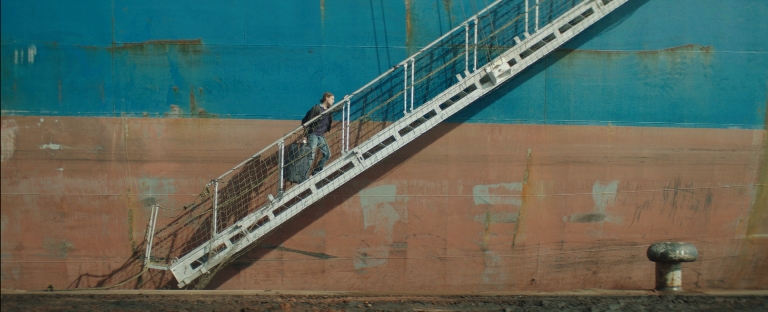
This life on the ocean certainly has a strangeness to it: the film was largely shot in real, on-board locations, and Simon Beaufils’ widescreen cinematography makes the most of these expanded dimensions, their shapes (pictured below) and associated natural colours and light throughout. There’s a disconcerting sense of almost endless surrounding ocean space, set against the relative claustrophobia of cabin interiors, and the independent life and noise of the engine rooms for which Alice is responsible: though they seem inert, the chance of unexpected accident is real. There’s a sense of suspension, in both time and place, broken by occasional almost symbolic rites: a burial at sea, a stop in an African port, the ritual of first-timers crossing the Equator, crew meals and special barbeques; on the film’s second voyage, for which Alice has been promoted to chief engineer, even Christmas. There’s little sense of schedule or destination; indeed it transpires on the latter trip that the vessel is “tramping”, heading for no fixed destination while awaiting instructions that will come from the trading markets that decide its cargoes.
Ariane Labed has real poise as Alice, compelling the camera’s attention. She’s probably best known to date from the Greek film Attenberg, and an element of that work’s alienation remains here: she’s independent, not least in her sexuality, and able to deal with this male-dominated world with absolute confidence, even to play it to her own volition. The crew, which itself rotates regularly, is an amorphous entity: its deck contingent is largely European (with variations reflecting the divisions of the continent itself), the galley and support staff Asian, bringing their own superstitions of bad luck into the wider equation.

 Alice is as forthright as any of them – “I’ve screwed on all five continents,” she chips in to a conversation quite naturally at one point – and her reengagement with Gaël might come as little surprise (Melvil Poupaud plays a much more conventional role here than his transgender uncertainties in Xavier Dolan’s Laurence Always). These rules of the ocean prohibit attachment – being “involved” on land for most actually allows for sexual freedom at sea by limiting obligations, rather than discouraging it – but Alice, particularly after a brief visit home and reunion with Felix, begins to challenge her previous assumptions. The consequences of her actions begin to come home to her, part of that journey mirrored in her reading the journal of her dead predecessor left behind in the cabin she is now occupying (something slightly mannered there).
Borleteau certainly leaves the conclusion of her film open, with a strange mood to its closing scenes, connected partly to the fact that the ailing Fidelio is to be consigned to scrap. Labed’s final half-smile is inscrutable, and Alice’s Journey has been acclaimed for allowing its heroine an unpredictable independence, and ability to resist type-casting, sexual or otherwise. (Borleteau has worked in the past with Claire Denis, another woman director who allows her heroines a degree of complexity that breaks accepted stereotypes: Denis’ last film Bastards also engaged in passing with the strange maritime world, with a similar sense of separation from home shores.)
It’s a style, however, that somewhat limits emotional involvement, almost as if we’re observing Borleteau’s characters in the same way that the director engages in an almost anthropological observation of on-ship rituals. There’s something cold here, almost metallic, like the ship’s physical environment, that’s impressive but less often engaging. We're not swept away by it, but caught up almost on a cerebral level, which was, I'm sure, Borleteau's intention: in that she challenges as much as her lead character.
Overleaf: watch the trailer for Fidelio: Alice’s Journey












Add comment