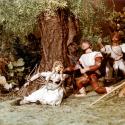
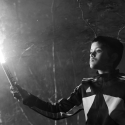
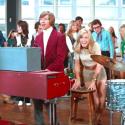
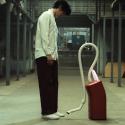
“With that film I became a filmmaker,” Wim Wenders remembers in one of the extras accompanying this new release of his 1974 Alice in the Cities. More importantly, it’s the one that convinced him that he wanted to be one. His third film after graduating from film school in Munich, it followed an adaptation of Nathaniel Hawthorne’s The Scarlet Letter which very nearly put him off cinema for good.
He recalls here how the only thing that he enjoyed directing in that one was a single half-hour scene between Rüdiger Vogler and Yella Rottländer, whose central pairing is at the heart of Alice (Vogler would become something of an alter ego for the director). After the earlier period film, Wenders vowed that from then on he would only make films that featured “a car, service station, television or jukebox”, and this road movie has all of them: we see the very end of Vogler’s character’s road trip across America, before he embarks on a different kind of exploration in the company of Rottländer’s eponymous eight-year-old heroine around Old Europe, and the anonymous landscapes of Germany. Wenders’ “Road Movie Trilogy” would develop spontaneously over the next two years with his follow-up films Wrong Move and Kings of the Road.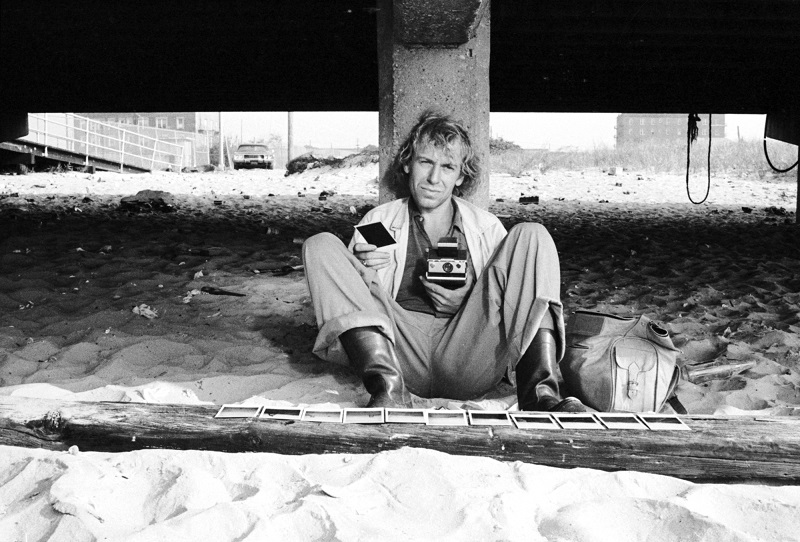 Even when set in contrast to today’s heightened concerns for child welfare, the premise of the film has a fairy-tale element in how Vogler’s hero Philip assumes improvisational custody of Alice when her mother, with whom he has only made the briefest acquaintance in New York, fails to appear at the airport to fly to Amsterdam. When she fails to rejoin them there as promised, an unlikely father-daughter relationship evolves as the two set out to find the girl’s grandmother, guided only by a photograph.
There’s nothing sentimental in their bond, rather an attractive element of tetchiness – Philip himself is drifting, and wants only to pass Alice on to someone who is expecting her – with a sublimely light feel to the film that’s highly influenced by its elements of improvisation. He’s still dazed by his experience of America, and Alice in the Cities is a meditation on that country’s glories as well as its nightmares, a theme which Wenders develops in a conversation with Mark Cousins that is an extra. It’s one that the director has somehow never left behind... (Pictured above: Rüdiger Vogler, "under the boardwalk")
There’s a fascinating short documentary, 'Restoring Time', on the 2014 digital restoration
Budget considerations had the director and his cinematographer Robby Müller shooting in 16mm black and white, which rather than proving a constraint created something wonderful in itself (the film was commissioned for German television, which demanded a 4:3 ratio, to which they adhered although the two framed it throughout to allow for the 16:9 format of its theatrical transfer). The score, from German indie group Can, appeared in characteristically improvisational circumstances.
This restored 4K digital transfer has a beguilingly luminous clarity, and there’s a fascinating short documentary attached, Restoring Time, on the 2014 digital restoration, in which, as we see, the director was very much involved. All in all, this is an exemplary rerelease package, complete with accompanying booklet and separate conversations with actors Rüdiger Vogler and Yella Rottländer. A final featurette about one of the key elements in Alice, “Instant Stories: Wim Wenders’ Polaroids”, was filmed late last year at London’s Photographers Gallery, where the exhibiton of the same name continues until early February.