The third of James Cameron’s world-building epics arrives 16 years after the first one, but only three after number two, Avatar: The Way of Water. Apparently proceedings were held up by Cameron and his army of technicians having to adjust to developments in technology, not least the gadgetry required for underwater performance capture.
Anyway here it is, and the results (in 3D) are fairly awesome, not least the running time of three and a quarter hours. We find ourselves back on the planet Pandora, a kind of supernatural paradise where human-like beings and an extraordinary array of intelligent animal life exist in a kind of holistic empathy and mutual understanding. It’s Eden before the Fall, but the merciless exploiters of the RDA (Resources Development Administration) have arrived from our cold, cruel Earth to kill every living thing and seize all the planet’s mineral wealth.
Despite the baffling array of characters, now including the Ash People (a psychotic mob led by the shrieking and monstrous Varang, played by an unrecognisable Oona Chaplin), the thrust of the story remains fairly simple. It’s rather like an interstellar version of a David Attenborough nature documentary crossed with Apocalypse Now and Star Wars, as the peaceable and spiritually-inclined Metyakina people (one of the clans of the Na’vi race) struggle to sustain their condition of natural harmony.
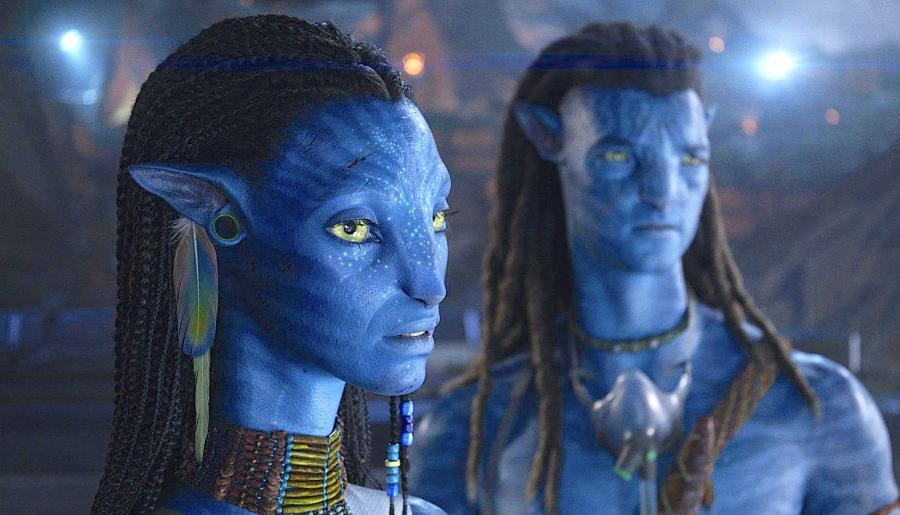
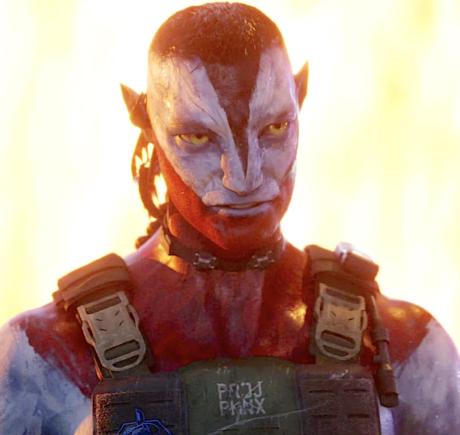
One of the drawbacks of having the cast made up with strange-coloured skin, funny-shaped noses, face paint and pointy ears is that’s quite difficult to spot the actor behind the camouflage. I suppose we have to take it on trust that it’s Zoe Saldaña playing Neytini, and Sam Worthington (both pictured above) as her husband Jake (who used to be an earthly Marine but had his mind transferred into his Na’avi avatar body). Top baddy is Colonel Quaritch (Stephen Lang, pictured below), who was an RDA commander killed during battle with the Na’vi but has now been resurrected as a “recombinant”. Yeah, we’ve all been there. Square-jawed, hard-assed Quaritch is like a pastiche of every brutal, gung-ho military fanatic in cinema history, and possibly a descendant of Dr Strangelove’s General Jack D. Ripper. And Cameron’s depiction of a simple agrarian lifestyle being annihilated by explosives and flame-throwers could well be a flashback to the Vietnam war.
But thanks to super-evolved film technology, it’s the animal life on Pandora that makes a larger impact than the one-dimensional and often interchangeable humanoids (or whatever they are). The film is bursting with extraordinary creatures, like the majestic Tulkun, the wise whale-like beings of whom Payakan is the one we get to know best, as he gazes out of the screen with a huge all-knowing eye. The natives whizz around Pandora on what look like high-performance pterodactyls with a chicken-like beak (and they’re smart enough to anticipate exactly what their riders want). Below the ocean surface we find stingray-like beings with super-long necks or cute little things that look like underwater kittens, while the people known as the Wind Traders are carried by vast inflatable membranes and pulled along by huge flying jellyfish with squid-like tendrils.
The animals are so persuasive that it’s genuinely painful to watching them suffer violent deaths and horrible injuries. Cameron has injected a powerful anti-whaling message for good measure, as the RDA killing machine seeks to corral all the Tulkun into a bay and massacre them. The depiction of the RDA’s monstrous armada of attack boats, factory ships and futuristic helicopters is unpleasantly intimidating.
You probably know by now if you want to buy in to Cameron’s Avatar universe, because it wears its heart plainly on its sleeve. It’s a staggering technical feat – or stream of technical feats – but this is not where you’d come looking for subtly nuanced dramatic performances or cunningly multi-layered narratives. The good guys are resoundingly virtuous, even if you’re not always sure which one is which, and the baddies are merciless capitalist exploiters. But it’s undeniably a full-blast, sensurround-style night out.