This is a film which, if you want to see it in a cinema, needs to be caught fast. It’s unlikely to please big crowds. Chronic won Best Screenplay at Cannes in 2015 and its elliptical narrative will certainly stay with you, but it’s not a joyous experience.
Tim Roth plays David, a nurse who specialises in the care of dying patients in their homes. When we first see him, he’s sitting in his car, watching a young woman walk to her vehicle and drive away. The previously static camera pans to his face as he follows her. Cut to him going through Facebook photos of a woman, her updates back and forth through time. We are not told who she is to him; our role is to follow the clues. What follows this pre-title sequence is a near-forensic observation of David’s work as a therapeutic carer – washing an emaciated young woman in the shower, feeding a client who has had a stroke, administering intravenous chemotherapy to a cancer patient, cleaning her up when she loses continence.
Chronic is Mexican director Michel Franco’s follow-up to his acclaimed After Lucia, and again he shows the influence of Michael Haneke (particularly Amour) with his use of long-held shots and minimal cutting. It’s not just the directing style, but also the ambiguity in which he cloaks his characters. Is David a ministering angel, prepared to tenderly take on the intimate care of dying strangers while their families flinch? Or is he a sinister Harold Shipman, insinuating himself into private homes to enact his own grim mission?
Bedrooms in wealthy LA houses are turned into sick bays, and funerals are attended. Disturbing clues in the minimal dialogue require close attention: in casual encounters in bookshops and bars David takes on the identity of his patients or their relatives, claiming to be the widower of a wife who has died of AIDS, or an architect tracking down art books of favourite buildings.
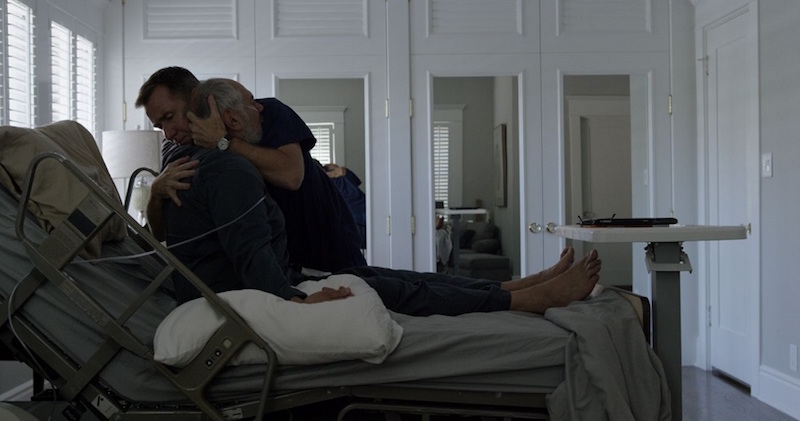
Chronic is a film told without close-ups or cross-cutting; long single takes leave the audience to concentrate on the performances and the dialogue. There is space to speculate on hints in the dialogue uninflected by a score (all the sound is naturalistic, save for unseen online porn and TV reports). This is very much filmmaking in the style of Dogme: no music, minimal lighting, the static frame often dominated by windows and doorways, bedrooms and bathrooms. The only movement comes when we see David running in the gym or on the street – even then he’s kept centred in the frame, the camera holding him steady in its gaze.
There are conversations where we are not clearly introduced to the characters, leaving the audience to work out David’s relationship to them, and his own emotional state. He has his own family history of caring for someone with a terminal illness, a backstory that the viewer will piece together through patient observation. Chronic is very much art house cinema, and whether you find it fascinating or pretentious will very much depend on your own taste and alliances. It’s not up there with Amour – Michel Franco lacks the maturity of Haneke. Tim Roth, while giving one of his best performances in many years, is no Jean-Louis Trintignant.
Certainly anyone who has looked after a friend or family member when they are utterly disabled by illness will find it powerful viewing – disturbing, familiar and intrusive in equal parts. It’s not a date movie, but will leave viewers with plenty to dissect in a post-cinema, post mortem discussion.