“Whichever way you turn, fate sticks out a foot to trip you,” Al Roberts (Tom Neal) says in Detour (1945), as if his native pessimism and self-destructive choices had nothing to do with his inexorable descent into hell.
Edgar G Ulmer’s minimalist film noir classic, which has been beautifully restored for this Criterion Collection release, tells a rancid tale. Roberts himself narrates it in an increasingly feverish voiceover. Early on, one of the flashbacks to his memories that comprise most of the movie, shows him as a talented pianist backing his singer girlfriend Sue (Claudia Drake) in a dreary New York club. They were in love. “All in all, I was a pretty lucky guy,” Roberts reflects, but his nostalgia deceives him. Sue comfortingly tells him he’ll make it to Carnegie Hall one day, but he whines, “Yeah, as a janitor.” It’s Roberts’s ruinous fatalism, not fate as an external force, that dooms him.
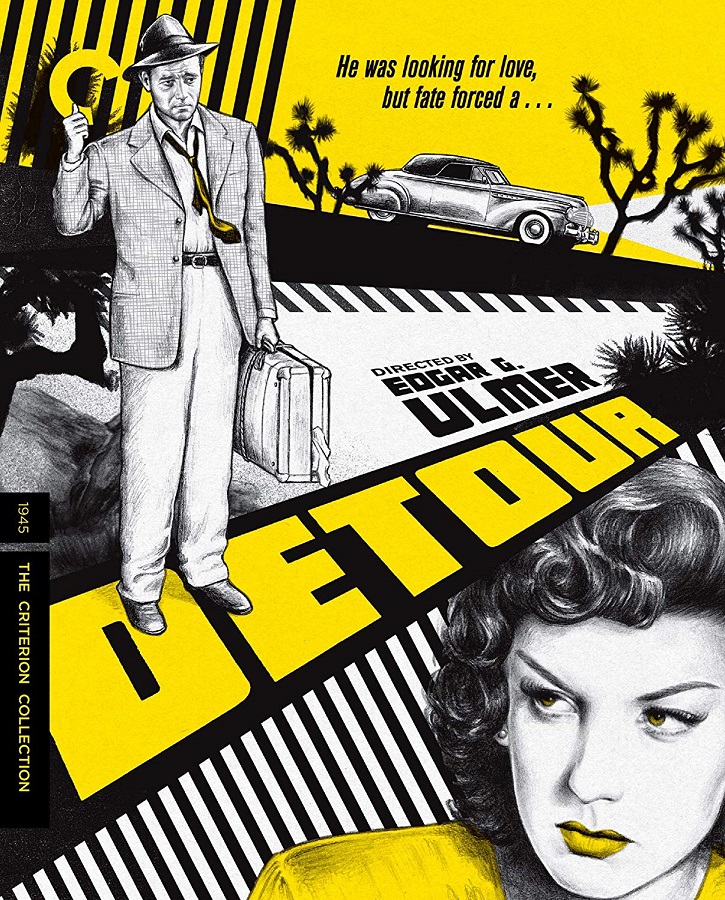 Shortly after Sue leaves town to try her luck in Hollywood, Roberts starts hitchhiking across country to join her so they can marry – doesn’t he know mid-40s America is as full of traps as a film noir? Somewhere in Nevada, he gets a ride from a flush bookie (transparently a conman) called Haskell (Edmund MacDonald). Later on, Roberts is driving that same vehicle alone when he picks up a sullen woman hitcher, Vera (Ann Savage). Privy to secrets about him, she blackmails him – her snarling threats brook no protests. Haskell and Vera are both fatally ill, but there’s a more outrageous coincidence that binds them in Roberts’s downward spiral. His travelling companions usher him toward the death he unconsciously yearns.
Ulmer’s sublimely weird art deco horror film The Black Cat (1934), his second American work, was a huge hit for Universal. But studio boss Carl Laemmle blackballed the German émigré director in Hollywood when he learned of his affair with Shirley Kassler, a trainee script supervisor who was married to Laemmle’s producer nephew Max Alexander. (Ulmer and Kassler married; their on-set collaboration partnership lasted over 30 years.) Ulmer went to work, productively, for the Poverty Row studio PRC. B-movie authorities interviewed in the lively 2004 documentary Edgar G Ulmer: The Man Off-Screen included in Criterion’s disc note that his exile elicited the best of him as an endlessly inventive visual stylist; Wim Wenders suggests Ulmer’s low budgets enabled him to make more truthful films than did his well-financed peers.
Savage and the Ulmers’ daughter Arianne confirm in the documentary that Ulmer shot Detour in six days. Despite his limited means, he created a sense of woozy unreality – via brightly lit close-ups of the sweating Roberts on the road, lulling back projections, and dabs of expressionism in interior scenes – that implies Roberts’s journey is as much psychological as it is physical.
He may fantasise about Sue becoming a star instead of a hash-slinger, but his true mate is Vera. Like spouses in a hateful codependent marriage, they end up bickering in a California motel room. The tough-looking, dark-chinned Neal plays Roberts as a passive, self-pitying sap who can’t get out of the way of himself. Savage is jolting as the rancorous Vera, who curdles that much more – and becomes sympathetic – when Roberts ignores her lustful gazes. Vera is the most atypical of noir's femme fatales – and "a b-i-t-c-h,” says Savage. Wenders credits Savage's performance as an influence on Quentin Tarantino's casting of actresses. “She was 30 years ahead of her time, but she drives you mad. She’s a revelation.”