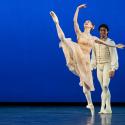
While the main gallery is closed for renovation, the Wellcome Collection has taken the opportunity to mount a fascinating upstairs show exploring the way choreographer Wayne McGregor collaborates with scientists.
 A timeline charting McGregor’s career reveals that it all started back in 1997 when he attended the opening of the Inter Communication Centre in Tokyo and learned that, with their brains wired up to scanners, two people could activate a toy car by accidentally thinking of the same number. This sparked an enduring fascination with the mind and how it acts upon, and interacts with, the body and the environment.
In 2005 he studied the heart from a biological, medical, mechanical and spiritual point of view, which included watching videos of open heart surgery, and described the body in terms of sensation, intuition, transformation, meditation and a container for space. You may notice the absence of any mention of feeling and emotion – crucial ingredients, to my mind, of any dance that aims to transcend the purely mechanical. McGregor prefers an analytic approach, though, which precludes things that can’t be measured or quantified.
With the help of scientists such as cognitive psychologist Phil Barnard, he has continued to investigate the mind/body relationship. Understanding this mystery is especially beneficial if your job is to encourage dancers to abandon physical patterns perfected over years of training in favour of unexpected and innovative ways of moving. To help build up a dossier of useful information, the poor souls were made to stop every 10 minutes during rehearsals and fill in questionnaires about what sparked their imaginations. Next came the task of devising ways to use the information to develop what McGregor calls "kinaesthetic intelligence" and promote fresh approaches to choreography.
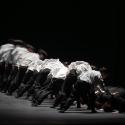
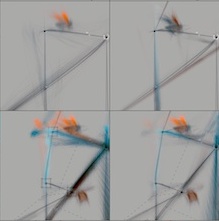 During rehearsals for Atomos (pictured above right), which his company Random Dance will perform at Sadler’s Wells in October, the dancers wore 3D glasses linked to a screen (main picture); known as Becoming, the software introduces an imaginary body in the form of a linear diagram unfolding in three dimensions. We are invited to don the glasses and view the diagram (detail pictured left), but although I regularly improvise movement sequences, I was unable to figure out how it would contribute.
Barnard and other members of the research team have also devised what they call Choreographic Thinking Tools (pictured below right), soon to be marketed as a teaching aid titled Mind and Movement. Under headings such as "Deconstruct", "Superimpose", "Add" and "Recontextualise", lesson plans encourage students to focus on just one element of an object, sentence or soundscape; to assemble two sounds or movements in new ways; or imagine relocating a movement to another place.
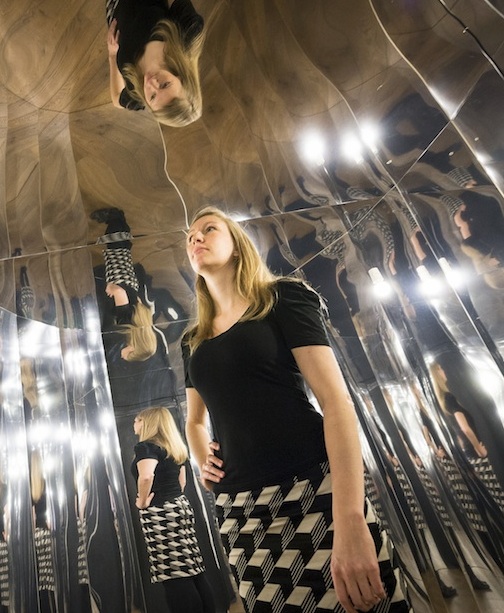 Exercises like this are familiar ingredients of improvisation workshops, but the desire to commodify and regulate them feels to me like a troubling symptom of the tendency to direct, measure and control every aspect of artistic endeavour, which has already stifled creativity in art schools.
McGregor describes the dance studio as a laboratory and says that "being in the studio working with bodies is the time when I am happiest". He is an impassioned speaker and his enthusiasm is palpable, but to my mind, engaging with bodies in space is not enough; motion become interesting only when it reveals intent or conveys feeling. In the performances and rehearsals shown here on video the intelligence of his choreography shines through, but focusing on fluent, high-energy motion devoid of emotion produces dances that feel sterile despite the brilliance of the technique. The belief that you can quantify and control something as wayward and evasive as creativity is extremely seductive, but to me this exhibition acts as a warning of a tendency we should resist.
- Thinking With the Body: Mind and Movement in the Work of Wayne McGregor at the Wellcome Collection until 27 October