

Composer Zoë Martlew’s album (Album Z) launch in the surround-sound environment of Hall 2 at Kings Place thrived on a theatricality rare outside the world of rock music and clubs. A wondrously energetic person, overflowing with a generosity and capacity for heartfelt relationship, Martlew thrives on high drama, as a performer as well as a person, with an almost child-like joy in making music that’s irresistibly contagious.
There was dramatic lighting, dry ice and earth-shaking electronics. In a deftly-constructed programme of new and older works, she created an enjoyable – at times hilarious and others deeply moving – showcase for her wide-ranging talents as a composer. Until recently, she was primarily a cellist, much sought-after in ensemble work and as a soloist in cutting-edge contemporary music. Martlew, whose love of edgy sounds originated with the discovery of Schoenberg, has been close to some of the leading British composers of our time: Oliver Knussen, Harrison Birtwistle and Thomas Adès among others.
Not least because of her years as a player, and the creative networking her native extroversion has always assured, she was joined at Kings Place by a star-studded cast of performers, in most cases the musicians for whom she had written the pieces in the first place. She opened the show with her bravura solo piece “G-Lude”, a kind of love-hate dance with her instrument: I read it as a borderline erotic farewell to her romance with the cello. She tore, caressed, pinched and plucked, producing all manner of tones, timbres and textures. As with some of her other pieces, the climactic fury was followed by a peaceful resolution, with a coda of gently plucked strings, serenity after the storm.
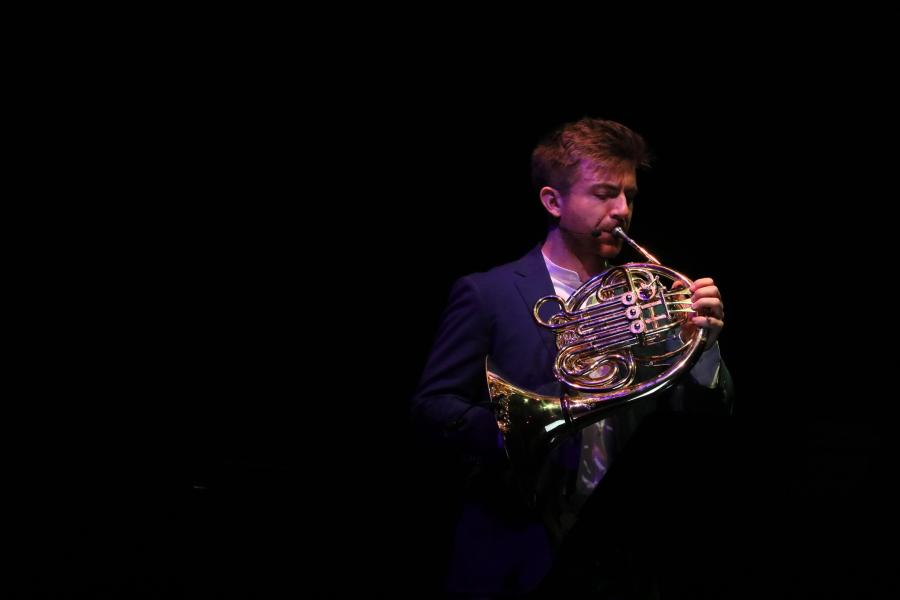
“Niburu” which came next displayed a similar arc. The piece is a vehicle for horn virtuoso Ben Goldscheider (pictured above), who played in the midst of an electronic tempest. Celebrating a planet only recently discovered, imagined as a harbinger of chaos, Martlew has composed an electronic element that conjures the full brutality of cosmic energy – clatters of thunder, deep wails of sounds reminiscent of the long horns played by Tibetan monks, evoking destruction, disorder and death. The horn, magnificent in the sensitive hands of the young player, weaves its way through the noise, as if seeking to survive drowning in primordial sound. As the thunderous assault quietens down and leads to something approaching silence, and a spoken message from the composer evoking the force of love, the horn returns, giving gentle voice to the peace that will of naturally follow.
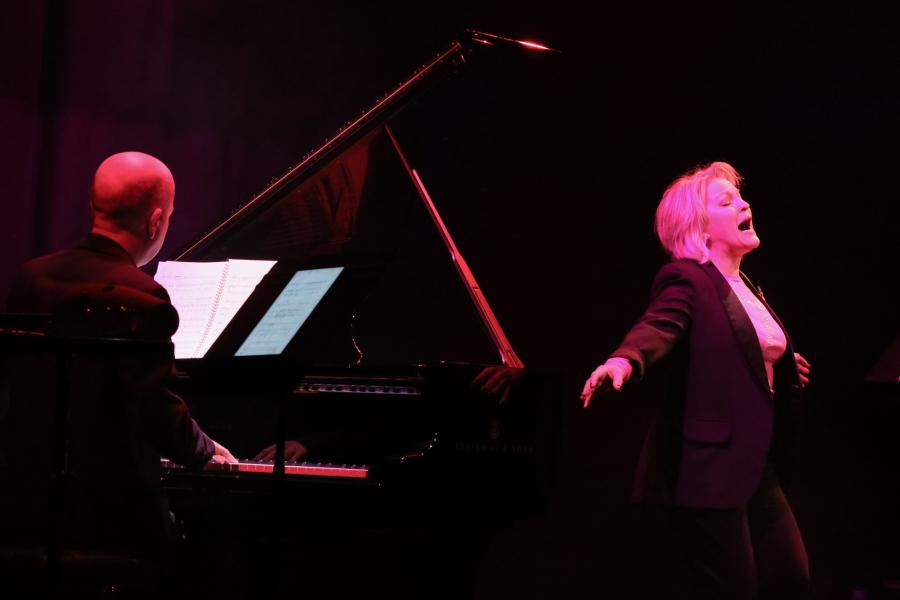
There is a great deal of variety in Martlew’s music – she draws on the mainstream of 20th century and contemporary classical, but she’s a child of her times, nourished by jazz, Weimar cabaret and rock. Mezzo-soprano Lucy Schaufer (pictured below) performed two very different songs from the cycle “Musae”, a reflection on 21st century womanhood, which she commissioned for the composer. Pianist and composer Huw Watkins (pictured below) accompanied her on “Why”, an acerbic account of a woman’s disgust at a “twat” of a husband, delivered with great force, punctuated by percussion from Martlew herself. The silent resignation that closes this violent female cry of disgust is echoed in the deep melancholy of a prostitute’s raw description of the oldest profession, (“Red Room”) languorously evoking the world of illusion her clients buy for cash.
Mark Padmore performed two songs that similarly expressed the composer’s characteristic range: Martlew’s taste for raw vulgarity – laced in a particularly English mode with a good dose of humour – was displayed in a tongue-in-cheek rendition of the 17th century poet John Wilmot, the Earl of Rochester’s no-holds-barred evocation of sex and lewdness in St James’ Park, with shrills blow on a whistle to fill in the gaps left by the redaction of the f-word and other obscenities. This delightful romp was followed by the near-total stillness of a haiku “In the Kyoto Garden”– written by Martlew, to which Padmore brought extraordinary delicacy, a high-tenor close to falsetto, handled with his customary grace and emotion.
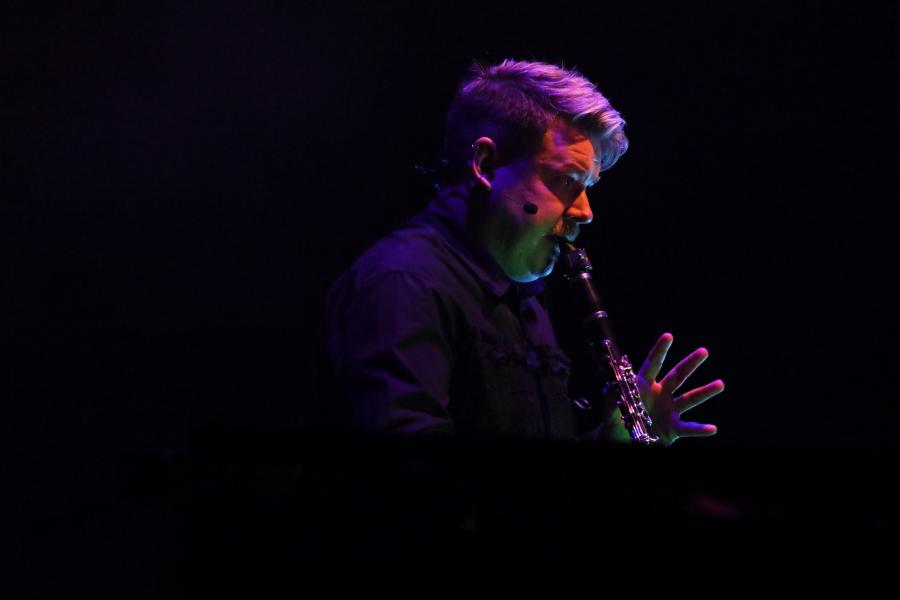
The stillness of the haiku held one’s breath, and voiced breath is essential to much of Martlew’s work – in the urgency of her gasps in the opening cello piece and in the vocal pieces that followed. The breath as the Ancient Greeks imagined it, is an expression of the soul: a key element in ecstatic devotion as much as in sex. In the piece “Atma” written for clarinet wunderkind and composer Mark Simpson, (pictured below) Martlew goes to the heart of her concern: the evocation of spirit, manifested in the human body; the cosmic breath too – as the Sanskrit title of the piece makes clear – the vehicle which animates the reed of this most emotionally rich wind instrument, played with breathtaking sensibility and technical brio by Simpson himself.
For all the theatricality and undeniable fun – which comes close at times to overwhelming the subtler elements in her work – Martlew speaks from the heart. She isn’t heavily spiritual as some contemporary composers: her strength comes from being able to switch registers. The great Sufi masters and Zen teachers knew that humour can open the heart and help us experience transcendence. There is also, at the core of Zoë Martlew’s work, an unusual and totally unselfish love of the other. She has an uncanny sense of how to write for great musicians, a gift that comes from sensing their essence, not just letting her ego do what it will. This in turn enables the musicians who interpret – or give life to – her compositions to surpass themselves. There is a depth of communication, and a devotion to music-making as a form of spiritual elevation and healing, that makes her work very special. What better piece to close with than “Nick My Pearls You Cry”, written for oboist Nicholas Daniel, who played in quasi-drag, bedecked in multiple strings of pearls. A jazzy knife-edge of a bravura performance, thrilling in a way that went beyond the usual and constraining categories of serious versus light: a moment of sublime foolishness that glowed with a sense of freedom and joy.



Add comment