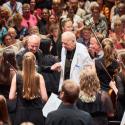
It's hard to miss German composer Wolfgang Rihm. He has an enormous head. There it is, bulging from his giant frame, a big, friendly grin slapped onto it while he wanders around the Barbican on his celebratory day, none of it going to waste. Listen to his prolifically combustible music, the million and one ideas hurtling about with the energy of a school playground and the intensity of a burning sun, and you soon realise that all that cranial space is probably quite necessary.
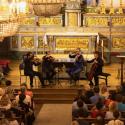
But for composition you need more than just head space for musical ideas to smash into one another. You need form. An organising principle. A narrative. Or one could tip all burning combustibles onto a palette and start painting. At first, this is what Rihm does. His early works from his late twenties appear to move intuitively and explosively. His Fifth String Quartet, Ohne Titel (1981-1983), is a raw Manichean struggle between various absorbing textures - an insistent scrubbing, a muddy plucking, a super-high tinnitus hum like the sound of next door's washing machine - that rarely lets up on a perpetuum mobile gallop. The Ardittis, as always, carved an intensely compelling path through this dramatic landscape.
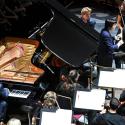
Schwarzer und roter Tanz (1981) is even more raw, even though its rawness seems straight-jacketed within the confines of a few demonically possessive pulses. It almost comes across as some mad joke or an even madder exercise in attempting to express total freedom through severe constraint. The hard-driving BBC Symphony Orchestra and their conductor André de Ridder gave it a brutal but never unsubtle outing. The work exemplified why there's never a dull moment in Rihm. Even at his most mad, his most intense or aggressive, he knows when to ease off. Or at least, he knows that an easing off, a pianissimo pit stop, a textural change of tack, is necessary. Even Schwarzer, therefore, one of his most unapologetically violent works, has moments of repose.
As well as being an able builder, a particle-smasher and an energy-generator, Rihm is also a listener. In order for the early works to pack their textural punches Rihm pulls back from rebelling in every sphere. Pitch-work for example is rudimentary. Harmony hardly gets a look in. Dissonance is never in, or of itself, an aim. Instead we get an ever-satisfying ebb and flow between the various characters being investigated at any given moment.
At some stage the jump cut of Buñuel and Eisenstein begins to grab Rihm. Bild (1984) is full of an allusive power. Unusual sound leaps to unusual sound. An interplay between cleanliness and dirtiness drives the music forward, like the propulsive similes and contradictions of Un Chien Andalou. His experimentation with form and texture, the white hot volatility of his ideas, has remained a constant in his huge oeuvre, though, in the past two decades, an investigation of more traditional techniques of counterpoint, harmony and melody have been added to the palette. Tonal, even romantic, oases emerge too.
In this process - a process of filling out and in - one loses the simple strangeness of Schwarzer, a profoundly mystifying piece. Yet, one gains nourishment. Only one of his recent crop of works failed for me: his companion operatic piece to Strauss's Salome, commissioned for the Salzburg Festival, Das Gehege (2004-5), like Saariaho's recent, Émilie, another monodrama. Not only does the libretto stretch a hyperbolic image - the image of a woman (sung by the hard-working Rayanne Dupuis) falling in love with and then murdering an eagle - well beyond its metaphorical breaking point but the music appears unsure on its feet. Its allusions clunk into view; its outbursts ring hollow.
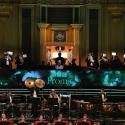
Quite different from the two other 21st century compositions on display yesterday, which were honest works of great formal sturdiness. The Concerto Seraphim (2006-2008) is a lusty work, moving like an enormous Baroque concerto, the activity passing from small ripieno groups, who sing out plangently, to tutti busyness. It's long and complex and handled with extraordinary ability by the London Sinfonietta and conductor Baldur Brönnimann. After several different ariosi like lyrical engagements combining a number of different instruments - very reminiscent of a Baroque passion - the ensemble finally leaves the world by way of an elating experience: the entry of an impossibly high, plain horn duet flowering into flutter-tonguing and finished with wood block.
If that was food for the brain, the cello concerto, the Konzert in einem Satz (2005-6) provided a fitting bit of edification. Steven Isserlis scampered up and up that fingerboard like a heroic mountaineer, ringing out the salmon-emulating, upward-striving romantic melodies that soar their way into the highest reaches of the cello register. There's a generosity to the sound - Rihm's sources echoing far and wide - and a mellowing of Rihm's tone that makes this one of his most attractive works. A doodling element wanders into the frame, a chorale and then a coda in the gloaming: a hushed Mahlerian reminiscence with suitably transcendental qualities. The BBC has done us a great service by showcasing this astonishing German composer, who remains little known in the UK. Every piece is or will be broadcast on BBC Radio Three. And virtually every piece is worth tuning in for.
- Find out more on the BBC Radio Three website
- Check out what else is on at the Barbican
- Book for the rest of the BBC Symphony Orchestra season
- Book for the rest of the London Sinfonietta season