

The last time I saw Wolfgang Holzmair in concert (at last year’s Oxford Lieder Festival, delivering one of the finest live performances of Winterreise I have heard) the silence that followed the cycle lasted almost 30 seconds – an absolute age where a fidgety post-concert audience is concerned. Last night’s programme of Schumann saw Holzmair finish and pause, hands raised prayerfully, holding his listeners’ attention like so many butterflies within his cupped palms. The release that followed was ecstatic, a spontaneous homage to the musical and narrative mastery of this extraordinary singer.
Joining the Wigmore’s celebration of this bicentenary year of Schumann’s birth, Holzmair and pianist Imogen Cooper presented a programme building up through the composer’s Heine settings and selections from the Op 39 Liederkreis to the rather inscrutable Kerner Lieder. Often neglected for the more easily accessed charms of Dichterliebe or Frauliebe und leben, the Kerner Lieder are characterised by their uncertain temperament. Brooding one moment, rejoicing in the delights of wine and travel the next, it is hard to follow the shifts of their narrator, and still harder for any singer to map these episodes into a single emotional arc.
This cycle is possessed however of some of the most intriguing song concepts Schumann addressed. A young girl commits herself to the life of a nun as a young man watches with silent love and despair in “Stirb, Lieb’ und Freud”; elsewhere the poet broods on the wine glass of a departed friend, and in “Stille Liebe” a lover sings (with elegant irony) of his inability to sing his lover’s praises. Matching its emotional extremes with those of vocal range and colour, the cycle is no less demanding technically, so it was with no small amount of suspicion that we learned that an ailing Holzmair would tackle the programme despite earlier thoughts of cancelling.
Aside from a slight fragility at the lower extremes of his range, Holzmair’s voice showed little evidence of any suffering however. If anything freer and more rounded (benefiting from his increasingly darker tone) than his 2002 recording of the cycle, his delivery has now become so narrative-driven and so natural as to make you forget that he is singing at all. Concealing the mechanisms of technical skill, Holmair presents a smoothly featureless surface upon which the drama of each musical episode may be projected. There is personality here in plenty, but only ever that of the narrator; Holzmair the singer has the gift – for a gift in lieder it assuredly is – of making himself invisible.
 The intelligence of the partnership of Holzmair and Cooper is never more evident than in their restraint. In “Stille Liebe” both pianist and singer staunchly rejected the lyric seductions of melody, sustaining a simplicity of delivery that mirrored the sense rather than the suggestions of the song. Again in “Stille Tränen”, both allowed the song’s sustained line the space to makes its impact without expressive embellishment or interruption. The postlude here, heartbreaking on almost the scale of "Am leuchtenden Sommermorgen", was the flower on the grave that Schumann so painfully digs for his hero through the cycle.
Highlights from the first half of the programme included Cooper’s dripping arpeggios in “Mein Wagen rollet langsam”, and the controlled elegy Holzmair made of “In der Fremde” with its wilful longing for a homeland that is no longer a home. The rightfully beloved “Mondnacht” unfolded with delicate timidity, all slinking accompaniment and caressing vocal line, surviving even the sabotage of a concert-goer who decided that this quietest of musical contemplations provided the perfect moment to set about unwrapping a cough sweet. Only the issue of Cooper’s pedal-work jarred, with buzzing chord-distortion colouring the release of almost every closing chord.
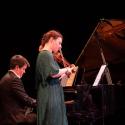
An unexpected bonus to this programme, balancing the paler shades of Schumann’s harmonies, was Aribert Reimann’s cycle-in-miniature Nachtstück. Composed in 1966, the work’s colouristic writing sits somewhere at the junction of Debussy and Schoenberg. Dense and harmonically allusive chords underpin a flighty vocal line that follows the rhythms and pitch patterns of speech – a natural fit for Holzmair’s fluid delivery, and a work that allowed Cooper (pictured above) a few rare moments of dynamic release.
Only gaining in authority as he ages, Holzmair’s high baritone is losing its tight brightness and replacing it instead with a more deconstructed, loosely expressive tone. The slight husk and break in the voice which he seems able to summon or abandon at will is a real asset for his core repertoire of lieder, daring to undercut the apparent lyricism of the vocal lines just as the music of Schumann and Schubert looks beyond the pastoral simplicity of the verses it sets.
With many great singers their success is in providing the definitive, could-never-be-any-other-way delivery. For Holzmair it is precisely the reverse; his skill is in rendering even the familiar deeply unsettling, uncanny, incapable of being fully assimilated by the listener. Pushing his audience away even as he draws us in, Holzmair is a master storyteller whose tales never quite reach the closure of “happily ever after”.
- See what's on at the Wigmore Hall this season
- Find Wolfgang Holzmair on Amazon
- Find Imogen Cooper on Amazon







Add comment