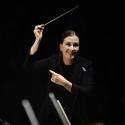
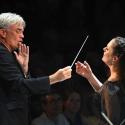
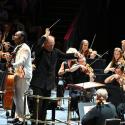
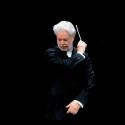
Short of rolling around the podium like a delirious pig in a mudbath, Sir John Eliot Gardiner couldn't have hidden his enjoyment of the warm, plush sounds and well-upholstered vibrato of this wonderfully old-fashioned orchestra, the Czech Philharmonic, less well at last night's Prom. As he embarked on one of the broadest, most unashamedly Romantic openings to Dvořák's Eighth Symphony I have ever heard, I wondered what the hell his years of all-out warfare on modern performance techniques had been about. Was Sir John doing a Kim Philby? Was the period movement's greatest propagandist defecting live on Radio 3? And might there be an encore of "Erbarme dich" for seven swannee whistles?
Sadly, no. What one always forgets with Gardiner is that, before the Bach pilgrimage, before the knighthood, before much of his most interesting work, way back, when he knew what white tie was - and we knew nothing of the strange Chinese waiters' outfits that he is now so attached to - this great innovator was a jobbing conductor doing the rounds of the symphony orchestras. Gardiner's Baroque work always ran in tandem with more conventional symphonic fare. And these parallel traditions have influenced each other down the years. Today, historical accuracy is held in check, and even - as in last night's Prom - led, by an impulsive, Romantic spirit.
It's something that particularly suits the splendid array of Czech works that were on offer, all of which have some passages that lend themselves to period-performance paring down and some that lend themselves to Romantic reverie. For much of the time, Gardiner seemed more comfortable and interested in indulging the romance than in sweeping it away. Dvořák's Carnival overture was attacked hell for leather - without immediate regard for complete synchronisation - reigned in for a remarkable passage of fragrant stillness on a rocking oboe and then exploded to the furthest reaches of the hall. Carnivalesque, indeed.
Martinů's Sixth Symphony, Fantasies symphoniques, and its fleeting passages of romance, menace and burbling is less superficially carnivalesque in tenor but requires as much fleetness and control as any circus performance, so brief are the images, so quickly do they morph. Gardiner was helped out by an extraordinary woodwind section, who burred away beautifully and in ever stranger ways, now resembling bees in a bottle, now a Barbara Windsor giggle, now a hessian mesh. Gardiner had no problem in structuring the disparate ideas, skewering the Janáček-like rhythmic cells that bubble up all over the place with a central melodic kebab stick. As my colleague David Nice has said elsewhere on this site, the work is a masterpiece, but one that is so delicate, so evanescent, that words do little justice to its ways.
The Grieg Piano Concerto came in for a little spring clean from both Gardiner and soloist Lars Vogt, but never so much so that you ever felt that they were trying to bleed the Romanticism out of the work. There was a light tidying up of certain passages, a withholding of dynamics, but none of the brooding moodiness, or the slow pacing was anything other than heightened. In fact, Vogt often ramped up the contrasts, the tracery whisper always giving way to a sudden fearsome amount of force. The orchestra and piano clubbed together for a nicely thuggish rendition of the heavy-footed third movement. This was a powerful presentation, devoid of schmaltz, big on muscle. As was a part of Vogt's encore, Chopin's Nocturne No 20 in C sharp minor, though never for long.
One fun game to be had during this celebration of all things Czech was to try to spot Czech-ness in the work of the four Czech composers on display - a difficult concept to pin down. I was especially interested in the aural trail that this concert seemed to offer for Martinů's woodwind burrs. It led directly to Janáček's Ballad of Blaník, performed after the second interval, and the little cells that seem to fragment off the cyclical clarinet motif at the start. But then came Dvořák's Eighth, in whose slow movement one hears a similar cell-like phrase crop up again and again as a counter-rhythm, first in the woodwind, then in the first violins. A lot of thought had gone into this programme and these performances.
Only the first movement of the Eighth appeared a little under rehearsed and failed to hang together or climax adequately. The molasses-like hue to the orchestra, the quite unique depth to the cello and double-bass sound, came in handy in the Eighth's finale, where bassoons and double-basses lead a part militaristic, part gamboling, part demonic march down through the keys, in a Wagner-like bit of harmonic slippage. It was glorious. Yet, not my favourite moment. That was reserved for Gardiner's way with the dances - the Slavonic Dance, Op 46 No 1, encore and the Allegretto grazioso minuet and trio of the Eighth - which were both bracingly swift and elegantly sentimental. This concert marked no defection. It heralded what Bill Clinton would call triangulation.