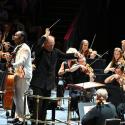
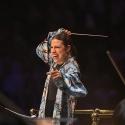
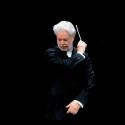
It is considerate of Manchester’s two professional symphony orchestras to have organised their opening Wagner celebration salvoes so that they dovetail so neatly. The BBC Philharmonic opened their season three weeks ago with the Wesendonck Lieder, famously inspired by the composer’s infatuation with Mathilde, the wife of his wealthy sponsor Otto Wesendonck, and featuring those two well-known studies for Tristan und Isolde, "Im Treibhaus" (In the Hothouse) and "Traume" (Dreams). Last night came the Hallé with the Prelude and Liebestod of that very opera.
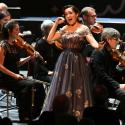
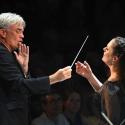
With principal guest conductor Markus Stenz from Cologne, a seasoned Wagnerian, in charge and the striking Swedish soprano, Iréne Theorin, a past Bayreuth Isolde, singing, we had every reason to expect a fulfilling performance. And they did not disappoint. The Hallé, just back from China, took a little time to get into gear, but Stenz gradually built up the momentum and produced great cohesion through the sustained romantic melody leading to the climax and preparing the ground for the famous Act 3 Liebestod (“Love’s Death”). Theorin, an imposing Nordic woman in a flowing blue gown, certainly has stage presence and a sense of drama. More importantly, she has a big and beautiful voice with reserves of power. “Am I the only one who can hear this melody?” she sang as Isolde, “blissfully lamenting”, looks upon Tristan’s corpse, extolling his heroic virtues and finally coming to terms with the consummation brought by death – “utter bliss”.
When it came to the finale, flawed but momentous, he had the Hallé playing with sensitivity and spirit
Theorin was vocally radiant and compelling. Her all-too-brief performance here was enough to make one want to hear her in a more extended and demanding outing, such as when she sings Brunnhilde in Barenboim’s forthcoming Ring in Berlin and Milan.
The Isolde experience was merely the curtain-raiser for Bruckner’s stamina-sapping Fourth Symphony, the Romantic. The Hallé has a unique historic link with this symphony, since their one-time chief conductor Hans Richter directed the 1881 premiere of the final revised version.
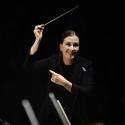
Stenz came into his own with the Bruckner. He has a real feel for the work, which flatters to deceive, lulling you into tranquillity only to blast you out of your seat; he has a sense of scale and an ability to steer the orchestra along a dynamic path through the highs and lows.
In a way, you can’t win with Bruckner. Apart from the Andante, with its haunting slow-march motif, the other three movements are marked “nicht zu schnell”. Not too quick, but “lively” he demands. Stenz got it just about right, no easy task. He captured the melodic vitality of the piece, most notably in the Scherzo with its hunting calls. There was some ferocious fiddling and the brass had a field day.
When it came to the finale, flawed but momentous, he had the Hallé playing with sensitivity and spirit through those highs and lows again, teasing and tumultuous before reaching that great awe-inspiring crescendo which earned him and the band prolonged applause.
Later in their season, the Hallé are offering a significantlymore substantial tribute to Wagner with one of Sir Mark Elder’s favoured blockbuster concert productions. The performance of the complete Act III of Die Meistersinger will bring together the massed ranks of Manchester’s choirs, including the Halle itself, the RNCM, Chetham’s and the University. In short, the Mastersingers of Manchester.