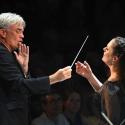
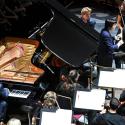
Tamara Stefanovich and Colin Currie – a dream team for Birtwistle’s The Axe Manual. Both are new music specialists with a gift for grace and dexterity, even in the most complex works. The score sets up a range of sophisticated relationships between piano and percussion, from sympathetic resonances to complex interplays of stretto and hocket. Yet none of this fazes the two players, nor ever challenges their close ensemble, seemingly telepathic in its precision.
The percussion setup is based around a large marimba, with a collection of mostly untuned instruments arranged at either side. Birtwistle makes extreme demands for doubling: for example, the two sticks held in the left hand are often required to play both the bass notes of the marimba and a drum positioned to the side. The work is in a single 25 minute span, but is sectional, with the percussionist moving from one playing position to another every few minutes.
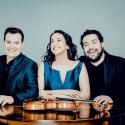
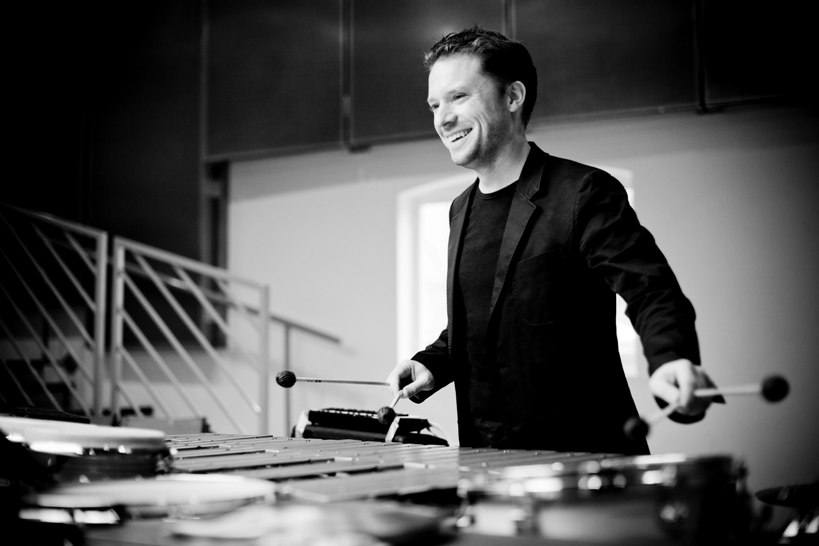 Colin Currie’s confident and unhurried movements (the percussionist pictured right by Marco Borggreve) gave the music an air of logic and natural flow, in marked contrast to the unpredictable and often erratic rhythms that he was actually playing. Stefanovich worked closely with Currie, occasionally a little too subservient, dropping from duo partner to accompanist. Yet the sophistication she brought to the music was impressive, especially in sections where timbres from the percussion are reflected in the piano, requiring a broad range of colours and attacks.
Stefanovich had the second half to herself, with performances of Messiaen and Ligeti. The previous evening, we heard Pierre-Laurent Aimard performing Birtwistle and Messiaen, and the comparison was instructive. Where Aimard is rhythmically incisive with clear, focused sonorities, Stefanovich instead emphasises line and flow. Her tone is warmer – rounder and less crystalline. Yet she is just as able to articulate Messiaen’s complex rhythms and often heavily accented attacks.
Cantéyodjayâ is a virtuosic showpiece, even by Messiaen’s standards. Its irrational rhythms, derived from Indian classical music, are impossible to second guess, yet sounded intuitively logical under Stefanovich’s hands. The two “Ile de feu” movements from Quatre études de rythme are stamping dances inspired by the native people and volcanic landscapes of Papua New Guinea. All those earthy rhythms and pounding accents came through well, and without Stefanovich ever compromising the flow of her phrases or the evenness of her articulation.
The sheer playfulness of these works was beautifully expressed
Ligeti’s Etudes are now central to the modernist piano repertoire, but are rarely performed with the agility or grace we heard here. Stefanovich selected eight, forming a roughly chronological sequence that also increased in complexity from one work to the next. The sheer playfulness of these pieces was beautifully expressed, for instance the dispute between the hands in "Touches bloquées", where the fingers of the left impotently strike notes already held down by the right, and the nervous, filigree opening of "Der Zauberlehrling", where the music seems trapped in its repeated opening motif, unable, or unwilling, to continue.
The sequence ended with a mighty showpiece, "L’escalier du diable", the most diabolically complex of Ligeti’s solo piano works. Any notions of reticence or reserve from Stefanovich were shed here, as she delivered a stunning, bravura performance. A spectacular conclusion to an impressive recital.