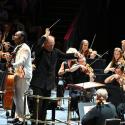
Billed as a “Viennese Whirl”, this programme showed that there are different kinds of music that may be known to the orchestral canon as coming from Vienna.
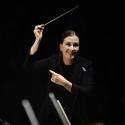
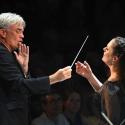
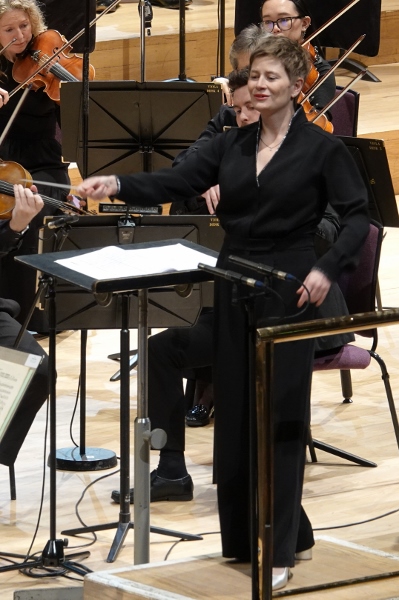
For a start, there’s the classical tradition of Mozart, Beethoven and those who aimed to be their successors. Then there are the 19th century dance creations and operettas of Johann Strauss II and his contemporaries. And there’s also the “Second Viennese School” … and conductor Anja Bihlmaier (pictured below) offered all three.
The last was represented by Berg’s Violin Concerto, probably the most endearing and enduring of works written using 12-tone technique – and in fact so imbued with a sense of tragedy arising from the death of Alma Mahler’s young daughter (with Walter Gropius, her other famous husband) in 1935, and written with a freedom that includes some remarkably traditional tonal harmonic effects and quotes an entire Bach chorale setting, that it appeals in a way that few others of that genre do.
 Josef Špaček was the soloist with the BBC Philharmonic, in a performance that was marked by soulfully lyrical expression and an approach from him and the orchestra that made every phrase sing. There’s an almost post-Mahlerian use of solo orchestral wind instruments in chamber music style that gave them scope to shine, but the big points of drama were there in abundance too. The ending of the work was gentle and elegiac, after the deconstructions that preceded it (tellingly emphasised by Bihlmaier) – bringing the trajectory to a sense of acceptance after it had plumbed the depths of shock and anger.
The earlier Viennese symphonic tradition was represented by Beethoven’s Seventh Symphony, in a performance with the same string forces (led by Zoe Beyers) that were used for the “Emperor” Piano Concerto when Bihlmaier was with the Philharmonic a few weeks ago: totalling 40, in the usual proportions plus a fifth double bass to give extra bite to the bass lines. It works extremely well, making for a lean, clean sound that’s capable of very small effects as well as big impacts.
Bihlmaier takes an approach to this music that’s one of close attention, careful balancing of voices and shaping of phrases, with a flowing and graceful style and plenty of light and dark contrast. The first movement was segue’d straight into the Allegretto, where there was solemnity from the rhythmic tread of the bass line despite a mobile pace, and strings’ precise articulation in the fughetta was admirable. The Scherzo was unhurried though skipping along without hesitation, and the phrases of the Trio were eloquently drawn. And the finale was pounding and relentless, but still delightfully balanced and clear.
And the Strauss ingredient? Each half of the concert began with a classic waltz concoction: the Emperor to open, and On the Beautiful Blue Danube after the interval. These were with the full symphonic strength of the Philharmonic, played with a combination of nostalgic sweetness and sumptuous tone – even, at times, near-Brucknerian brass resonance. Each phrase was carefully enunciated, the violins occasionally giving repeated downbows for emphasis.
The codas were drawn with a touch of sentiment, acknowledging in the one case the sense of time passing as the bewhiskered old inhabitant of the Schönbrunn palace measured out his days, and the awareness of a glory that was all too soon to be departed from a great empire in the other: just a little portamento can say a great deal.
- To be broadcast on Radio 3 on 5 June
- More classical reviews on theartsdesk