The main course of this Wigmore lunchtime concert was Brahms but I was lured in by the dessert: a rare chance in this country to hear the music of the French composer Guillaume Connesson. Macedonian pianist Simon Trpčeski and his international group also treated us to a newish piece by another Macedonian, Pande Shahov, in a nicely-proportioned programme that started with high seriousness and ended with a fluffy-light soufflé.
Sadly I was unable to be there in person, but caught the stream on the Wigmore’s website – their streaming of concerts that began during Covid seems to have become a permanent thing – and the concert is also available on BBC Sounds: I would strongly recommend having a look.
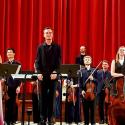
Brahms’s meaty third Piano Quartet was inspired by Goethe’s The Sorrows of Young Werther and also perhaps by the young composer’s complex relationship with Robert and Clara Schumann. Its rhetoric is forceful, not least in the scherzo, with Trpčeski as muscular here as he was gentle in the slow movement – and then thunderous in the double octaves of the finale. Violist Sorin Spasinovici was authoritative in his moments in the spotlight, and cellist Alexander Somov sang out his slow movement theme exquisitely.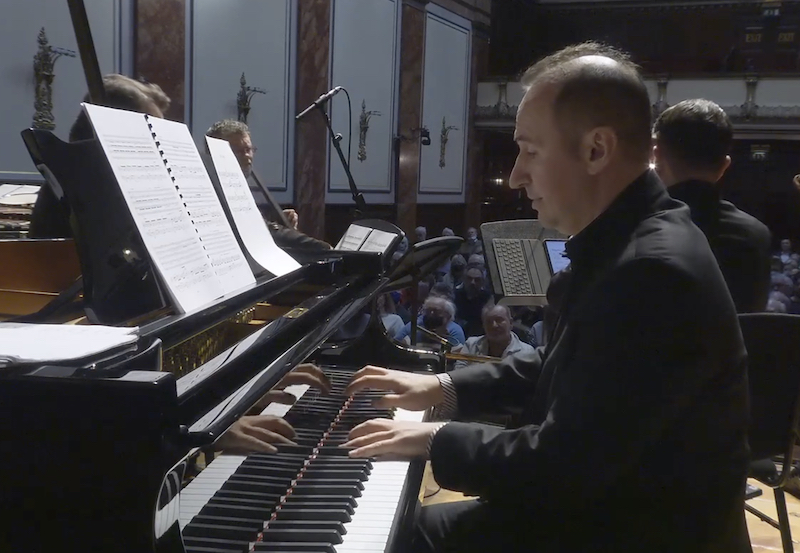 The group worked as a real collective, without any sense of Trpčeski (pictured above) – undoubtedly the ‘big name’ – being the frontman. Their playing was characterful and big-hearted, the music familiar, paving the way for some novelty.
Pande Shahov – not a name I knew – is a Macedonian-born London resident who has made extensive arrangements of his native folk music for this group of players, for whom he also wrote his Quintet. This saw the viola replaced with clarinet and percussion (mainly vibraphone) and the clarinet writing owed something to Messiaen’s Quartet for the End of Time, especially in the slow second movement, beautifully played by Hidan Mamudov. But for much of the piece the vibraphone felt like an outsider to the rest of the group, both musically and timbrally. It came together better in the buzzing, scurrying finale, which raced to a helter-skelter end, Vlatko Nushev’s vibes mallets flying.
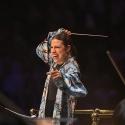
I have long been a committed admirer and advocate of Guillaume Connesson (b. 1970), who is widely performed in Europe and the US but almost completely overlooked in the UK. The Divertimento is an excellent introduction to his music – although as the original version was written in 1998 a lot of ink has flowed through his pen since then. It shows his skill in instrumental scoring, his melodic sensibility and his ability to entertain.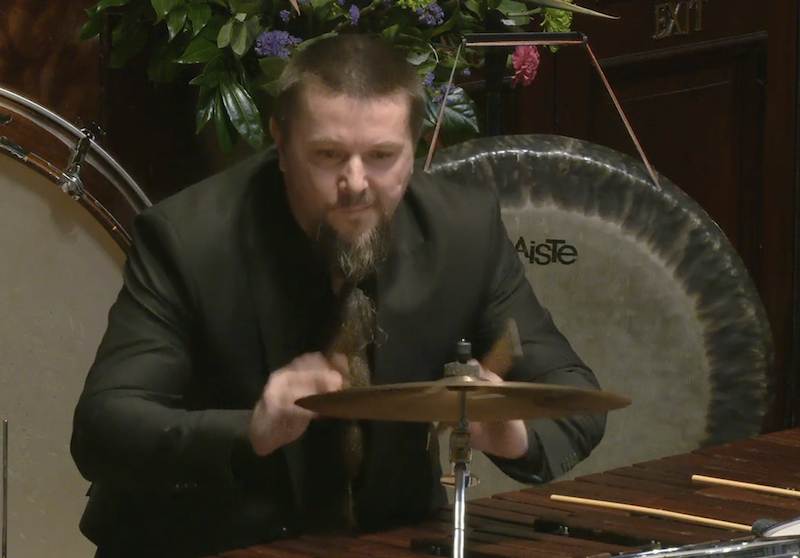 The Divertimento is an arrangement by percussionist Vlatko Nushev (pictured above) of Connesson’s Sextet, faithful to the original for the most part but adding a busy percussion part, both tuned and untuned, that feels totally in keeping with Connesson’s original conception.
The first movement owes a lot (and avowedly so) to John Adams. The percussion takes on much of the original oboe line, but now on marimba or xylophone, giving it a completely different colour. The martial snare drum adds a whole other element – not least in the big-top tattoo that counted in the finale (Nushev’s own addition). The Ravelian slow movement is the gorgeous heart of the piece, and here the percussion was all about deepening the nocturnal atmosphere, through quiet bass drum booms, swelling suspended cymbal and delicate glockenspiel underpinning Mamudov’s endlessly spun-out clarinet melody. (The occasional intonation insecurities in the clarinet were the only shortcomings of the whole performance.) The last movement shows Connesson as the heir to Poulenc: witty, quirky and joyous, with a brilliant punchline ending.
Trpčski was happy to sit back in the texture with his minimalist figuration and let the others lead the way – again Spasinovici was at the centre of things – but the hero, both as arranger and hyperactive performer, was Vlatko Nushev. His arrangement was as impressive as his belted beard, and if it can lead to wider recognition of Connesson’s wonderful music in this country, so much the better.