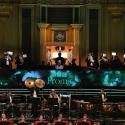
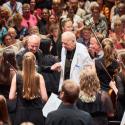
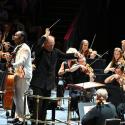
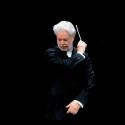
Standing ovations. Spontaneous genuflections. A we-can-change-the-world lecture. This must be what's it like to live in a Communist state. Funnily enough, the Simón Bolívar Youth Orchestra, who we were saying goodbye to last night in the final concert of their four-day Southbank residency, already do. I'm not a supporter of El Sistema, the body which gave birth to this youth orchestra. I'm amazed anyone thinks that an educational organisation set up to impose the Western classical canon on street kids in Venezuela (and now Scotland) because it's somehow supposed to miraculously make them a) cleverer and b) wealthier is worth supporting. I'm not a supporter of El Sistema for the same reason that I'm not a supporter of Voodoo.
Contrary to what Jude Kelly and El Sistema's many propagandists say, there is no evidence that classical music is an effective agent for "social transformation". Playing in an orchestra does not make you any better, wiser, richer, more emotionally or socially intelligent, as anyone who has read Professor John Carey's What Good Art The Arts? will know. In fact, if anything Carey's book suggests that the only way that music has transformed the world in the past is for the worse. Certainly, the propaganda that Chavez's authoritarian government has received through the orchestra's worldwide evangelisation might be argued to have made Venezuelans' lives worse in bolstering a tyrant.
How is it that Terfel can maintain his dignity while looking like a cheap hen-do stripper?
But if music can't change the world, it can at least transform an evening. And I've got to hand it to them, this the Bolivarians did with aplomb - even though they were slightly hamstrung by some dodgy contemporary music in the first half. Esteban Benzecry's three movement Rituales Amerindios, a touristy journey through the pre-Columbian cultures, is a strange hodgepodge of postwar styles. A bit of fast-bowled Boulezian arpeggiation. A dash of Ligetian textural denseness. A large dollop of Varèsian energy. Some Vivier-like moments of tonal clarity. And a Coplandesque harmonic and rhythmic orderliness. So foursquare was the overall shaping, however, that the work found it quite easy to morph into "We Will Rock You" at its close.
But then came Strauss's Alpine Symphony. That they'd go hell for leather was expected. That they'd invest each note with a degree of sensuality was also unsurprising. But that there would be maturity and musicality too was not in the script. But there it unmistakably was. Following an amble by the brook that appeared to include a hanky-panky stop-off - at least that's how I made sense of their obscene portamentos, the sort of portamentos that could undo bra-straps and whip off knickers - and a sojourn at a waterfall that not only cascaded and shimmered as any self-respecting waterfall should but also played scratchily with our faces, they returned to their long wind up to the mountaintop.
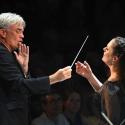
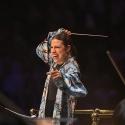
Here one witnessed one of the greatest passages of orchestral legato I've ever heard. Dudamel led them up as one, leaving behind a melody that was as epic as it was heady. One got the sense of airlessness at this peak, a sense of oxygen-deprivation that almost seemed to be turning the Alpine vista psychedelic. Certainly, on the descent, the three trombones and tuba appeared to give voice to the mountain itself and, with one last rumbly sneeze, shook us hiking interlopers off. What was interesting was how little one could attribute this vivid phantasmagoric journey to sectional triumphs. Each had spirit, but only the violins stood out in terms of technical and textural virtuosity. Otherwise this was about team effort and collective intensity and a bit of Dudamel magic.
Welsh bass-baritone Bryn Terfel unexpectedly stepped out onto the stage for an encore, wearing a horned hat, eyepatch and spear. How is it that Terfel can sing his way through one of the pivotal early moments of Rheingold, "Abendlich Strahlt der Sonne Auge", and maintain his dignity, while looking like a cheap hen-do stripper?