

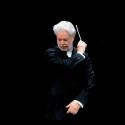
It was as a violin soloist with the Scottish Chamber Orchestra that Joseph Swensen first appeared, in the mid-1980s, on the Scottish musical scene. He went on to become the orchestra’s principal conductor – a long and fruitful collaboration that lasted from 1996 to 2005. In this concert he returned to the orchestra where he now holds the title Conductor Emeritus, as both conductor and soloist, taking the podium for Stravinsky’s Dumbarton Oaks and Britten’s Variations on a Theme of Frank Bridge, and picking up his violin for Prokofiev’s Cinq Mélodies and Barber’s Violin Concerto.
I have lost count of the number of times I have been asked, normally by someone new to the concert scene, what it is that a conductor actually does. All that pointing, gesticulating, arm-waving – does it make any difference? Well, here was a concert that demonstrated very clearly that for the best conductors, the vast majority of the work is done before the concert, in rehearsal. This is where the interpretation is crafted and the orchestral balance set; difficult entries and changes in tempo and dynamics are flagged up so that come the performance the conductor does not have to navigate, but merely steer the ship.
In this concert, Swensen’s role as a meticulous party-planner became obvious after the interval. With the violin pitching in right from the first note, the Barber concerto doesn’t leave much space for a soloist to conduct – a pointed glance here and there for the piano entry in the first movement, some caressing sweeps of the bow, but for the most part this was a performance carefully rehearsed and beautifully executed. It was tightly controlled, yet within Swensen’s structure there was room for spontaneity and lyricism. It helps that this is such a fine orchestra that it has no difficulty steering itself when the conductor is busy, so it was that the great first movement climax built beautifully, intriguingly, and burst upon us with scarcely a gesture from Swensen.
Two double basses set the scene with some astonishingly rich basso profundo notesIn the second movement we enjoyed the long, achingly romantic woodwind solos and in the last movement, well, who can tell if the orchestra was really prepared for the gathering accelerando and whirlwind finish? We, the audience, got a hint at the beginning. Swensen turned to us with a playful wink as the helter-skelter gets under way with a rather trite little tune, but from then on in he led his army from the front, towards the end moving so fast that I thought the trumpeters would explode and the orchestra, very ably led by Stephanie Gonley, become a blur like a Hoffnung cartoon.
The Barber was a fitting climax to a well-constructed programme. Before it, we heard the Prokofiev Cinq Mélodies in Swensen’s own arrangement (he is a composer too), a wistful series of miniatures which, though beautiful, were somewhat overshadowed by what was to come. In the first half of the concert, Swensen did not so much conduct as comb the air with his outstretched fingers – no baton, and only the gentlest of directions. You could argue that the diminutive chamber forces for Dumbarton Oaks scarcely need a conductor – it is often enough performed without – but given the conventions of orchestral concerts Swensen’s presence on the platform was as nicely judged as you could expect.
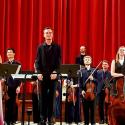
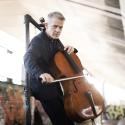
With the full strings assembled for the Britten Variations, it was clear that much time had been spent in rehearsal working on getting each variation just so, beautifully poised, each contrasting in texture with its neighbours. In the Introduction, two double basses set the scene with some astonishingly rich basso profundo notes – special mention to Nikita Naumov, a charismatic performer who clearly relished being brought to prominence. A few minutes later the March bristled and fizzed with energy, only to switch in the Romance to a crooning sound more appropriate for the BBC Light Programme. In the famous Rossini pastiche "Aria Italiana", Swensen played to the gallery, but the episodic and unsettling "Wiener Walzer" was perhaps more telling – here again the pauses and turns had clearly been carefully rehearsed.
Overall this was a joyful performance, notwithstanding the moments of solemnity, with the sense of confidence and control nowhere better illustrated than in the closing moments when Swensen swept the orchestra to a close at the same time as stepping off the podium to stand among the first violins.



Add comment