

Soccer-mad Shostakovich’s score for a ballet about a Soviet football team visiting Western Europe, the world premiere of an oboe concerto by John Casken marking the 1914 centenary, and a rare semi-staged performance of Kurt Weill’s The Seven Deadly Sins made up this remarkable programme. Even Sir Mark Elder pronounced it “eccentric”.
The centrepiece and a musical milestone was Casken’s specially commissioned work, Apollinaire’s Bird, inspired by Guillaume Apollinaire’s poem, “A Bird Sings”, written while fighting in the trenches. In that poem, he captured the isolation of a bird singing amid the chaos, but also reminding him of happier times. Guillaume’s part in helping to coin the word “surrealism” also inspired Casken.
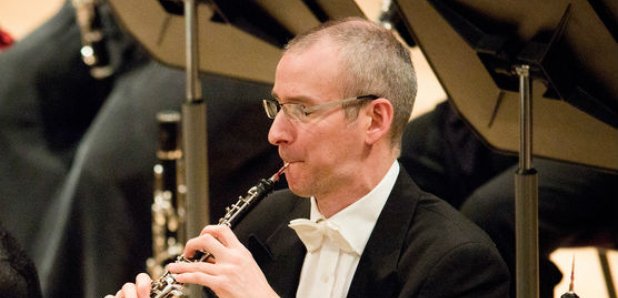 The concerto is a 30-minute piece, in two movements like other Casken works. From the off it captures the bird on the solo oboe before the rifle fire comes in from the percussion and the extra-large orchestra looms up to reflect the darkness of the mud-infested trenches. Casken exploits the oboe to the full, from quarter notes to multiphonics. Soloist Stéphane Rancourt (pictured above), the Hallé principal for whom it was written, gave a truly virtuoso performance, at times playing unaccompanied. Elder managed the balance between solo and orchestra superbly: a major achievement all round.
Sir Mark likes to take on unusual enterprises and enjoys musical theatre and a bit of pizzazz. As the last collaboration between Weill and Brecht, The Seven Deadly Sins received mixed receptions in Paris and London in 1933. Little performed, it disappeared from the repertoire until revived by Balanchine, its original choreographer, for New York City Ballet in 1958.
Shostakovich plays up the contrast by juxtaposing the western dance tunes, including the decadent cancan, and the Soviet healthy sportingness
In this staging, the two sisters, alter egos Anna I and Anna II, singer and dancer, originally played by Lotte Lenya and Tilly Losch, are exposed on a bare stage, with the orchestra moved to one side. They leave their Louisiana home on the banks of the Mississippi to travel across America to earn money in order to return and build a house for the family. They resist each capitalist in each of seven cities in seven years. Six singers in hick costumes perform with minimal props (directed by Caroline Clegg). Elder joined in the fun by appearing in an unbuttoned black waistcoat and white shirt with rolled-up sleeves, like a western bartender. There was an impressive performance by Jessie Buckley as Anna I, singing with style and clarity in Lenya-style lower register, and Anna Cooper gave a raunchy cabaret version of Anna II. The four-man “family” chorus of Sam Furness, Joshua Ellicott, Grant Doyle and David Soar (a busty be-wigged mother) sang well, although it was often difficult to make out the words. And a carp here – what is the point of helpfully printing the script in the programme and then putting out the house lights so that you can’t read it?
The programme opened with the Shostakovich excerpt and a health warning from Elder. “It’s the maddest music I’ve ever heard,” he said. “Fasten your seat belts.” He launched into The Music Hall Scene from the ironically titled The Golden Age, linking nicely with the Weill through its 1930s feel and cabaret atmosphere by featuring dances from tap to tango, polka to cancan, and with Brecht’s anti-capitalism. In Alexander Ivanovsky’s propagandistic scenario, originally titled Dynamiada, a Soviet football team visits Western Europe and exposes the failings of capitalism by sampling them. Shostakovich plays up the contrast by juxtaposing the western dance tunes, including the decadent cancan, and the Soviet healthy sportiness. Elder was in his element and in the frenzied decadent finale had the orchestra playing out of their skins.
The original Soviet concept rings true. Many years ago when Moscow Dynamo visited Bolton Wanderers I acted as interpreter. The Soviet players were very excited when we took them to Blackpool for a day out and they saw some of the decadent pleasures of western culture. The Golden Age endorsed.




Add comment